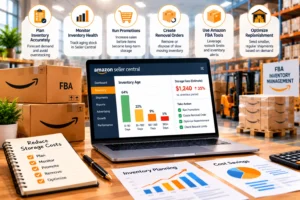

Starting an Amazon FBA business involves several important decisions, including product selection, sourcing, pricing, shipping, and inventory management. However, one of the biggest challenges for new sellers is deciding how many units to send to Amazon’s fulfillment centers.
Ordering too many products can tie up capital, increase storage costs, and create excess inventory. Sending too few units can result in stockouts, interrupted advertising, and missed sales opportunities.
This raises an important question: How much inventory should you send to Amazon FBA for your first shipment?
Some sellers begin with small testing quantities, while others place large manufacturing orders to reduce their per-unit sourcing costs. Neither strategy is universally correct.
The ideal first Amazon FBA shipment quantity depends on expected product demand, supplier lead time, shipping costs, available investment, competition, and your ability to replenish inventory.
In this comprehensive 2026 guide, we explain how to calculate an initial FBA shipment, estimate demand, avoid overstocking, plan replenishment, and manage inventory for Amazon UAE, USA, UK, Saudi Arabia, and other marketplaces.
How Much Inventory Should You Send to Amazon FBA for Your First Shipment?
New Amazon sellers should calculate their first FBA shipment using expected daily sales, the number of days they want to cover, and a reasonable safety stock allowance. There is no universal requirement to send 100, 300, or 500 units for every product.
A practical starting point is to estimate demand over a controlled testing period and limit the amount of inventory exposed to storage and unsold-stock risk.
For example, if a product is expected to sell five units daily and the seller wants 45 days of inventory, the estimated demand is 225 units.
Adding a safety allowance of 25 units produces an illustrative first shipment of 250 units.
However, new products often lack reliable historical sales data, so the assumed five daily sales must be treated as a forecast rather than a certainty.
Amazon’s inventory management guidance recommends balancing stock availability with storage costs and uses roughly two months of supply as a general reference.
The actual quantity should reflect your product, replenishment lead time, cash flow, and marketplace conditions.
How Do You Calculate Your First Amazon FBA Shipment Quantity?
A simple method is to calculate forecast demand over a defined inventory coverage period and add an appropriate buffer.
First FBA Shipment Quantity = Expected Daily Sales × Planned Days of Supply + Safety Stock
For example, assume:
- Expected daily sales: 5 units
- Planned coverage period: 45 days
- Safety stock: 25 units
The calculation is:
(5 × 45) + 25 = 250 units
Under these assumptions, the seller could plan to send approximately 250 units to Amazon FBA.
This formula does not account for units already available in FBA, existing inbound shipments, or inventory reservations.
If stock already exists, subtract the available and expected inbound units when calculating how much additional inventory to send.
For a product with no sales history, build conservative, expected, and optimistic sales scenarios before committing capital.
How Many Units Should Beginners Send to Amazon FBA?
Beginners sometimes ask whether 100, 200, 300, or 500 units are enough for an Amazon product launch.
These quantities can be useful for illustrating different levels of financial exposure, but none is an official Amazon recommendation.
The appropriate number depends on the type of product and forecast demand.
| Illustrative Quantity | Potential Use | Main Consideration |
|---|---|---|
| 100 units | Limited product testing | May sell out quickly |
| 200 units | Controlled launch inventory | Depends on actual demand |
| 300 units | Moderate initial testing | Greater capital exposure |
| 500 units | Higher-demand forecast | Higher overstock risk if sales disappoint |
These are hypothetical planning examples, not prescribed Amazon shipment sizes.
A seller offering a specialized industrial accessory may require far fewer units than a brand launching a frequently purchased household product.
Product price also matters.
Sending 300 units costing $3 each creates a different financial commitment from sending 300 units costing $40 each.
What Factors Determine the Right First FBA Shipment Quantity?
The first shipment decision should reflect the commercial and operational characteristics of the product.
1. Expected Product Demand
Demand forecasting is the foundation of inventory planning.
Sellers can study relevant competitor products, historical demand where available, pricing, customer search interest, and seasonal patterns.
However, competitor estimates do not prove that a new listing will generate identical sales.
New products may lack customer reviews and historical performance.
Develop several demand scenarios instead of relying on a single optimistic forecast.
2. Supplier Minimum Order Quantity
Manufacturers often require a minimum order quantity, commonly called MOQ.
For example, a supplier may require a purchase of 500 units even when the seller initially wants to test only 200 units through Amazon FBA.
In this situation, the seller can investigate whether the remaining stock can be held by the manufacturer or a suitable third-party warehouse.
However, storage and handling arrangements should be documented clearly.
A supplier’s MOQ determines the purchase commitment, not necessarily the number of units that must immediately enter Amazon fulfillment centers.
3. Product Price and Available Capital
Higher-priced products may require more working capital for each unit purchased.
Before ordering, calculate the total commitment for sourcing, inspection, freight, customs, preparation, Amazon fees, advertising, and possible returns.
Do not invest all available funds in the initial inventory order.
Sellers may need additional capital for advertising, replenishment, unexpected logistics costs, and operational expenses.
4. Manufacturing and Shipping Lead Time
Lead time is the amount of time required to produce, transport, receive, and make replacement inventory available for sale.
For international sellers, it may include manufacturing, inspection, customs clearance, transportation, and Amazon receiving.
Long replenishment lead times can increase the amount of inventory needed to protect against stockouts.
Shorter and more reliable lead times may allow smaller, more frequent shipments.
5. Product Size and Storage Costs
Large or bulky products generally occupy more fulfillment center space.
Their inventory storage costs may therefore be greater than those of compact items.
A product with expensive storage requirements may benefit from more conservative shipment planning.
Always use accurate packaged product dimensions when calculating expected FBA expenses.
6. Seasonality and Customer Demand Changes
Seasonal products can have very different sales patterns throughout the year.
For example, winter thermal clothing, holiday decorations, and summer outdoor products may experience concentrated demand.
A shipment that is appropriate during a peak period may create excess inventory during slower months.
Plan inventory around realistic seasonal demand and avoid assuming peak sales will continue indefinitely.
Should You Send 30, 60, or 90 Days of Inventory to Amazon FBA?
Days of supply is a useful inventory planning metric.
It estimates how long the available stock will last at a particular sales rate.
Amazon’s public inventory guidance uses approximately two months of stock as a general inventory management reference.
However, a first shipment for an untested product may require a more conservative approach.
Consider the following hypothetical scenarios using expected sales of five units daily.
| Coverage | Demand Forecast | Inventory Risk |
|---|---|---|
| 30 days | 150 units | Lower stock commitment; greater stockout exposure |
| 60 days | 300 units | More coverage; greater capital use |
| 90 days | 450 units | More overstock risk if demand is weak |
The table excludes safety stock.
If actual sales differ from the forecast, days of supply will also change.
For a completely new product, it may be preferable to validate demand with a smaller initial inventory commitment while arranging a reliable replenishment process.
However, a small shipment is not appropriate when the next shipment cannot arrive before the product sells out.
How Do You Calculate Amazon FBA Reorder Points?
A reorder point indicates when a seller should begin replenishing inventory.
It accounts for expected demand during replenishment and additional stock held to absorb uncertainty.
Reorder Point = Average Daily Sales × Replenishment Lead Time + Safety Stock
Suppose a seller has:
- Average daily sales: 8 units
- Total replenishment lead time: 30 days
- Safety stock: 80 units
The calculation is:
(8 × 30) + 80 = 320 units
Under these assumptions, the seller should begin replenishment when the relevant inventory position approaches 320 units.
The calculation assumes the replenishment lead time includes the time until stock becomes sellable, not merely the date it is delivered to Amazon.
Sellers should also account for inventory already inbound, reserved stock, and demand changes.
Amazon’s inventory management guidance recommends using reorder points and buffer stock to reduce the risk of running out of inventory.
How Much Safety Stock Should a New Amazon Seller Keep?
Safety stock provides additional inventory when sales exceed expectations or replenishment takes longer than planned.
The appropriate amount depends on uncertainty in demand and lead time.
For example, sellers with highly reliable local suppliers may need less safety stock than sellers facing unpredictable international transportation.
A simple illustrative method is to estimate the number of extra days of demand you wish to protect.
Safety Stock = Average Daily Sales × Additional Buffer Days
If expected daily sales are six units and the seller chooses 10 buffer days, the calculation gives 60 units.
This simplified formula does not statistically measure demand variability.
Businesses with reliable historical data may use more advanced safety stock calculations based on demand and lead-time variation.
New sellers should choose a reasonable buffer that balances stockout risk against the cost of holding unsold products.
Should You Send All Supplier Inventory Directly to Amazon FBA?
Not necessarily.
A manufacturer may require a larger order than the quantity suitable for immediate FBA storage.
Sending every unit directly to Amazon can increase storage expenses and reduce flexibility if demand is weaker than expected.
An alternative is to split inventory between Amazon FBA and another appropriate storage facility.
For example, a seller may purchase 600 units, initially send 250 units to FBA, and hold 350 units at a warehouse for replenishment.
This approach can reduce the quantity exposed to FBA storage while preserving reserve inventory.
However, 3PL warehousing, handling, and additional shipments also create expenses.
Compare total costs before selecting a split-shipment strategy.
For eligible US products, Amazon Warehousing and Distribution may offer another inventory storage and replenishment option.
How Does Amazon PPC Advertising Affect First Shipment Planning?
Advertising may increase product visibility and generate additional traffic during a launch.
However, spending more on PPC does not guarantee that a new product will sell at the expected rate.
When planning the first FBA shipment, sellers should estimate advertising budgets, likely click volume, and realistic conversion assumptions.
For example, a launch forecast based on aggressive advertising may prove inaccurate if the product has weak reviews, unsuitable pricing, or limited customer demand.
Avoid ordering large quantities based solely on assumed PPC performance.
Instead, monitor actual advertising-attributed orders and total sales after the product becomes available.
Update demand forecasts as reliable performance data accumulates.
Advertising strategy and inventory planning should remain connected.
What Happens if You Send Too Much Inventory to Amazon FBA?
Excess stock can create several financial and operational problems.
Monthly FBA storage fees may increase when more products occupy fulfillment center space.
Slow-selling inventory can also tie up cash that could support more successful products.
Additional aged inventory charges may become relevant if units remain unsold long enough.
The thresholds and rates vary by marketplace.
Products may also lose commercial appeal because of seasonal changes, evolving competition, or customer preferences.
Sellers may eventually need to offer discounts, arrange removals, or liquidate stock.
Buying extra inventory to achieve a lower supplier unit price is not always beneficial when the additional carrying costs and inventory risk exceed the sourcing savings.
What Happens if You Send Too Little Inventory to Amazon FBA?
A very small first shipment may reduce initial financial exposure but create stockout risk if demand develops faster than expected.
When a product becomes unavailable, customers cannot purchase the out-of-stock offer.
The seller may also need to interrupt advertising or delay planned promotions.
Emergency replenishment can involve higher freight expenses.
To reduce these risks, calculate the supplier-to-sellable replenishment timeline before choosing a very small launch quantity.
Monitor sales velocity closely after the first units become available.
Begin preparing the next shipment before available inventory falls below the reorder point.
Do not assume every stockout causes a fixed ranking penalty; actual search visibility depends on multiple factors.
How Do You Create Your First Shipment in Amazon Seller Central?
Amazon provides the Send to Amazon workflow for preparing eligible FBA shipments.
A typical first-shipment process includes:
- Confirm Product Eligibility: Check that the product can be sold and fulfilled through the applicable Amazon marketplace.
- Prepare the Listing: Create or convert the relevant offer to FBA and confirm required product information.
- Verify Product Barcodes: Follow applicable barcode and labeling requirements.
- Check Dimensions and Packaging: Ensure products meet Amazon’s preparation and packing requirements.
- Open Send to Amazon: Access the shipment workflow through Seller Central.
- Enter Shipment Quantities: Specify the units and packing information for the products being sent.
- Review Shipping Options: Confirm applicable transportation and placement arrangements.
- Print Required Labels: Apply the relevant unit, carton, and pallet labels when required.
- Dispatch and Track: Monitor shipment progress, receiving, and inventory availability.
Amazon’s published Send to Amazon guidance covers confirming inventory, selecting transport, printing labels, and tracking shipments.
Requirements can vary by marketplace, product, and shipment configuration.
A seller should also verify any applicable capacity limits, product restrictions, and shipment-specific fees.
What Are the Biggest First Amazon FBA Shipment Mistakes?
Common mistakes include:
- Ordering inventory without researching realistic demand.
- Assuming competitors’ estimated sales will match a new listing.
- Sending the full supplier MOQ directly to FBA unnecessarily.
- Ignoring manufacturing and shipping lead times.
- Failing to reserve capital for Amazon PPC and replenishment.
- Using inaccurate packaging dimensions when calculating fees.
- Failing to consider inventory storage charges.
- Sending products before resolving compliance or listing eligibility issues.
- Ignoring seasonal demand and inventory expiration dates.
- Failing to establish a reorder point before the launch.
Avoiding these mistakes can help new sellers make more informed inventory investments and reduce preventable operational problems.
How Can iNNOVEX Enterprises Help With Your First Amazon FBA Shipment?
Preparing a first FBA shipment requires coordination between product sourcing, inventory planning, supplier communication, logistics, customs clearance, and Amazon marketplace operations.
At iNNOVEX Enterprises, we support Amazon sellers with services that help organize these activities.
Our relevant services include:
- Amazon FBA Setup and Management: Supporting sellers with FBA preparation and applicable fulfillment workflows.
- Inventory and Warehousing: Assisting with storage coordination, inventory planning, and replenishment strategies.
- Product Research and Sourcing: Supporting supplier research and evaluation of product-related costs.
- Amazon Shipping and Logistics: Helping sellers coordinate inventory shipments and transportation requirements.
- Customs Clearance Support: Assisting with international import and clearance requirements.
- Amazon Listing Creation: Preparing accurate product information for marketplace listings.
- Amazon PPC Management: Supporting launch advertising and campaign optimization.
- Amazon Account Management: Coordinating inventory, catalog, and advertising-related operations.
We support businesses selling across Amazon UAE, USA, UK, Saudi Arabia, and other international marketplaces.
The appropriate shipment quantity and logistics strategy should be determined using the seller’s products, expected demand, costs, and operational constraints.
Planning your first shipment to Amazon FBA? Visit iNNOVEX Enterprises to discuss FBA setup, inventory management, and logistics support.
Frequently Asked Questions About First Amazon FBA Shipments
1. How many units should I send to Amazon FBA for my first shipment?
There is no universal quantity. Estimate expected daily sales, choose a realistic coverage period, and add reasonable safety stock. The resulting quantity should also fit your financial and logistical constraints.
2. Is sending 100 units to Amazon FBA enough?
It may be enough for a limited test of a slow-selling product, but insufficient for a product expected to sell quickly or requiring a long replenishment lead time.
3. Should beginners send 300 or 500 units to Amazon?
Neither quantity is inherently better. Select the amount using demand forecasts, available capital, supplier terms, and storage costs rather than a fixed number.
4. Does Amazon require a minimum first FBA shipment quantity?
Amazon does not prescribe one universal first-shipment unit count for all products. Shipment eligibility, packaging rules, program requirements, and other constraints may apply.
5. Should I send 30 or 60 days of FBA inventory?
Both can be appropriate depending on demand uncertainty, lead times, and storage risk. Amazon’s general inventory guidance uses approximately two months of supply as a reference, not as a mandatory launch quantity.
6. How do I calculate an Amazon FBA reorder point?
Multiply average daily sales by replenishment lead time, then add suitable safety stock. Review available and inbound inventory when deciding how much to replenish.
7. Is it cheaper to ship all inventory to FBA at once?
Not always. Bulk transportation may lower freight costs per unit, but additional storage charges and working capital exposure may outweigh those savings.
8. Can I use a 3PL warehouse for reserve inventory?
Yes. Eligible sellers can store reserve stock with a third-party logistics provider and replenish FBA when needed, subject to service availability and total logistics costs.
9. What happens if my first Amazon FBA shipment does not sell?
Unsold products may accumulate storage costs and eventually become eligible for additional aged inventory charges. Sellers should review pricing, listing performance, demand, and suitable inventory management options.
10. Can an Amazon agency help plan my first FBA shipment?
An experienced provider may help evaluate expected demand, sourcing, logistics, fulfillment preparation, and replenishment planning. Results depend on actual market conditions and cannot be guaranteed.
Conclusion: What Is the Best Quantity for Your First Amazon FBA Shipment?
The best first Amazon FBA shipment quantity is the amount that balances realistic customer demand, replenishment lead times, storage costs, and available working capital.
New sellers should avoid selecting quantities based only on supplier recommendations or competitor sales estimates.
Instead, forecast a practical number of days of supply, calculate safety stock, and determine when replenishment must begin.
A smaller first shipment may reduce inventory exposure when demand is uncertain, while a larger shipment may be justified by reliable sales expectations and longer supply chains.
Amazon’s inventory management tools can help sellers monitor stock and improve replenishment decisions as actual sales data becomes available.
Ultimately, successful Amazon FBA inventory planning is about sending the right quantity at the right time rather than maximizing the number of units in storage.
Need help preparing your first Amazon FBA shipment? Contact iNNOVEX Enterprises for Amazon FBA setup, inventory planning, and logistics support.
Official Sources and References
- Amazon – FBA for Beginners and Inventory Planning
- Amazon – Inventory Management Best Practices
- Amazon – Inventory Reorder Point and Safety Stock Guidance
- Amazon – Preparing and Shipping FBA Orders
- Amazon – Warehousing and Distribution Replenishment
Disclaimer: This article provides general inventory planning information as of October 2026. The suggested quantities and financial examples are illustrative, not official Amazon shipment requirements. Actual demand, inventory limits, fees, fulfillment policies, and replenishment conditions vary by product and marketplace.