Selling through Amazon FBA can simplify order fulfillment, storage, shipping, and customer service. However, many Amazon sellers discover that increasing sales do not always lead to increasing profits.
A product may generate consistent orders and strong revenue, yet the actual amount remaining after Amazon fees, advertising expenses, product costs, and logistics charges can be surprisingly low.
This raises an important question: Why are Amazon FBA fees reducing your profit margins, and how can you control them in 2026?
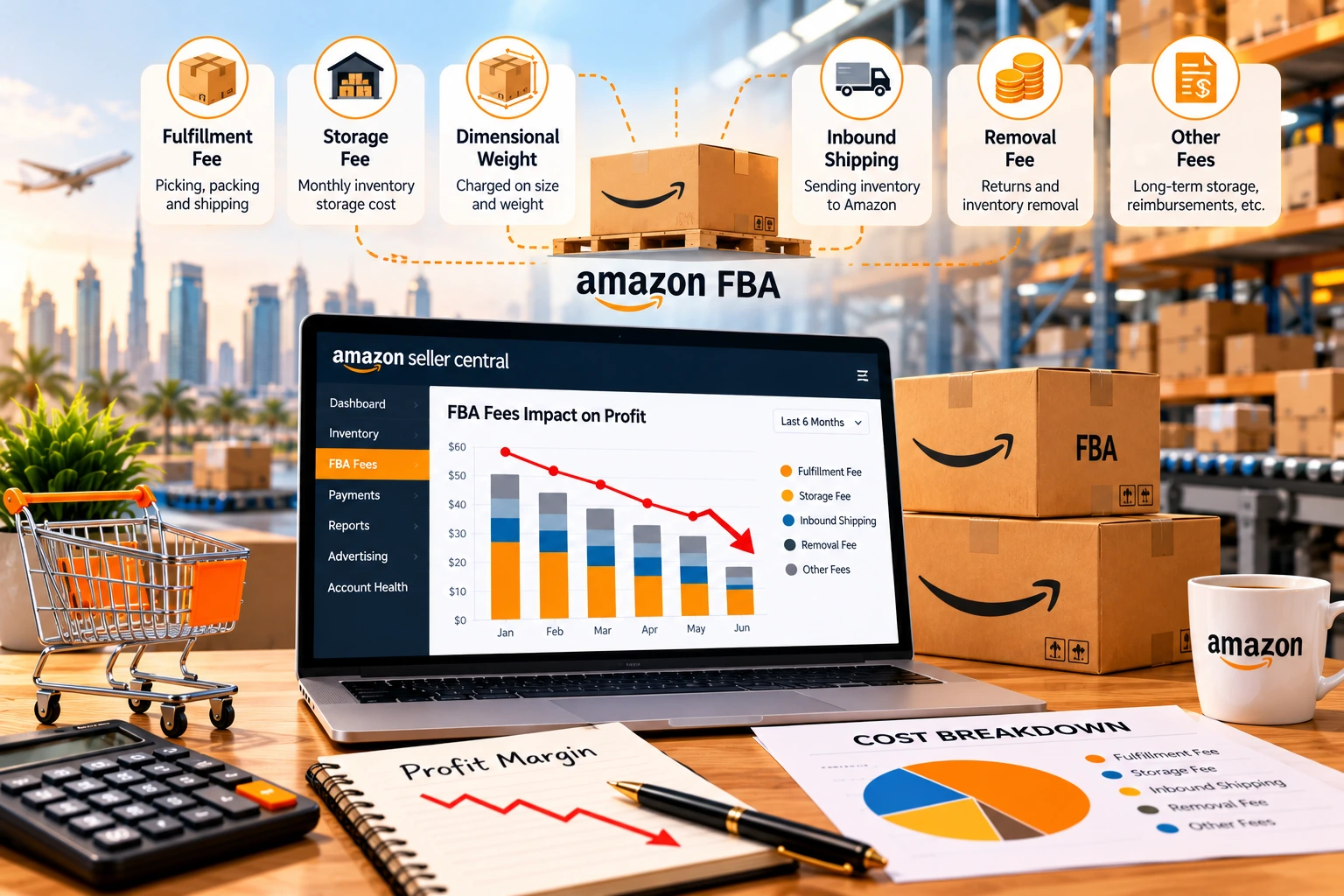
The answer often involves more than one fee. Fulfillment charges, referral fees, inventory storage, aged inventory surcharges, returns, and inbound shipping costs can collectively reduce the amount earned on each sale.
For Amazon sellers operating in the UAE, USA, UK, Saudi Arabia, and other marketplaces, understanding these expenses is essential for making informed pricing and inventory decisions.
In this guide, we explain the different Amazon FBA fees, how they affect profitability, and practical ways to reduce unnecessary costs while maintaining reliable fulfillment operations.
Why Are Amazon FBA Fees Reducing Your Profit Margins?
Amazon FBA fees reduce profit margins because sellers must cover fulfillment, storage, and other applicable charges in addition to product sourcing, referral fees, advertising, and business operating costs.
Fulfillment by Amazon is designed to manage logistics activities such as storing inventory, picking and packing orders, shipping products, and handling applicable customer service and returns.
These services have associated costs.
For example, if a product sells for AED 100, the seller does not keep the entire AED 100 as profit.
Amazon may deduct referral and fulfillment fees, while the business must also recover product sourcing expenses, shipping to Amazon, advertising, and other costs.
When inventory moves slowly or requires additional processing, further charges may reduce profitability.
The problem is not necessarily that Amazon FBA is too expensive. It is that sellers sometimes price products or forecast profits without including all relevant costs.
What Are Amazon FBA Fees in 2026?
Amazon FBA fees are charges associated with using Fulfillment by Amazon and certain related logistics services.
They are separate from some other Amazon selling costs.
Amazon’s official July 2026 fee guidance identifies fulfillment costs, inventory storage charges, aged inventory costs, returns processing, and other applicable services.
The exact charges vary by marketplace, product category, dimensions, weight, pricing, and fulfillment circumstances.
Understanding each cost category helps sellers identify where profit margins may be declining.
1. Amazon Referral Fees
A referral fee is a selling fee that Amazon generally charges when a product is sold.
It is not specifically an FBA fulfillment fee, because referral fees can also apply to merchant-fulfilled orders.
The applicable percentage depends on the product category, marketplace, and pricing rules.
Amazon UAE’s published pricing information indicates that referral fees vary across categories, with many category rates falling between approximately 5% and 15%.
Some categories have different or tiered structures.
Sellers should verify the referral fee for their exact product category rather than using a standard percentage for every item.
2. FBA Fulfillment Fees
FBA fulfillment fees cover the services involved in preparing and delivering customer orders.
Amazon calculates these charges according to applicable size and weight classifications.
Larger or heavier products commonly incur higher fulfillment costs.
For example, Amazon UAE’s published pricing schedule lists fulfillment fees beginning at AED 7.50 per unit for certain products, with different fee levels for other price, weight, and size tiers.
A product that crosses into a larger size classification may become less profitable even if its selling price remains unchanged.
This makes product dimensions and packaging important financial considerations.
3. Monthly Inventory Storage Fees
Amazon charges sellers for inventory occupying space in fulfillment centers.
Storage costs are generally calculated using the average volume of stored products during the relevant billing period.
Products with large packaging require more space than compact products.
Inventory that remains in storage longer also creates additional cumulative costs.
In some marketplaces, seasonal storage rates may increase during periods of higher demand.
Sellers should plan inventory levels according to realistic sales velocity rather than sending excessive stock without a replenishment strategy.
4. Aged Inventory and Long-Term Storage Charges
Products that remain unsold for extended periods may incur additional inventory charges.
Importantly, the relevant thresholds are not the same in every Amazon marketplace.
Amazon’s US guidance identifies aged inventory surcharges for eligible inventory stored for more than 181 days.
Amazon UAE’s public pricing page refers to long-term storage fees for inventory stored for 365 days or longer.
These distinctions matter when selling internationally.
Sellers must review the current fee schedule for their marketplace and inventory category.
Slow-moving inventory can therefore affect profitability even when products are not generating sales.
5. FBA Returns Processing and Removal Fees
Returns can introduce additional expenses beyond the original fulfillment cost.
Depending on marketplace rules, category, and applicable circumstances, sellers may incur returns processing charges.
Returned products may also become unsellable.
When inventory needs to be removed, disposed of, or liquidated, applicable fees can further reduce its financial value.
A high return rate may indicate product quality problems, unclear listing information, inaccurate sizing, or customer expectation mismatches.
Reducing avoidable returns should therefore be part of an FBA profitability strategy.
6. Inbound Shipping and Inventory Placement Costs
Sending products to Amazon fulfillment centers creates additional expenses.
These may include freight, customs clearance, supplier handling, preparation, labeling, and transportation.
In the United States, Amazon also identifies an FBA inbound placement service as a potential charge.
The applicability and cost depend on the shipment and available inbound placement options.
Sellers should evaluate these charges before confirming a shipment.
Inbound expenses should be allocated to the products receiving the service when calculating landed cost.
Amazon FBA Fee Breakdown: What Costs Should Sellers Track?
A complete profitability calculation should distinguish Amazon charges from other operational expenses.
| Cost Type | Description | Impact |
|---|---|---|
| Referral Fee | Amazon selling fee | Per sale |
| FBA Fulfillment | Picking, packing and delivery | Per fulfilled unit |
| Inventory Storage | Fulfillment center space | Recurring |
| Aged Inventory | Extended storage | Conditional |
| Returns Processing | Eligible returned orders | Conditional |
| Inbound Logistics | Freight and inventory preparation | Shipment cost |
| Amazon PPC | Optional paid advertising | Campaign spend |
Not all costs apply to every product or order.
The goal is to identify the expenses that actually affect your business rather than assume every seller pays identical fees.
How Do You Calculate Your Real Amazon FBA Profit Margin?
Many sellers calculate profit by subtracting product sourcing costs and Amazon referral fees from the selling price.
This approach can significantly overestimate profitability.
An accurate calculation should also include FBA fulfillment, inbound shipping, storage allocation, expected returns, advertising, and other applicable expenses.
A simplified formula is:
Estimated Profit Per Unit = Net Sales Revenue − Product Landed Cost − Amazon Fees − Advertising Allocation − Other Relevant Expenses
Profit Margin = Estimated Profit ÷ Net Sales Revenue × 100
Use a consistent basis for taxes, discounts, refunds, and revenue.
For VAT-registered businesses, recoverable VAT should not automatically be treated as a permanent product cost. Actual VAT treatment depends on applicable rules and the seller’s circumstances.
Amazon FBA Profit Margin Calculation Example
Consider a hypothetical seller offering a product on Amazon UAE for AED 100.
The following amounts are illustrative, not official Amazon fee quotations.
| Financial Component | AED |
|---|---|
| Net Sales Revenue | 100 |
| Product Landed Cost | 30 |
| Referral Fee | 15 |
| FBA Fulfillment | 10 |
| Storage Allocation | 2 |
| Advertising Allocation | 15 |
| Other Variable Expenses | 3 |
| Estimated Contribution After Listed Costs | 25 |
Under these assumptions, the remaining contribution is AED 25 on AED 100 of net sales revenue.
The estimated contribution margin is 25%.
This figure is not necessarily final accounting net profit because fixed overhead, any excluded expenses, and applicable tax adjustments may still need consideration.
A seller who ignored storage and advertising would overstate the contribution available from the sale.
Why Do Product Size and Weight Affect FBA Profitability?
Product dimensions and weight are important factors in Amazon FBA fulfillment fees.
Two products with similar selling prices can have different fulfillment costs because their packaged dimensions and shipping weights are different.
For example, a compact product may occupy less fulfillment center space and qualify for a different fee tier than a bulky product.
Packaging decisions therefore influence both logistics costs and inventory storage requirements.
Sellers should verify product measurements using the fully packaged item rather than relying exclusively on supplier estimates.
Incorrectly estimating dimensions can result in an unrealistic profitability forecast.
However, businesses should never misrepresent actual product measurements or use inadequate packaging simply to reduce fees.
The objective is to develop safe, efficient packaging that accurately reflects the product and complies with Amazon requirements.
How Do Slow-Moving Products Increase Amazon FBA Costs?
Slow-moving inventory creates costs even when customers are not placing orders.
Unsold units continue occupying fulfillment center space and may accumulate storage charges.
As inventory ages, additional charges may apply depending on the marketplace and eligibility.
For example, a seller may forecast strong demand and ship 2,000 units but sell only 100 units per month.
The business may then hold significantly more inventory than needed for its current sales velocity.
This can tie up working capital and increase storage expenses.
Sellers should review inventory age, historical sales, seasonal patterns, and replenishment lead times.
Reducing excess stock may involve adjusting reorder quantities, improving product offers, offering suitable discounts, or considering removal and liquidation options.
The best approach depends on whether holding inventory is likely to create more value than the cost of disposing of or discounting it.
Can Amazon PPC Advertising Make FBA Products Unprofitable?
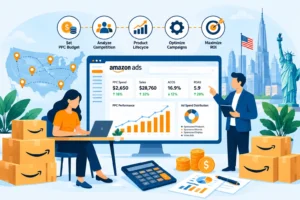
Amazon PPC advertising is a separate cost from FBA fulfillment, but it directly influences overall product profitability.
A product may have an acceptable contribution margin before advertising and become unprofitable after advertising expenses.
For example, suppose a product has a 25% contribution margin before advertising.
If its advertising-attributed sales incur 30% ACOS, the ad-attributed sales may generate negative contribution under the same cost assumptions.
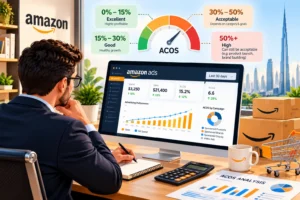
ACOS = Advertising Spend ÷ Advertising-Attributed Sales × 100
Sellers should calculate break-even ACOS using the contribution margin available before advertising.
However, not all products or campaigns must pursue immediate advertising profitability.
Controlled launch testing may sometimes justify higher advertising costs.
Such decisions require clear objectives and financial limits.
The important point is to connect advertising spending with product costs rather than evaluating PPC reports in isolation.
How Can You Reduce Amazon FBA Fees Without Hurting Sales?
Reducing FBA costs requires identifying avoidable expenses while preserving product quality, customer experience, and reliable fulfillment.
The following strategies can help sellers improve their unit economics.
Optimize Product Packaging and Dimensions
Review whether packaging contains unnecessary empty space or excessive materials.
Compact, compliant packaging may reduce storage volume and potentially affect fulfillment fee classification.
Confirm that packaging still protects the product during shipping and meets Amazon’s requirements.
Request accurate dimensions and weights from the supplier before preparing a shipment.
Improve Inventory Forecasting
Use actual sales velocity, seasonal demand, lead times, and advertising plans to estimate replenishment needs.
Avoid sending excessive quantities simply because purchasing larger volumes reduces the supplier’s unit price.
Lower sourcing costs may be outweighed by storage and aged inventory expenses.
A balanced replenishment plan helps protect working capital and reduce unnecessary fulfillment center storage.
Monitor Inventory Age and Storage Costs
Review available inventory reports and identify products approaching relevant surcharge thresholds.
Evaluate whether a price adjustment, promotion, removal, or liquidation is financially appropriate.
Different marketplaces have different inventory age rules, so use the applicable local policy.
Sellers should compare the expected recovery from selling inventory against the cost of keeping or removing it.
Reduce Avoidable Customer Returns
Accurate listings can help customers make better purchasing decisions.
Review sizing information, dimensions, product photographs, materials, and specifications.
Avoid misleading imagery or unsupported product claims.
Analyze available return reasons and identify recurring problems.
Improving packaging quality and supplier quality control may also reduce damaged or defective products.
Actual return outcomes depend on customer behavior and product performance.
Compare FBA With Other Fulfillment Options
Fulfillment by Amazon is not automatically the cheapest option for every product.
Some products may be more economical through seller-managed fulfillment, depending on order volume, size, shipping geography, service requirements, and operational capabilities.
Use Amazon’s Revenue Calculator to compare available fulfillment methods.
The calculation should include transportation, labor, storage, customer service, returns, and any relevant benefits of each option.
The lowest apparent shipping rate does not always produce the lowest total cost.
Should You Increase Product Prices to Cover Higher FBA Fees?
Price adjustments may help recover rising fulfillment costs, but sellers should evaluate customer demand and market competition first.
Increasing the selling price can improve revenue per unit if sales volume and other costs remain stable.
However, a higher price may reduce conversion rates or make the offer less competitive.
Before adjusting prices, calculate the required contribution margin and compare similar products in the marketplace.
Consider whether packaging improvements, sourcing negotiations, or reduced advertising waste could improve profitability without increasing retail prices.
A combination of cost reduction and careful pricing may be more sustainable than relying on price increases alone.
Are Amazon FBA Fees Different in UAE, USA, UK, and Saudi Arabia?
Yes. Amazon marketplaces have different fee schedules, product classifications, storage policies, and tax considerations.
For example, Amazon UAE publishes fulfillment fees in AED and identifies specific local referral fee categories.
Amazon USA uses its own fulfillment classifications and aged inventory surcharge rules.
UK and Saudi Arabia sellers should use their respective marketplace pricing schedules.
A fee quoted for one marketplace should not be copied into the profitability model for another.
International sellers must also consider currency conversion, freight, customs, and applicable tax requirements.
Before launching a product internationally, calculate its financial performance separately for each marketplace.
What Tools Can Help Sellers Calculate Amazon FBA Fees?
Amazon provides tools and reports that can help sellers estimate fulfillment expenses and evaluate profitability.
The Amazon Revenue Calculator allows users to compare estimated FBA and alternative fulfillment costs using product information.
Seller Central also provides fee-related information and inventory reports.
Sellers should use actual product measurements, selling prices, and relevant cost inputs rather than relying entirely on generic assumptions.
A product profitability spreadsheet can provide additional visibility into sourcing, freight, storage, advertising, returns, and other expenses.
Review calculations whenever Amazon updates its fee schedules or your supplier changes pricing.
Forecasts are estimates and should be reconciled with actual transaction and settlement reports.
What Are the Most Common Amazon FBA Profitability Mistakes?
Several mistakes can cause sellers to overestimate their expected profits.
- Ignoring fulfillment fees: Calculating profit using only product cost and referral charges.
- Underestimating dimensions: Using inaccurate product measurements in fee forecasts.
- Overstocking: Sending too much inventory without realistic demand forecasts.
- Forgetting inbound expenses: Excluding freight, preparation, and applicable placement costs.
- Ignoring returns: Failing to account for refunds and unsellable products.
- Overlooking advertising: Evaluating product profitability without PPC costs.
- Using outdated fee tables: Applying historical rates after Amazon changes its pricing.
- Mixing marketplaces: Applying US fee rules to products sold in the UAE or other countries.
- Confusing sales with profit: Treating marketplace revenue as cash available to the business.
- Incorrect tax treatment: Failing to account properly for VAT or other applicable taxes.
Avoiding these mistakes requires accurate calculations before sourcing and continued monitoring after a product launches.
How Can iNNOVEX Enterprises Help Reduce Amazon FBA Costs?
Managing Amazon FBA profitability requires coordination between product sourcing, logistics, inventory planning, advertising, and marketplace operations.
At iNNOVEX Enterprises, we support Amazon sellers with services that help them evaluate and manage important aspects of their marketplace businesses.
Our relevant services include:
- Amazon FBA Setup and Management: Supporting sellers with FBA-related workflows and operational planning.
- Inventory and Warehousing: Helping businesses organize inventory storage and replenishment processes.
- Product Sourcing: Supporting supplier research, sourcing coordination, and product cost evaluation.
- Amazon Logistics and Shipping: Assisting with shipping preparation and logistics coordination.
- Customs Clearance Support: Helping sellers navigate international shipment and clearance requirements.
- Amazon PPC Management: Reviewing advertising spending and campaign efficiency.
- Product Listing Optimization: Improving product information to support more informed purchasing decisions.
- Amazon Account Management: Coordinating catalog, inventory, and marketplace activities.
Our services support businesses operating in Amazon UAE, USA, UK, Saudi Arabia, and other international marketplaces.
The appropriate cost-reduction strategy depends on the seller’s products, inventory, available reporting information, and commercial objectives.
Are Amazon fulfillment, storage, or advertising expenses reducing your margins? Contact iNNOVEX Enterprises to discuss Amazon FBA management, logistics, and marketplace optimization support.
Frequently Asked Questions About Amazon FBA Fees
1. Why are my Amazon FBA fees so high?
FBA costs may increase because of product size and weight, inventory storage, aging stock, returns, or other applicable services. Your total selling expenses may also include referral fees, advertising, and inbound logistics.
2. What are Amazon FBA fulfillment fees?
These are charges for applicable fulfillment services such as picking, packing, and delivering eligible customer orders. Rates depend on the marketplace and product classification.
3. How much are Amazon FBA fees in the UAE?
Amazon UAE’s published fee schedule shows fulfillment starting at AED 7.50 per unit for certain products. Exact charges depend on size, weight, price tier, and current fee rules. Referral and storage charges are separate.
4. Does Amazon charge FBA storage fees every month?
Amazon generally charges monthly inventory storage costs based on the relevant volume of inventory stored in its fulfillment centers.
5. When do Amazon aged inventory fees begin?
Thresholds vary by marketplace. Amazon’s US guidance identifies surcharges after more than 181 days, while Amazon UAE’s public pricing page refers to long-term storage charges for inventory held for 365 days or longer.
6. Can Amazon FBA fees make a profitable product unprofitable?
Yes. If selling, fulfillment, inventory, advertising, and other expenses exceed the available product margin, the business may lose money despite generating sales.
7. How can I reduce Amazon FBA storage fees?
Improve demand forecasting, monitor inventory age, avoid excessive shipments, and evaluate suitable options for slow-moving stock.
8. Is Amazon FBA cheaper than self-fulfillment?
Not always. The better option depends on product dimensions, order volume, shipping costs, service requirements, and the total cost of operating each fulfillment method.
9. How do I calculate my Amazon FBA profit margin?
Subtract product landed costs, Amazon selling and fulfillment fees, advertising, and other applicable expenses from net sales revenue. Divide the remaining profit or contribution by net sales revenue and multiply by 100.
10. Can an Amazon agency help reduce FBA expenses?
An experienced service provider may help review inventory planning, logistics, sourcing, product listings, and related costs. However, actual savings depend on the business and cannot be guaranteed.
Conclusion: How Can Amazon Sellers Protect Their FBA Profit Margins?
Amazon FBA fees reduce profit margins when fulfillment, storage, selling, advertising, and inventory-related expenses consume too much of the revenue generated by each product.
Understanding your actual costs is the first step toward improving profitability.
Sellers should verify current marketplace fee schedules, calculate product-level contribution margins, monitor inventory age, and evaluate packaging and replenishment decisions.
Advertising performance also matters because high PPC spending can reduce the profit remaining after fulfillment expenses.
Rather than focusing exclusively on sales volume, businesses should evaluate whether each product generates enough contribution to support sustainable operations.
A combination of accurate forecasting, efficient logistics, careful inventory management, and informed advertising decisions can help sellers protect their margins.
Need support with Amazon FBA logistics, inventory management, or seller account operations? Visit iNNOVEX Enterprises to explore our Amazon seller services.
Official Sources and References
- Amazon US – Guide to Amazon FBA Fees, July 2026
- Amazon UAE – Official Selling and FBA Pricing
- Amazon US – Fulfillment by Amazon
- Amazon UAE – Fulfillment by Amazon
Disclaimer: This article provides general Amazon FBA information as of October 2026. Actual fees, inventory age thresholds, tax treatment, and fulfillment rules vary by marketplace and may change. All financial calculations are illustrative and do not guarantee profitability.