
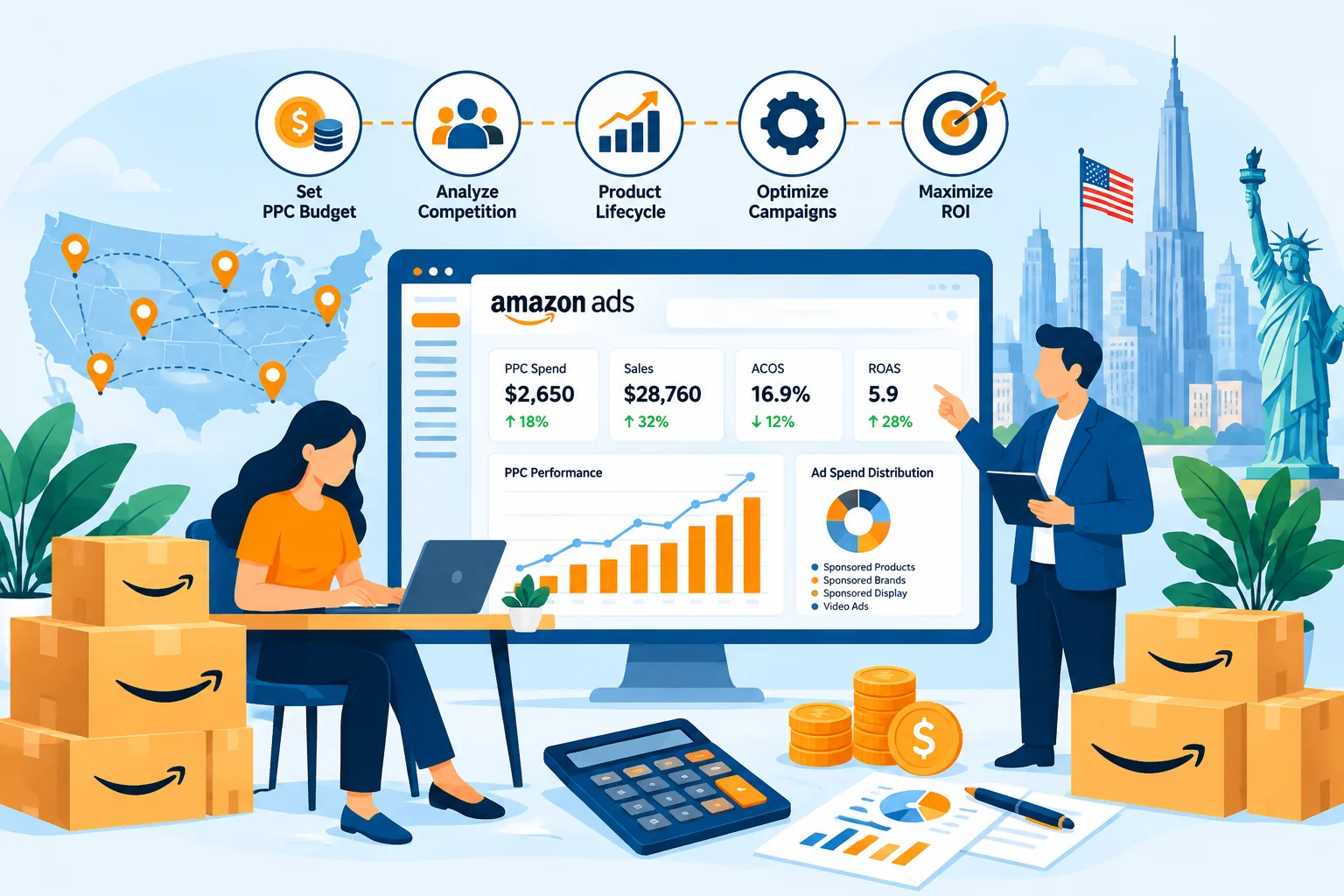
Amazon PPC advertising is one of the most important tools for increasing product visibility, attracting potential customers, and generating sales on Amazon. However, one question continues to challenge both new and experienced sellers: How much should Amazon sellers spend on PPC advertising in 2026?
Some sellers spend hundreds of dollars every month, while established brands may invest thousands in Sponsored Products and other Amazon advertising campaigns. Yet spending more money does not automatically produce better results.
The ideal Amazon PPC budget depends on product price, competition, profit margins, cost per click, conversion rate, marketplace, and business objectives.
Whether you sell on Amazon UAE, USA, UK, or Saudi Arabia, understanding how to calculate an advertising budget can help you reduce wasted spending and make better decisions.
This guide explains Amazon PPC costs in 2026, recommended starting budgets, advertising formulas, campaign allocation strategies, and practical methods for improving advertising profitability.
How Much Should Amazon Sellers Spend on PPC Advertising in 2026?
Amazon sellers should set their PPC budgets according to product profitability, advertising objectives, expected cost per click, and available working capital rather than following a universal spending rule.
Amazon’s official Sponsored Ads guidance recommends starting daily budgets of approximately $10 for the United States, AED 40 for the UAE, SAR 40 for Saudi Arabia, and £10 for the United Kingdom.
These figures are suggested starting points for campaign planning, not mandatory minimum spending requirements.
A new seller testing one product may begin with a carefully controlled budget, while an established brand with multiple profitable products may spend substantially more.
The most important goal is to generate enough relevant data to evaluate advertising performance without risking money that the business cannot afford to lose.
Your ideal Amazon PPC budget should be sustainable, measurable, and supported by realistic product economics.
What Is the Recommended Amazon PPC Daily Budget by Marketplace?
Amazon advertising costs vary across marketplaces because customer demand, keyword competition, product pricing, and advertiser activity differ.
Amazon provides marketplace-specific starting budget recommendations in its official Sponsored Ads guidance.
| Amazon Marketplace | Recommended Daily Starting Budget |
|---|---|
| Amazon UAE | AED 40 |
| Amazon Saudi Arabia | SAR 40 |
| Amazon USA | USD 10 |
| Amazon UK | GBP 10 |
| Amazon Canada | CAD 10 |
These values are based on Amazon’s published campaign guidance and may change.
They do not mean that every campaign should use the same budget or that the recommendation will generate a particular number of clicks or sales.
For example, a seller advertising three products across separate campaigns should evaluate the available budget for each campaign rather than assuming the marketplace recommendation covers an entire advertising account.
Review the current recommendations displayed in Amazon Ads before launching.
How Much Does Amazon PPC Advertising Cost Per Click?
Amazon Sponsored Products advertising generally operates through a cost-per-click model.
Advertisers place bids on relevant keywords or products, and advertising costs accumulate when customers click eligible ads.
The actual CPC depends on auction conditions, competition, bidding strategy, placement adjustments, and other relevant factors.
There is no single standard CPC across all Amazon categories.
Highly competitive products may require higher bids than specialized products with fewer competing advertisers.
How Do You Calculate Average CPC?
The basic formula is:
Average CPC = Total Advertising Spend ÷ Total Advertising Clicks
For example, if you spend AED 300 and receive 200 clicks, your average CPC is AED 1.50.
This calculation helps estimate how many clicks a proposed budget might support.
If your average CPC is AED 2 and your daily budget is AED 40, the budget could theoretically support approximately 20 clicks at that average cost.
Actual clicks will vary because auction costs, traffic availability, bidding adjustments, and campaign eligibility can change.
A lower CPC is not automatically better if the traffic is irrelevant or does not convert.
How Do You Calculate the Right Amazon PPC Budget for Your Product?
A practical budgeting method combines expected CPC, target clicks, conversion rate, and product profit margin.
Start by estimating the number of relevant clicks required to generate meaningful sales data.
Then calculate how much those clicks may cost.
Estimated Advertising Budget = Expected Clicks × Estimated Average CPC
Suppose you plan to test a new Amazon UAE product and expect an average CPC of AED 1.50.
If your testing plan requires 300 clicks, the estimated advertising budget is AED 450.
Spread across 15 days, this represents an average spending allowance of AED 30 per day.
However, whether AED 450 is financially sensible depends on the product’s selling price, conversion rate, and available margin.
Campaign budgets should not be selected using click volume alone.
How Much Should Beginners Spend on Amazon PPC?
New Amazon sellers often have limited advertising budgets and little historical performance data.
Rather than launching many campaigns simultaneously, beginners may benefit from focusing on a small number of eligible products and highly relevant targets.
For financial planning, a seller might allocate a limited testing fund and divide it between automatic discovery and manual keyword targeting.
The objective during early testing is to learn which searches generate relevant traffic and whether the product listing converts.
Beginners should avoid spending heavily before checking product availability, listing quality, competitive pricing, and Amazon advertising eligibility.
A new product with weak images, missing specifications, or poor price positioning may struggle regardless of advertising spend.
Start with a budget you can sustain long enough to evaluate results, and increase spending only when the evidence supports it.
How Much Should You Spend on Amazon PPC for a Product Launch?
A product launch may require a different advertising strategy from an established listing with historical sales and keyword performance.
New products frequently have limited customer reviews, little advertising history, and uncertain conversion rates.
During launch, PPC campaigns can help introduce eligible products to relevant shoppers and provide useful search term data.
However, launch advertising should not be treated as a guarantee of organic ranking improvements.
The appropriate spending level depends on expected CPC, product margin, competitiveness, stock availability, and the seller’s willingness to fund early testing.
Consider dividing your launch budget into an initial research phase, an optimization phase, and a scaling phase.
In the research phase, prioritize relevant keywords and gather sufficient advertising data.
In the optimization phase, refine targeting, evaluate conversion, and address listing weaknesses.
In the scaling phase, increase budgets selectively for targets demonstrating acceptable results.
Avoid increasing spending solely because a product is newly launched.
How Should You Allocate Your Amazon PPC Budget Across Campaign Types?
A structured campaign strategy helps advertisers understand where their budget is being spent.
For Sponsored Products, one approach is to separate automatic targeting from manual exact, phrase, and broad keyword targeting.
This can provide clearer control over bids, budgets, and performance.
For illustration, consider a seller allocating AED 100 per day across four campaigns.
| Campaign Type | Allocation | Daily Budget |
|---|---|---|
| Manual Exact | 40% | AED 40 |
| Manual Phrase | 25% | AED 25 |
| Manual Broad | 15% | AED 15 |
| Automatic Targeting | 20% | AED 20 |
| Total | 100% | AED 100 |
This allocation is a hypothetical example, not an Amazon-recommended distribution.
Existing accounts may prioritize exact campaigns when relevant targets already demonstrate strong conversion.
Newer accounts may require a larger discovery allocation.
Sellers should adjust the structure according to their data and avoid unnecessary campaign duplication.
What Is ACOS and How Does It Affect Your Amazon PPC Budget?
ACOS stands for Advertising Cost of Sales. It measures advertising spend as a percentage of attributed advertising sales.
The formula is:
ACOS = Advertising Spend ÷ Advertising-Attributed Sales × 100
For example, if your campaign spends AED 500 and generates AED 2,000 in attributed sales, your ACOS is 25%.
ACOS is useful for evaluating advertising cost efficiency, but it does not independently determine whether a campaign is profitable.
Profitability depends on the amount of contribution remaining after product costs, Amazon fees, fulfillment, and other relevant expenses.
Amazon’s own guidance states that there is no universally good ACOS because acceptable performance varies between businesses and campaigns.
How Do You Calculate Break-Even ACOS?
Break-even ACOS represents the approximate advertising cost percentage a product can absorb before its contribution from ad-attributed sales reaches zero.
First, calculate the contribution available before advertising.
For example, assume a product sells for AED 100 and has AED 70 in attributable product, Amazon, fulfillment, and other variable costs before advertising.
The available contribution is AED 30.
Break-Even ACOS = Contribution Before Advertising ÷ Selling Price × 100
In this example, break-even ACOS is 30%.
An ACOS above 30% would exceed the contribution available under these assumptions.
A seller seeking an additional profit margin would generally target an ACOS below the break-even level.
Actual break-even calculations should reflect VAT treatment, returns, discounts, and all relevant per-unit expenses.
What Is a Good Amazon PPC Budget Based on Profit Margin?
The relationship between CPC, conversion rate, and contribution margin provides a useful method for evaluating advertising affordability.
Suppose a product sells for AED 100 and has AED 30 contribution available before advertising.
If its advertising conversion rate is 10%, the expected number of clicks per order is approximately 10.
At an average CPC of AED 2, the expected advertising cost per order would be AED 20.
This leaves an estimated AED 10 contribution after advertising, before any costs excluded from the calculation.
If CPC rises to AED 4 while conversion remains 10%, expected advertising cost per order would increase to AED 40.
The same product would then have an estimated AED 10 loss per advertising-attributed order under these assumptions.
Higher budgets should not be approved without considering whether the expected cost of acquiring orders is economically sustainable.
Should Amazon Sellers Spend More on PPC During Holidays and Sales Events?
Shopping events and seasonal demand can create opportunities for increased advertising activity.
However, increasing budgets during major sales events does not automatically improve profitability.
Auction competition, product pricing, inventory availability, and promotional eligibility should be evaluated first.
Amazon supports budget rules that can help advertisers increase campaign budgets during specified schedules or when performance criteria are satisfied.
Its September 2026 guidance describes schedule-based and performance-based budget rules for supported sponsored advertising campaigns.
For example, an advertiser may use an eligible schedule-based rule during a planned shopping event.
A performance-based rule may increase the budget when the applicable campaign metric meets a defined condition.
These tools should be configured according to the seller’s advertising objectives and financial limits.
Always evaluate whether the product has sufficient inventory and an attractive offer before increasing spending.
How Often Should You Review Your Amazon PPC Budget?
Amazon PPC budgets should be monitored regularly, but not every campaign requires major daily changes.
A useful approach is to review spending and operational problems frequently while evaluating strategic performance over a meaningful reporting period.
Daily checks can identify unexpected spending, unavailable products, or campaigns exhausting budgets unusually early.
Weekly reviews can assess search terms, bids, conversions, and campaign performance.
Longer-period reviews can help evaluate trends in ACOS, TACOS, total sales, and profitability.
Amazon’s budget guidance recommends reviewing whether campaign budgets remain appropriate at least every two weeks.
Avoid making major decisions based only on incomplete advertising attribution or a very small number of clicks.
The review frequency should reflect campaign spending, product maturity, and data volume.
How Can Sellers Reduce Amazon PPC Spending Without Losing Valuable Sales?
Reducing advertising expenses does not always require lowering every campaign budget.
Sellers should first identify which targets, placements, and products generate poor results.
Review the Sponsored Products search term report to identify irrelevant searches and evaluate whether negative targeting is appropriate.
Adjust bids for persistently inefficient keywords and product targets.
Improve product detail pages where weak images, missing information, or pricing problems reduce conversion.
Consider reallocating funds from consistently unproductive campaigns to profitable targets.
However, sellers should avoid excluding search terms solely because they have received a few clicks without orders.
Some keywords require more evidence before their value can be assessed.
The objective is to reduce inefficient advertising spend while retaining traffic that supports profitable sales and relevant business goals.
Should You Increase Amazon PPC Budgets When Campaigns Are Profitable?
Profitable performance can provide a reason to consider expanding advertising, but scaling should be controlled.
A campaign with strong ROAS may already be capturing much of its available relevant traffic.
Increasing its budget may not generate proportional additional sales.
Before scaling, review whether the campaign is frequently limited by budget, whether additional relevant search demand exists, and whether the product has sufficient inventory.
Also consider the possibility that additional clicks may be more expensive or convert at a lower rate.
Gradual budget increases can make it easier to evaluate performance changes.
Continue monitoring ACOS, CPC, advertising orders, total sales, and product-level profitability.
Scale based on available profitable opportunities, not simply because a campaign has a low ACOS.
What Are the Biggest Amazon PPC Budgeting Mistakes in 2026?
Even experienced sellers can make decisions that reduce advertising efficiency.
Common mistakes include:
- Setting budgets without calculating margins: Advertising costs may exceed the contribution available from each order.
- Increasing budgets to fix poor conversion: More traffic does not automatically resolve listing or offer weaknesses.
- Ignoring search term reports: Irrelevant traffic may continue consuming the budget.
- Duplicating campaigns without a clear purpose: Overlapping discovery structures can complicate reporting and budget allocation.
- Using one budget for every product: Products vary in demand, profitability, and competition.
- Making decisions too quickly: Limited data can produce misleading conclusions.
- Focusing only on ACOS: Sellers may overlook total sales, contribution margin, and longer-term business goals.
- Ignoring inventory availability: Advertising plans should reflect available and replenishable stock.
Avoiding these mistakes requires consistent performance analysis and a clear financial strategy.
How Can iNNOVEX Enterprises Help Optimize Your Amazon PPC Budget?
Creating an effective Amazon advertising budget requires more than selecting a daily spending limit.
Sellers must understand product profitability, keyword relevance, campaign structure, search term performance, and the relationship between advertising costs and revenue.
At iNNOVEX Enterprises, we support Amazon businesses with advertising audits, campaign management, and marketplace growth strategies.
Our services include:
- Amazon PPC Audit: Reviewing campaign spending, targeting relevance, performance, and opportunities to reduce wasted budget.
- Amazon PPC Management: Ongoing campaign monitoring, bid adjustments, budget allocation, and performance optimization.
- Amazon PPC Campaign Structure: Organizing Sponsored Products campaigns for clearer targeting and reporting.
- Amazon PPC Keyword Research: Identifying product-relevant search terms for advertising campaigns.
- Sponsored Products Management: Managing automatic and manual targeting, bids, negative targeting, and campaign performance.
- Amazon PPC Campaign Optimization: Evaluating advertising efficiency and improving campaign decision-making.
- Amazon Listing Optimization: Improving product detail pages to support customer understanding and conversion.
- Amazon Account Management: Coordinating advertising performance with inventory and marketplace operations.
Our services support sellers operating across Amazon UAE, USA, UK, Saudi Arabia, and other marketplaces.
We focus on evaluating advertising performance using relevant account data, product economics, and business objectives.
Are you unsure how much to spend on Amazon PPC or struggling with high advertising costs? Contact iNNOVEX Enterprises to discuss Amazon PPC audits, advertising management, and campaign optimization support.
Frequently Asked Questions About Amazon PPC Budgets
1. What is the minimum Amazon PPC budget in 2026?
Amazon’s general advertising FAQ lists a Sponsored Products minimum daily budget of $1 or the local equivalent, while its getting-started guidance recommends higher starting budgets, such as AED 40 in UAE and $10 in USA. Check the current requirements shown in your advertising account.
2. Is $10 per day enough for Amazon PPC?
It may be sufficient for limited testing in some circumstances. However, the ability to collect useful data depends on CPC, search demand, competition, and conversion rate.
3. How much should Amazon UAE sellers spend on PPC?
Amazon’s official guidance recommends AED 40 as a starting daily budget. The actual amount should be adjusted according to product profitability, campaign structure, and business objectives.
4. What percentage of sales should go toward Amazon PPC?
There is no universal percentage. Sellers should determine affordable spending using contribution margins, target ACOS, business goals, and the relationship between advertising and total sales.
5. What is a good ACOS for Amazon PPC?
A good ACOS depends on the product’s available contribution margin and advertising objectives. The same ACOS can be profitable for one product and unprofitable for another.
6. Should beginners run automatic or manual PPC campaigns?
Both can be useful. Automatic targeting supports search discovery, while manual targeting provides more direct control over selected keywords and products.
7. Can increasing PPC budgets improve Amazon sales?
Increasing budgets may allow profitable campaigns to capture additional traffic when demand is available. However, more spending does not guarantee more orders.
8. How much should I budget for Amazon PPC during a product launch?
Calculate a testing budget based on expected CPC, desired data volume, available inventory, and acceptable financial risk. Avoid using a fixed launch budget without evaluating product economics.
9. How often should I adjust Amazon PPC budgets?
Monitor campaign spending regularly and review strategic performance over appropriate reporting periods. Avoid making repeated large adjustments using incomplete or insufficient data.
10. Can an Amazon PPC agency guarantee profitability?
No. Agencies can audit campaigns, improve targeting, manage budgets, and recommend optimization strategies, but results depend on product demand, pricing, competition, conversion, and other factors.
Conclusion: How Much Should You Really Spend on Amazon PPC in 2026?
The best Amazon PPC budget is not necessarily the largest budget. It is the amount your business can sustain while generating relevant advertising data and pursuing financially sensible sales opportunities.
Amazon’s marketplace-specific starting recommendations can provide an initial reference, but they should not replace calculations based on actual product costs, expected CPC, conversion rates, and profit margins.
New sellers should prioritize product readiness, focused testing, and disciplined spending.
Established sellers should allocate additional advertising funds according to reliable campaign performance and available profitable search demand.
Regularly reviewing ACOS, ROAS, CPC, and total sales can help identify advertising opportunities and unnecessary expenses.
A well-structured Amazon PPC strategy connects campaign spending with business objectives rather than treating advertising budget as an isolated metric.
Need help managing your Amazon advertising budget? Explore professional Amazon PPC management services at iNNOVEX Enterprises and discuss your campaign optimization requirements.
Official Sources and References
- Amazon Ads – Getting Started With Sponsored Ads
- Amazon Ads – Sponsored Products Best Practices
- Amazon Ads – Understanding ACOS
- Amazon Ads – Advertising FAQs
- Amazon Ads – Sponsored Ads Budget Rules
Disclaimer: This article provides general Amazon advertising information as of October 2026. Marketplace budget recommendations, advertising fees, campaign features, and reporting rules may change. Financial calculations and campaign allocations are illustrative and do not guarantee advertising profitability or sales.