Amazon FBA helps sellers store products, fulfill customer orders, and manage shipping through Amazon’s fulfillment network. However, inventory that remains unsold for long periods can gradually increase operating costs and reduce overall profitability.
Many Amazon sellers focus on product sourcing, advertising, and sales growth while overlooking how much money is tied up in excess inventory.
When products remain in fulfillment centers for extended periods, sellers may face monthly storage fees and additional aged inventory surcharges.
This raises an important question: How can Amazon sellers avoid long-term inventory storage costs in 2026 without creating stockouts or losing potential sales?
The solution involves understanding Amazon’s storage policies, monitoring inventory age, improving demand forecasts, and responding to slow-moving products before additional charges accumulate.
Whether you sell on Amazon UAE, USA, UK, Saudi Arabia, or other marketplaces, effective Amazon inventory management can help protect working capital and improve profitability.
This guide explains Amazon long-term storage fees, inventory aging, excess stock management, forecasting, and practical strategies to reduce unnecessary FBA costs.
How Can Amazon Sellers Avoid Long-Term Storage Fees?
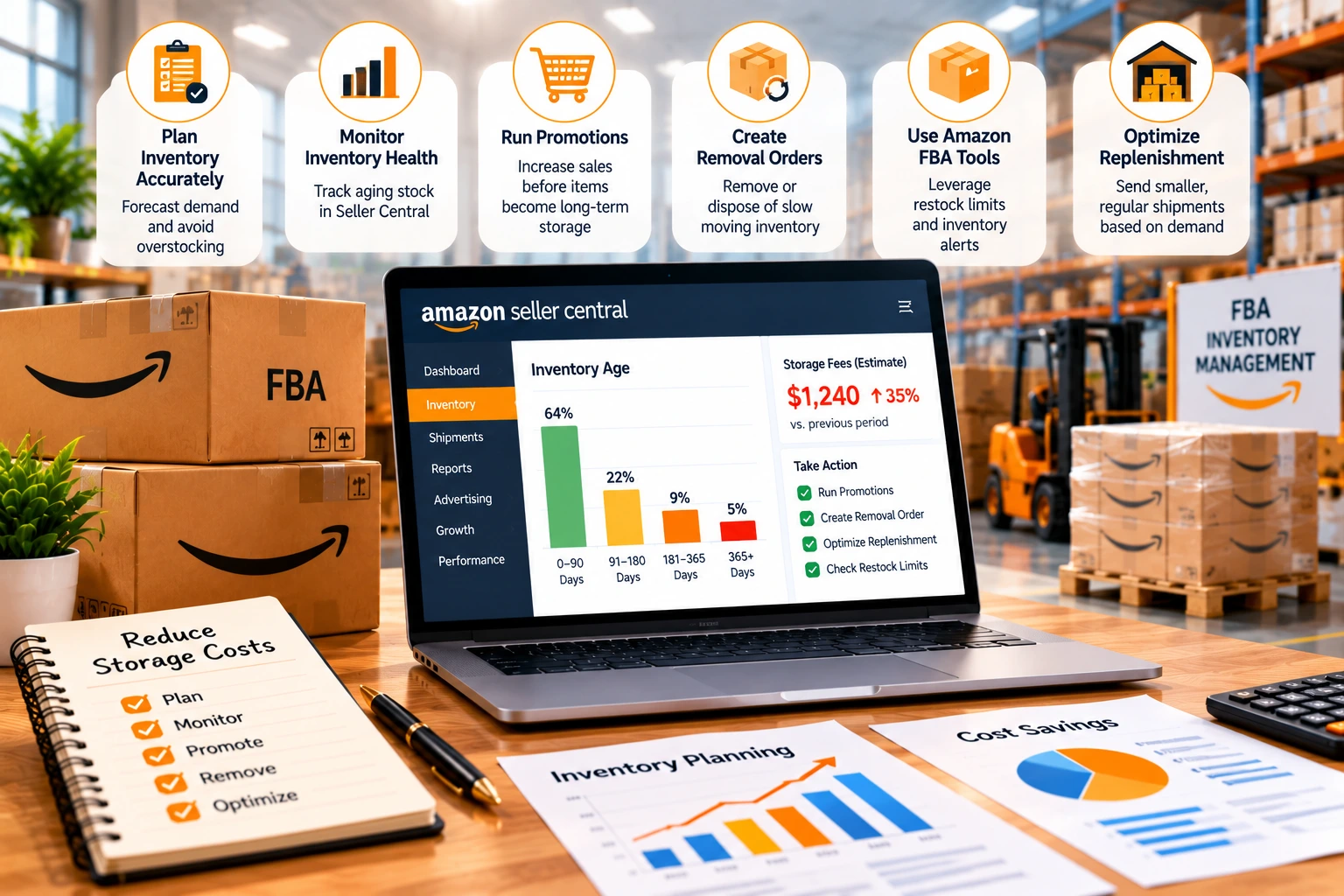
Amazon sellers can reduce long-term storage costs by monitoring inventory age, forecasting demand accurately, sending smaller replenishment shipments, fixing stranded listings, and selling or removing slow-moving stock before additional storage charges become excessive.
The most effective strategy is prevention.
Instead of waiting until inventory becomes old, sellers should calculate realistic monthly sales, monitor how long existing stock will last, and avoid unnecessary overstocking.
Amazon provides inventory management reports and dashboards that help sellers identify slow-moving inventory and take corrective action.
Depending on the marketplace and available services, sellers may use promotions, price adjustments, removal orders, liquidation, or other inventory solutions.
However, these decisions should be based on profitability rather than simply eliminating storage charges.
The goal is to maintain enough inventory to satisfy customer demand without paying to store substantially more products than the business can realistically sell.
What Are Amazon Long-Term Storage Fees?
Amazon long-term storage fees are additional charges associated with products that remain in FBA fulfillment centers beyond specified inventory-aging thresholds.
In the United States, Amazon generally refers to these costs as aged inventory surcharges.
Other marketplaces may use the term long-term storage fees.
These charges are separate from ordinary monthly inventory storage costs.
Monthly storage fees relate to the amount of fulfillment center space inventory occupies.
Aged inventory charges apply when eligible units remain in Amazon’s fulfillment network beyond the relevant time threshold.
The specific fees, thresholds, calculation methods, and exceptions vary by marketplace.
Therefore, sellers should review current marketplace-specific policies instead of applying one country’s rules to every Amazon account.
When Do Amazon Aged Inventory Fees Start in the USA?
Amazon’s official US FBA guidance identifies aged inventory surcharges for applicable inventory stored in fulfillment centers for more than 181 days.
The fee structure can vary depending on how long inventory has remained in storage and the relevant product classification.
Sellers should check the current US aged inventory surcharge schedule in Seller Central for applicable rates and exceptions.
Inventory approaching the surcharge threshold should be reviewed before additional charges accumulate.
Amazon’s inventory dashboards can help sellers identify products requiring attention.
When Do Long-Term Storage Fees Apply on Amazon UAE?
Amazon UAE’s published FBA pricing guidance identifies long-term storage charges for inventory stored for 365 days or longer.
Ordinary monthly storage fees can still apply before the inventory reaches this threshold.
Amazon UAE calculates ordinary inventory storage charges using average inventory volume, measured in cubic feet.
The current public pricing page lists AED 2 per cubic foot per month for its standard monthly storage schedule, with additional conditions and applicable VAT.
The actual costs for individual sellers may vary depending on product classification, special conditions, and current terms.
A seller should verify the fees shown in Seller Central before making inventory removal or replenishment decisions.
Amazon USA vs UAE: Inventory Storage Rules in 2026
Amazon sellers operating in multiple countries should review each marketplace independently.
| Storage Rule | Amazon USA | Amazon UAE |
|---|---|---|
| Regular Storage | Monthly volume-based fees | Monthly volume-based fees |
| Aged Inventory Threshold | More than 181 days | 365 days or longer |
| Additional Charges | Aged inventory surcharges | Long-term storage fees |
| Inventory Tools | FBA inventory and aging reports | Available Seller Central inventory reports |
These are general published thresholds as of October 2026.
Sellers operating in the UK, Saudi Arabia, or other marketplaces should consult their corresponding Amazon fee documentation.
Why Does Excess Amazon FBA Inventory Reduce Profit Margins?
Excess inventory affects business profitability in several ways.
First, unsold products occupy fulfillment center space and generate ongoing storage expenses.
Second, inventory ties up working capital that could otherwise support product development, advertising, or replenishment of better-performing items.
Third, slow-moving products may become less competitive because of market changes, newer alternatives, or seasonal demand fluctuations.
Fourth, prolonged storage can result in additional aged inventory fees.
Finally, sellers may eventually need to discount products, arrange removals, or liquidate stock at a reduced recovery value.
For example, buying 2,000 units at a slightly lower supplier price may appear attractive.
However, if the business can sell only 100 units monthly, the large shipment represents approximately 20 months of stock before considering demand changes.
Any saving on sourcing costs must be compared with additional storage, financing, and inventory risks.
Ordering more products does not necessarily reduce total business costs.
How Do You Calculate Amazon Inventory Days of Supply?
Days of supply estimates how long available inventory may last based on recent or forecast daily sales.
A basic formula is:
Days of Supply = Available Sellable Units ÷ Average Daily Unit Sales
Suppose a seller has 600 units available and sells approximately 10 units each day.
The estimated days of supply would be 60 days.
If sales fall to five units per day, the same inventory would represent approximately 120 days of supply.
This metric helps sellers understand whether their inventory is likely to sell before approaching applicable aging thresholds.
However, historical daily sales may not predict demand accurately during seasonal changes, promotions, or product launches.
Therefore, sellers should combine days of supply with forecasts, upcoming events, replenishment lead times, and inventory already in transit.
How Much Amazon FBA Inventory Should You Keep in Stock?
There is no universal inventory quantity suitable for every Amazon seller.
The appropriate stock level depends on sales velocity, supplier lead times, logistics reliability, seasonality, and the seller’s tolerance for stockout risk.
For example, a product selling 10 units daily with a 30-day replenishment lead time requires different planning from a product selling two units daily with a 90-day lead time.
A seller should calculate expected demand during replenishment and maintain appropriate safety stock.
The objective is to avoid both excessive inventory and preventable stockouts.
Amazon provides inventory planning tools that help sellers evaluate inventory health and replenishment needs.
For new products, sellers should be especially careful about ordering large quantities before validating realistic demand.
What Is the Amazon Inventory Performance Index (IPI)?
The Inventory Performance Index (IPI) is a metric Amazon uses to evaluate aspects of FBA inventory management.
It helps sellers understand inventory efficiency and identify potential areas for improvement.
Relevant factors include excess inventory, sell-through performance, stranded inventory, and maintaining appropriate availability of popular products.
IPI scoring and related operational requirements can change.
A better inventory health position may help sellers avoid unnecessary storage expenses and manage storage capacity more effectively.
However, a high IPI score does not automatically eliminate monthly storage fees or aged inventory surcharges.
Sellers should use the score as part of a broader inventory management strategy rather than treating it as the only important performance indicator.
What Are the Best Ways to Avoid Amazon Long-Term Storage Fees?
The following strategies can help sellers address the underlying causes of excess and aging inventory.
1. Monitor Inventory Age Every Week
Regularly review inventory aging reports and identify products that are approaching the applicable surcharge thresholds.
Prioritize products with large quantities, slow sales velocity, or high storage volume.
Weekly monitoring helps sellers identify problems while more corrective options may still be available.
Inventory that is already close to an assessment date may require immediate attention.
Do not assume that placing a removal request instantly ends every possible storage charge. Review the applicable processing and fee rules.
2. Use Accurate Demand Forecasting
Review historical sales, advertising performance, seasonal demand, competitor activity, and anticipated promotions.
Forecasting should consider realistic sales rather than relying exclusively on supplier minimum order quantities.
For example, if the product usually sells 150 units per month, ordering 3,000 units creates substantial inventory exposure.
Compare anticipated demand with supplier lead times and available working capital.
Forecasts should be revised when customer demand changes.
3. Send Smaller Replenishment Shipments
Shipping all available inventory to Amazon at once may increase fulfillment center storage requirements.
Where commercially feasible, sellers can divide stock into more manageable replenishment quantities.
Additional units may be stored with an appropriate third-party logistics provider or another warehouse.
However, smaller shipments may have higher transportation costs per unit.
Evaluate the combined cost of freight, external storage, handling, and Amazon storage before deciding on shipment frequency.
4. Improve Product Listing Conversion
Products that receive relevant customer traffic but generate few purchases may accumulate inventory.
Review the product title, main image, bullet points, specifications, pricing, variations, and delivery information.
Ensure the listing accurately represents the product.
Improved product information may help customers make informed purchasing decisions and support conversion.
However, listing optimization does not guarantee sales increases.
Businesses should evaluate results against the product’s actual competitive position.
5. Use Promotions Carefully for Slow-Moving Stock
Discounts and suitable promotions can sometimes help clear excess inventory.
However, sellers should calculate the contribution remaining after discounts, Amazon fees, fulfillment, and advertising.
A promotion that generates sales below the recovery value of alternative disposal or liquidation options may be financially unattractive.
Compare the likely proceeds with expected future storage costs.
Promotions should comply with Amazon’s applicable pricing and eligibility policies.
6. Remove or Liquidate Inventory When Appropriate
When a product has limited future demand, continuing to store it may create greater losses.
Available options may include removal, disposal, or liquidation, depending on the marketplace and product eligibility.
Each option has different costs and possible recovery values.
A removal order may allow stock to be resold through another channel.
Liquidation may recover only a portion of the inventory’s original value.
Sellers should calculate the expected financial outcome rather than selecting an option based solely on the lowest visible fee.
7. Resolve Stranded Inventory Quickly
Stranded inventory refers to stock stored by Amazon that is not connected to an active purchasable offer.
This may happen because of listing problems, suppressed offers, compliance restrictions, or other account issues.
Inventory that cannot be purchased may continue generating storage costs.
Review stranded inventory reports and investigate the reason for each affected listing.
Reactivate eligible offers when the underlying issue can be resolved.
If an item cannot become sellable, assess suitable inventory removal options.
8. Optimize Packaging Volume
Large product packaging can increase the amount of fulfillment center storage space used.
Review whether packaging includes unnecessary empty space while maintaining product protection and compliance.
A compact package may reduce storage volume and can sometimes improve logistics efficiency.
Use accurate product dimensions in forecasts and fee calculations.
Never misstate dimensions or compromise packaging safety to obtain a lower fee classification.
9. Plan Seasonal Inventory Separately
Products associated with holidays, winter, summer, or specific shopping events require careful planning.
Demand may increase sharply during a short period and decline afterward.
Ordering according to peak-season demand without an exit strategy can create substantial unsold stock.
Review previous seasonal sales, realistic growth assumptions, and supplier lead times.
Prepare plans for discounting or reallocating inventory if demand falls short of expectations.
10. Review Inventory Costs Alongside Advertising Performance
Amazon PPC advertising may help attract shoppers, but increased spending does not guarantee that aged inventory will sell profitably.
Review keyword targeting, CPC, conversion rates, ACOS, and available contribution margins.
For slow-moving products, compare the incremental cost of advertising with the potential storage fees avoided and revenue recovered.
In some situations, accepting lower margins on selected inventory may be financially rational.
However, spending heavily on poorly converting advertisements can compound losses.
Amazon FBA Inventory Management: Example Stock Planning Calculation
Consider a hypothetical Amazon seller with the following inventory information.
| Metric | Example |
|---|---|
| Available Inventory | 900 units |
| Average Daily Sales | 10 units |
| Days of Supply | 90 days |
| Supplier and Shipping Lead Time | 30 days |
| Illustrative Safety Stock | 100 units |
If sales remain stable at 10 units daily, the business has approximately 90 days of supply.
A 30-day replenishment lead time implies anticipated demand of around 300 units during replenishment.
Adding the illustrative safety stock produces a reorder point of approximately 400 units.
Reorder Point = Expected Demand During Lead Time + Safety Stock
In this example, the seller can monitor inventory until stock approaches the calculated reorder point rather than sending another large shipment immediately.
This calculation does not predict when individual units will trigger aged inventory fees.
Inventory age, sell-through, and stock availability should be monitored separately.
Seasonal demand, existing inbound shipments, and supplier variability may also require a different reorder point.
Is Using a 3PL Warehouse Better Than Sending Everything to Amazon FBA?
A third-party logistics provider can sometimes help sellers avoid keeping excessive quantities inside Amazon fulfillment centers.
For example, a seller might store reserve inventory at a 3PL facility and replenish Amazon FBA according to demand.
This approach may reduce Amazon storage exposure and provide greater flexibility for distributing stock to other marketplaces.
However, 3PL services also involve warehousing, handling, transportation, and potential administrative charges.
The best arrangement depends on product size, sales velocity, shipment frequency, and total logistics costs.
Compare the full landed and storage cost of each option before moving inventory.
An external warehouse is useful only when its overall financial and operational benefits justify the additional handling and freight.
When Should You Discount, Remove, or Liquidate Slow-Moving Inventory?
Sellers should compare the expected financial outcomes of available options.
For example, assume that inventory has an expected recovery value of AED 30 per unit if sold normally, after relevant selling and fulfillment costs.
If holding the unit for several more months creates AED 12 in expected additional storage costs, the seller should evaluate whether the probable future sale justifies that carrying cost.
If a discount would generate a faster sale and leave AED 22 contribution, selling earlier might be preferable under the assumed demand conditions.
However, if a liquidation option returns only AED 8, the seller should compare liquidation proceeds with the risk and cost of continued storage.
All these figures are hypothetical.
Actual decisions should account for probability of sale, time value of money, disposal costs, and remaining product value.
The most profitable option is the one with the best expected net recovery, not necessarily the option that clears inventory fastest.
What Are the Most Common Amazon Inventory Management Mistakes?
Several recurring mistakes increase the risk of unnecessary storage costs.
- Ordering large quantities before validating product demand.
- Ignoring inventory aging reports and surcharge thresholds.
- Failing to update forecasts after sales slow down.
- Sending all available supplier stock directly to Amazon.
- Allowing stranded inventory to remain unresolved.
- Ignoring seasonal demand changes.
- Failing to compare FBA storage with alternative warehousing options.
- Discounting products without calculating contribution margins.
- Assuming advertising can always clear excess stock profitably.
- Using the same replenishment strategy for every product.
Avoiding these issues requires continuous inventory monitoring, reliable reporting, and clear financial decision-making.
How Can iNNOVEX Enterprises Help Reduce Amazon Inventory Storage Costs?
Effective Amazon inventory management requires coordination between forecasting, product sourcing, logistics, advertising, and marketplace operations.
At iNNOVEX Enterprises, we support Amazon sellers with services designed to improve operational planning and manage important marketplace workflows.
Our services include:
- Amazon Inventory and Warehousing: Supporting inventory planning, storage coordination, and replenishment workflows.
- Amazon FBA Setup and Management: Helping sellers prepare and manage applicable FBA processes.
- Product Sourcing: Supporting supplier coordination and product cost analysis.
- Amazon Shipping and Logistics: Assisting with inventory shipment planning and logistics coordination.
- Customs Clearance Support: Supporting businesses with international import and clearance processes.
- Amazon PPC Management: Reviewing advertising spending and opportunities to improve campaign efficiency.
- Amazon Listing Optimization: Improving product information and supporting conversion-focused listing development.
- Amazon Account Management: Coordinating operational activities related to catalog, advertising, and inventory management.
We assist businesses operating on Amazon UAE, USA, UK, Saudi Arabia, and other international marketplaces.
Appropriate inventory management strategies depend on the seller’s product portfolio, actual demand, storage costs, and available resources.
Are slow-moving products and Amazon FBA storage costs reducing your profit margins? Contact iNNOVEX Enterprises to discuss Amazon inventory management, FBA support, and logistics solutions.
Frequently Asked Questions About Amazon Long-Term Storage Fees
1. How can I avoid Amazon long-term storage fees?
Monitor inventory aging, improve demand forecasting, avoid excessive replenishment, resolve stranded inventory, and consider suitable promotions or removal options before additional charges become excessive.
2. When does Amazon charge aged inventory fees in the USA?
Amazon’s published US FBA guidance identifies aged inventory surcharges for applicable products stored longer than 181 days. Confirm the current rates and exceptions in Seller Central.
3. When do Amazon UAE long-term storage fees start?
Amazon UAE’s published FBA pricing information identifies long-term storage charges for inventory stored for 365 days or longer.
4. Does Amazon charge monthly storage fees before inventory becomes aged?
Yes. Ordinary monthly storage fees generally apply to inventory held in Amazon fulfillment centers, even before any aged inventory surcharge threshold is reached.
5. Can Amazon remove my old FBA inventory automatically?
Automatic removal options may be available under applicable marketplace programs and settings. Review account configuration, inventory eligibility, and removal fees before relying on automated processes.
6. Is it better to discount or remove slow-moving stock?
The better option depends on expected net proceeds, demand, storage costs, removal charges, and potential resale opportunities. Compare the financial outcomes before choosing.
7. What is Amazon Inventory Performance Index?
IPI is an Amazon metric used to evaluate aspects of FBA inventory management, including inventory efficiency and related performance indicators.
8. Can Amazon PPC advertising help clear excess inventory?
Advertising may attract additional shoppers, but profitability depends on CPC, conversion rates, product margins, and the amount of inventory available for sale.
9. Should I use a 3PL warehouse instead of FBA storage?
A 3PL may be useful for reserve stock, but sellers should compare external storage, handling, transportation, and Amazon replenishment costs before making a decision.
10. Can an Amazon agency help reduce storage fees?
An experienced service provider may support inventory forecasting, logistics planning, replenishment, and cost reviews. Actual savings depend on the seller’s circumstances and cannot be guaranteed.
Conclusion: How Can Amazon Sellers Protect Their Profits From Storage Costs?
Amazon sellers can avoid many unnecessary long-term inventory storage costs by forecasting demand accurately, monitoring inventory age, maintaining appropriate stock levels, and acting early on slow-moving products.
Storage fees are an important part of Amazon FBA profitability, but reducing them should not create preventable stockouts or unnecessary logistics expenses.
Sellers should evaluate inventory health regularly, compare alternative storage options, and calculate expected financial outcomes before discounting, removing, or liquidating products.
Different Amazon marketplaces have different inventory aging thresholds, making local fee verification essential.
Effective inventory management is not simply about holding less stock. It is about maintaining the right products in the right quantities at the right time.
Need support with Amazon inventory forecasting, FBA logistics, or warehousing? Contact iNNOVEX Enterprises for professional marketplace and inventory management support.
Official Sources and References
- Amazon US – Fulfillment by Amazon and Inventory Costs
- Amazon US – FBA Fees Guide 2026
- Amazon – Inventory Management Best Practices
- Amazon UAE – Official FBA Storage and Selling Fees
- Amazon UAE – FBA Storage Information
Disclaimer: This article provides general Amazon inventory management information as of October 2026. Inventory surcharge thresholds, pricing, eligibility, and removal policies vary by marketplace and may change. All calculations are illustrative, and financial outcomes are not guaranteed.