
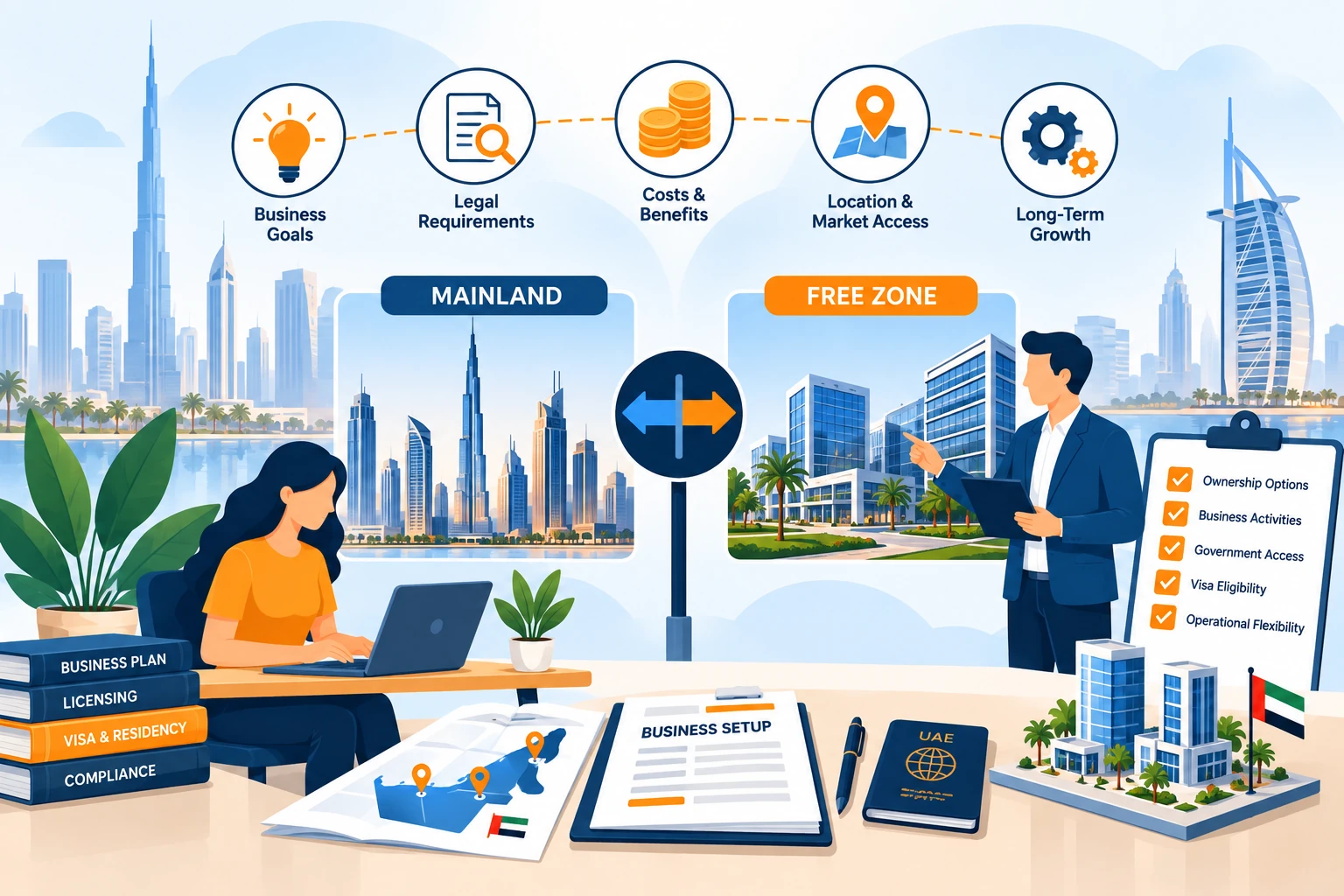
Starting a business in the UAE requires several important decisions, and one of the earliest is choosing where the company will be established. Entrepreneurs generally consider two major options: mainland business setup and free zone business setup. Both structures can support different types of businesses, but they operate within different regulatory and commercial environments.
The right choice depends on factors such as your business activity, target customers, location, office requirements, ownership structure, expansion plans, and how you expect to operate inside and outside the UAE. The UAE government provides separate processes and services for businesses operating on the mainland and in free zones, so understanding the distinction before registration can help you make a more informed decision. Official UAE business guidance
This guide explains the main differences between mainland and free zone business setup and the factors you should consider before selecting one for your business.
What Is Mainland Business Setup in the UAE?
A mainland company is a business established within the UAE’s onshore commercial jurisdiction and licensed by the relevant emirate’s economic authority. Mainland companies can operate according to the activities permitted on their licences and can establish offices or other business facilities based on their operational requirements.
Mainland setup can be relevant for businesses that want to serve customers across the UAE market, work with local clients, participate in commercial opportunities, or maintain a physical presence in a particular emirate. The UAE government provides dedicated processes for starting, operating, recruiting, accessing services, and closing mainland companies. UAE mainland business information
The exact requirements are not identical for every company. The selected business activity, legal form, emirate, premises, approvals, and other regulatory requirements can affect the setup process. This is why entrepreneurs should determine their intended activity before deciding on a jurisdiction.
What Is Free Zone Business Setup?
A free zone company is established within a designated economic zone created to support specific commercial and investment activities. The UAE has numerous free zones covering areas such as technology, logistics, media, healthcare, financial services, manufacturing, retail, and other industries. The official UAE government portal currently lists 40 free zones supporting different sectors.
Free zones have their own authorities and regulatory frameworks, so the available business activities, licence options, office requirements, visa arrangements, and operating rules can vary from one free zone to another. The UAE government provides dedicated guidance for starting, running, recruiting, and closing businesses in free zones. :contentReference[oaicite:2]{index=2}
A free zone may therefore be attractive to an entrepreneur whose business model fits the activities and facilities offered by a particular zone. However, choosing a free zone should involve more than comparing advertised setup packages. The business activity, intended customers, operational location, banking requirements, warehouse needs, and future expansion plans should all be considered.
Understand Your Business Activity Before Choosing a Jurisdiction
Your business activity should be one of the first factors you evaluate because the activity can influence the licence type, approvals, premises, and jurisdiction that are available to you. A consultancy, e-commerce company, trading business, manufacturing operation, technology company, logistics business, and professional service provider may have very different requirements.
Before choosing mainland or free zone setup, clearly define what your company will actually do. Consider whether you will sell products, provide services, import goods, export products, manufacture items, manage an online store, provide professional consulting, or perform several related activities.
Free zones are often organized around particular industries and business models, while mainland licensing provides access to activities regulated through the relevant emirate’s economic authority. The official UAE investor guidance identifies selecting the place of incorporation and selecting the type of economic activity as separate early steps in the company formation process.
A clear activity definition can therefore prevent problems later when you need to obtain additional approvals, open a business bank account, lease premises, or expand your operations.
Consider Where Your Customers Are Located
Customer location is another important factor when comparing mainland and free zone setup. Think about whether your primary customers will be UAE-based consumers, local businesses, international clients, government entities, or customers in overseas markets.
A business that depends heavily on direct operations within the UAE may need to examine mainland arrangements carefully. A business that mainly provides international services, exports products, operates digitally, or uses a specialized free zone ecosystem may have different priorities.
This does not mean that every free zone company follows the same operating model or that every mainland company must serve only local customers. The practical rules can depend on the activity, licence, emirate, free zone authority, and applicable regulations.
The important point is to start with the customer journey. Map how a customer finds you, how you deliver your product or service, where goods are stored, where contracts are performed, and where payments are received. This operational picture can help identify which setup is more compatible with your business model.
Compare Mainland and Free Zone Ownership Considerations
Ownership is an important part of company formation, particularly for international entrepreneurs. UAE rules have evolved significantly, and full foreign ownership is available for many commercial companies under applicable rules. The official UAE government portal specifically provides information on full foreign ownership of commercial companies on the mainland.
However, ownership should not be considered in isolation. The business activity, legal form, licensing authority, and any activity-specific requirements also matter.
Free zones have their own company formation frameworks and ownership structures. Entrepreneurs should therefore review the rules of the specific free zone rather than assuming that every free zone operates identically.
When comparing options, ask what ownership structure is available for your intended activity, who will hold the shares, what documents are required, and whether any additional approvals apply. These questions can provide a clearer picture than simply comparing the headline cost of incorporation.
Think About Office and Physical Location Requirements
Your physical presence can have a major effect on the most suitable business setup. Some businesses can operate with a relatively small office, while others require warehouses, retail premises, workshops, production facilities, or specialized commercial spaces.
Mainland companies can select premises according to their business requirements and applicable licensing rules. Free zones can also provide different office, desk, warehouse, and facility options, but these depend on the individual zone.
Location also matters from a practical business perspective. A company that needs frequent access to ports may value proximity to logistics infrastructure. A consulting company may prioritize a central business district. An e-commerce company may focus on warehouse access and fulfillment efficiency.
Instead of asking only which option has the cheapest office package, calculate how the location affects your daily operations, employee travel, supplier access, customer meetings, storage, logistics, and future expansion.
Compare Business Operations and Market Access
One of the most important distinctions to investigate is how your company will conduct business within the UAE market. Mainland and free zone companies can have different operating frameworks, and a free zone licence should not automatically be treated as equivalent to a mainland licence for every type of local activity.
Some free zone regulations specify that a licence authorizes operations within the relevant free zone and that conducting activities outside the zone is subject to the applicable laws and requirements of the other jurisdiction. For example, regulations published through the UAE government portal for Dubai Airport Freezone set out this distinction.
This is why entrepreneurs should examine the exact rules applicable to their intended activity and customer model. If your business will sell directly to UAE customers, operate a physical retail location, provide services at client premises, or undertake regulated activities, the market-access implications should be reviewed before incorporation.
Compare Setup and Ongoing Business Costs
Cost is naturally important when establishing a company, but comparing only the initial registration price can produce an incomplete picture. A more useful approach is to consider the total cost of operating the business over several years.
Potential cost categories can include the business licence, office or workspace, visas, establishment-related requirements, government fees, employee-related costs, accounting, compliance, banking, insurance, warehouse space, transportation, and other operational expenses.
Free zones may offer different packages based on the number of visas, workspace requirements, business activity, and other factors. Mainland companies also have costs that can vary according to the emirate, activity, premises, legal form, and approvals.
The cheapest initial package may not necessarily be the most economical choice for a growing company. A business should instead compare the full operating model and identify which structure provides the facilities and permissions it actually needs.
Consider Visa and Employee Requirements
Visa requirements can become increasingly important as a company grows. A founder operating alone may have very different needs from a company planning to employ sales staff, managers, technical employees, warehouse workers, or other personnel.
Both mainland and free zone environments have processes for recruiting employees, but the relevant rules and procedures can differ. The UAE government maintains separate information covering recruitment and employment in mainland and free zone businesses.
Before selecting a jurisdiction, estimate your current and future staffing requirements. Consider how many visas may be required, whether employees need to work from a physical office, whether warehouse or operational staff will be needed, and whether the company expects to grow its workforce.
This forward-looking approach can help you avoid choosing a structure that works for a one-person business but becomes inconvenient when the company begins expanding.
Think About Import, Export, Warehousing, and Logistics
For trading and e-commerce companies, logistics should be considered from the beginning rather than after incorporation. Where will products arrive? Where will they be stored? Where will they be inspected, packed, or distributed? Will products be sold within the UAE or exported internationally?
Free zones can be particularly relevant to businesses whose operations involve logistics, warehousing, manufacturing, or international trade because many zones are designed around specialized commercial ecosystems. However, the actual advantages depend on the particular free zone and business activity.
Mainland setup can also be appropriate for trading and distribution businesses, especially when the operating model requires direct engagement with the UAE domestic market.
For an e-commerce or Amazon-focused business, it is useful to map the complete supply chain before choosing a jurisdiction. Consider supplier location, shipping routes, customs, storage, fulfillment, marketplace operations, returns, and final customers.
Consider Banking, Accounting, Tax, and Compliance
Company formation is only the beginning of operating a legal business. After incorporation, the company may need banking, accounting, bookkeeping, tax-related processes, record keeping, licence renewals, contracts, payroll, and other compliance activities.
The regulatory environment should therefore be considered as an ongoing responsibility rather than a one-time registration task. The UAE government provides dedicated information covering business laws, finance, taxation, and other business requirements.
Tax treatment should also be assessed based on the company’s actual circumstances rather than assuming that a free zone automatically means no tax obligations. The applicable UAE corporate tax rules, qualifying conditions, taxable income, activities, and other requirements should be reviewed using current official guidance and professional advice where necessary.
The same principle applies to banking. A business should consider whether its proposed activity, ownership structure, transaction profile, documentation, and expected revenue model are suitable for its intended banking arrangements.
Evaluate Your Long-Term Business Goals
The most suitable business structure today may not necessarily be the most suitable structure five years from now. Your company may start as a small online operation and later develop into a larger trading, distribution, consulting, technology, or e-commerce business.
Think about your expected growth before making the decision. Will you hire employees? Open a physical location? Import inventory? Work with UAE corporate clients? Expand into other emirates? Add new activities? Establish warehouses? Enter international markets?
A business plan that answers these questions can make the jurisdiction decision much clearer.
The UAE’s official investor guidance describes the choice of incorporation location as a decision that helps define the company’s future setup and operational process.
Mainland vs Free Zone: Questions to Ask Before Deciding
Instead of choosing based only on a general comparison, evaluate your own business using practical questions.
Where are your main customers located? What exact business activities will you perform? Do you need a physical office, warehouse, shop, or production facility? Will you import or export products? How many employees do you expect to hire? Do you need a specialized free zone ecosystem? Will you sell directly into the UAE market? What are your expected expansion plans?
You should also check the exact rules of the relevant mainland authority or free zone before incorporation because requirements can vary by emirate, activity, and jurisdiction.
This approach turns the decision from a simple mainland-versus-free-zone comparison into a business planning exercise based on your actual operating model.
Common Mistakes When Choosing a Business Setup
One common mistake is choosing a jurisdiction based only on the advertised registration price. The initial price does not necessarily represent the complete cost of operating a business.
Another mistake is selecting a free zone without checking whether its permitted activities match the company’s actual operations. Business owners may also underestimate office, warehouse, employee, banking, accounting, and compliance requirements.
Choosing a structure before defining the business activity can create unnecessary complications. Similarly, assuming that every free zone provides the same benefits can lead to an unsuitable decision because free zones differ in sectors, facilities, rules, and services.
A better approach is to define the business model first, identify the required activity and facilities, compare suitable jurisdictions, and then review the applicable requirements.
How to Make a Practical Mainland or Free Zone Decision
Start by writing down your business activity and the products or services you intend to offer. Then identify your primary customers and markets. After that, determine your requirements for office space, warehouse facilities, employees, visas, logistics, and local operations.
Next, identify mainland and free zone jurisdictions that permit your intended activity. Compare their licensing requirements, premises options, operating rules, renewal requirements, and other relevant costs.
Finally, consider your three-to-five-year growth plan. A structure that supports your expected expansion can reduce the need for restructuring later.
The UAE government provides dedicated resources for both mainland and free zone businesses, including information about starting, operating, recruiting, and closing companies.
Frequently Asked Questions
What is the main difference between mainland and free zone business setup?
The main difference is the jurisdiction and regulatory framework under which the company operates. Mainland companies are established onshore through the relevant emirate’s economic authority, while free zone companies are established within designated economic zones governed by their respective authorities.
Is a free zone company suitable for every business?
No. Suitability depends on the business activity, customers, location, facilities, operating model, and applicable free zone rules. Entrepreneurs should check the exact requirements of the selected free zone before registration.
Can foreigners own a UAE company?
Foreign ownership is available for many UAE commercial companies under applicable rules. The exact requirements can depend on the activity, legal form, and jurisdiction, so the current regulations should be checked before incorporation.
Is mainland business setup better for local UAE customers?
A mainland structure can be relevant for businesses that need direct onshore operations in the UAE, but the appropriate setup depends on the specific activity and operating model. Free zone businesses may also conduct activities outside their zones subject to applicable laws and requirements.
Can a free zone company operate outside its free zone?
The answer depends on the applicable rules, licence, activity, and the jurisdiction where the company intends to operate. A free zone licence does not automatically authorize every activity outside the free zone. The relevant regulations should therefore be checked before conducting business elsewhere.
How should I compare the cost of mainland and free zone setup?
Compare the complete cost of operating the company rather than only the initial licence price. Consider licensing, office space, visas, employees, accounting, compliance, banking, warehousing, logistics, and renewal costs.
Which option is suitable for an e-commerce business?
Both structures can be relevant to e-commerce businesses. The choice depends on where customers are located, how inventory will be stored and shipped, the required business activity, marketplace operations, employee requirements, and whether the company needs direct onshore operations.
Can a business change from a free zone to mainland later?
Business restructuring or changing jurisdictions may be possible depending on the circumstances and applicable regulations. However, it should not be assumed to be a simple conversion. Entrepreneurs should evaluate the legal, licensing, banking, tax, operational, and contractual implications before making such a change.
Final Thoughts
Choosing between mainland and free zone business setup is an important part of planning a UAE company. Neither structure should be selected simply because it appears cheaper or more convenient at first glance. The better approach is to start with your business activity, target market, operational requirements, staffing plans, location needs, logistics, and long-term growth strategy.
Mainland and free zone businesses can serve different commercial purposes, and the exact rules can vary according to the emirate, free zone authority, business activity, and legal structure. Reviewing current official requirements before registration can help entrepreneurs understand the obligations associated with each option.
By comparing the jurisdiction against your actual business model rather than relying on general assumptions, you can make a more informed decision about how to structure your company in the UAE.