
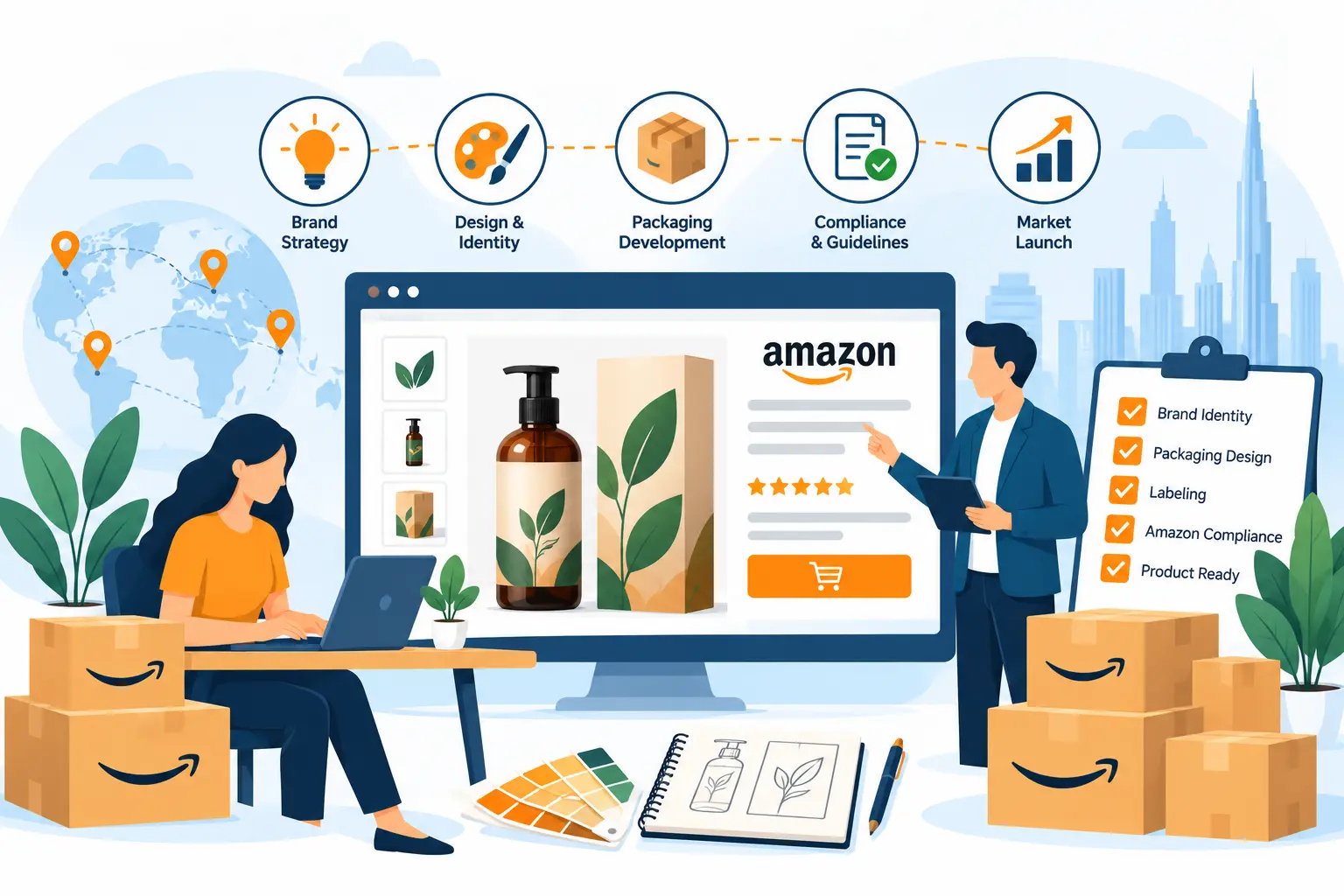
A strong brand identity and professional packaging can make a major difference when launching a private label product. Customers often see the brand name, logo, colors, product packaging, and product images before they know anything about the company behind the product. A consistent visual identity helps communicate what the brand represents and can make a product easier to recognize across Amazon, eCommerce websites, social media, and physical retail channels.
For Amazon sellers, brand identity and packaging are especially important because customers often compare multiple similar products on the same search results page. A clear brand identity can help a product establish a recognizable presence while professional packaging can strengthen the overall customer experience.
Designing a successful brand is not simply about choosing an attractive logo or adding more colors to a package. It requires a strategic approach to brand positioning, visual identity, packaging structure, typography, color selection, product presentation, and customer expectations.
This guide explains how to design brand identity and packaging that stands out, particularly for Amazon private label products and eCommerce brands.
What Is Brand Identity and Packaging?
Brand identity is the visual and strategic representation of a business. It includes elements such as the brand name, logo, colors, typography, imagery, tone, and overall visual style.
Packaging is the physical presentation and protection of a product. It can include product boxes, bottles, pouches, labels, inserts, sleeves, cartons, and other packaging components.
Brand identity and packaging work together because packaging is often one of the most visible physical expressions of a brand.
For example, a skincare brand may use a minimalist visual identity with neutral colors, clean typography, and premium packaging. A children’s product brand may use brighter colors, playful typography, and more energetic visual elements.
The design should reflect the intended audience, product category, positioning, and customer expectations.
Why Brand Identity Matters for Private Label Products
Private label sellers are not only selling individual products. They are building a brand that customers can potentially recognize across multiple products.
A consistent identity can help create recognition when customers encounter the brand on Amazon, Google, social media, packaging, advertising, or other channels.
Brand identity can also help communicate positioning. A product designed for premium customers may require a different visual approach from a product positioned around affordability, simplicity, sustainability, or convenience.
For Amazon sellers, this becomes particularly important when expanding a product catalog. A consistent brand identity can connect different products and create a recognizable visual system.
Your branding should therefore be considered before creating individual product packaging rather than added as an afterthought.
Start With Your Target Customer
Effective brand identity begins with understanding the customer.
Before designing a logo or packaging, identify who the product is intended for and what matters to that audience.
Consider the customer’s age range, lifestyle, purchasing motivations, expectations, price sensitivity, and preferences within the product category.
Research competing products to understand how brands communicate visually with the same audience.
Look at their colors, packaging styles, typography, product photography, messaging, and overall positioning.
The objective is not to copy competitors. Instead, identify patterns within the category and find opportunities to create a distinctive but relevant visual identity.
A successful brand should feel appropriate for its market while still having recognizable characteristics of its own.
Define Your Brand Positioning
Before creating visual elements, define what your brand should communicate.
Your positioning can be based on factors such as quality, convenience, performance, innovation, simplicity, affordability, sustainability, or a particular customer need.
Think about the perception you want customers to have when they encounter your product.
A premium positioning may use refined typography, restrained colors, high-quality imagery, and sophisticated packaging materials.
A performance-focused product may use stronger visual contrast, bold typography, and imagery that communicates functionality.
The design decisions should support the positioning rather than exist independently from it.
Create a Strong Brand Name and Logo
Your brand name and logo are important components of your visual identity.
A good brand name should be distinctive, relevant to the business, and practical for use across packaging, product listings, advertising, and digital channels.
The logo should remain recognizable at different sizes. It may appear on a product package, Amazon listing image, website header, social media profile, shipping materials, and promotional content.
Avoid making the logo unnecessarily complicated.
A simple logo can often be easier to reproduce across different packaging materials and digital formats.
For private label businesses, consider how the logo will look both on the product itself and in Amazon product images.
Before finalizing a brand name, sellers should also investigate relevant trademark and marketplace requirements rather than assuming that a name is available.
Choose a Consistent Brand Color Palette
Color is one of the strongest visual components of brand identity.
Choose a primary brand color along with supporting colors that can be used consistently across packaging, website design, product images, advertising, and other marketing materials.
Do not select colors simply because they look attractive individually. Consider how they communicate the positioning of the brand and how they compare with competing products.
A premium brand may use restrained colors and subtle contrasts, while a youthful or energetic brand may use brighter combinations.
The color palette should also work across different materials and printing processes.
Create clear brand guidelines that specify primary colors, secondary colors, backgrounds, and appropriate usage.
Consistency is more important than using a large number of colors.
Select Typography That Matches Your Brand
Typography is another important part of visual identity.
Choose fonts that are readable and appropriate for the product category.
The primary typeface can be used for major brand elements, while supporting fonts can be used for product information and secondary content.
Avoid using too many different fonts across your packaging and marketing materials.
Typography should remain readable when printed on smaller packaging areas.
For Amazon product images, the same typography system can also help create consistency between the packaging and supporting visual content.
A consistent type system makes the brand feel more organized and recognizable.
Design Packaging Around the Product
Packaging should protect the product while communicating the brand.
Start by understanding the physical characteristics of the product, including its size, weight, fragility, shape, and storage requirements.
Then determine the most appropriate packaging format.
Depending on the product, this could include a box, bottle, pouch, tube, jar, sleeve, mailer, or another packaging structure.
The packaging should fit the product appropriately without unnecessary empty space or excessive material.
For Amazon products, packaging also needs to withstand transportation, handling, storage, and delivery.
A visually attractive package that does not adequately protect the product can create customer experience problems.
Make the Packaging Easy to Understand
Good packaging communicates important information quickly.
Customers should be able to understand what the product is, what the brand is, and the key characteristics of the product without struggling to interpret the design.
Prioritize the most important information.
The brand name, product name, product type, important features, quantity, and relevant product information should have an appropriate visual hierarchy.
Avoid filling every available space with text or graphics.
A clean package can often communicate more effectively than a crowded design.
Information should also remain legible at the actual packaging size rather than only looking good on a large computer screen.
Use Visual Hierarchy in Packaging Design
Visual hierarchy determines the order in which customers notice information.
The most important elements should receive the strongest visual emphasis.
For many products, the brand name and product identity should be easy to recognize first. Supporting information can then provide additional context.
Size, contrast, spacing, typography, positioning, and color can all influence visual hierarchy.
Avoid giving equal visual importance to every element.
When everything is emphasized, nothing stands out.
A structured hierarchy makes packaging easier to scan and can improve the overall perception of professionalism.
Differentiate Your Packaging From Competitors
Research competing products before finalizing your packaging.
Study the colors, layouts, package shapes, imagery, typography, and visual patterns commonly used in your category.
This research can reveal whether the market is dominated by a particular visual style.
For example, if most competitors use white packaging with small product images and similar typography, a carefully designed alternative visual approach may create stronger differentiation while still appearing relevant to the category.
Differentiation does not mean making packaging unusual simply for attention.
The goal is to create a recognizable design that communicates the product clearly and fits customer expectations.
Design Packaging for Amazon Product Photography
Amazon customers often encounter the product through images before they ever receive the physical package.
Packaging should therefore photograph well.
Consider how the product and packaging will appear in the main product image, secondary images, lifestyle photography, and marketing content.
Strong contrast, readable branding, recognizable colors, and clean design can make packaging easier to identify in product photography.
Your packaging and Amazon listing should also communicate a consistent brand identity.
For sellers working on their product listing, professional Amazon listing creation can help connect packaging, product messaging, images, and listing content into a consistent customer experience.
Connect Packaging With Your Amazon Listing
Your packaging should not feel disconnected from the Amazon product page.
Customers should recognize the same brand colors, visual style, product positioning, and messaging across the packaging and listing.
Product images should accurately represent the physical product and packaging.
Your listing content should also reinforce the same value proposition communicated by the package.
For example, if packaging emphasizes premium quality and professional presentation, the Amazon listing should maintain a similar visual and written style.
This consistency can strengthen brand recognition across the customer’s buying journey.
Consider Packaging Unboxing Experience
The customer experience continues after the purchase.
When customers open the package, the presentation of the product can influence their perception of the brand.
Consider how the product is positioned inside the package, how easily it can be removed, and whether the packaging feels organized and intentional.
Brand inserts, instructions, thank-you cards, and other appropriate materials can also contribute to the experience, provided they comply with applicable marketplace policies.
The goal is not to add unnecessary materials.
Every element should have a clear purpose, whether it protects the product, provides useful information, supports the customer experience, or reinforces the brand.
Balance Packaging Cost and Brand Quality
A strong packaging design does not necessarily require expensive materials.
Packaging decisions should be connected to the product’s price point, margins, customer expectations, shipping costs, and positioning.
Premium materials may be appropriate for a premium product, but excessive packaging can increase costs and shipping weight without creating proportional value.
Evaluate the complete packaging cost rather than looking only at the printing price.
Consider packaging production, customization, storage, shipping dimensions, transportation, and potential damage.
The best packaging solution balances appearance, protection, usability, and cost.
Create Brand Guidelines
Once the visual identity is established, document it in brand guidelines.
Brand guidelines can define the approved logo versions, color codes, typography, imagery style, packaging rules, spacing, icons, and other visual elements.
This becomes increasingly useful when a business has multiple products or works with different designers, manufacturers, photographers, and marketing teams.
Without guidelines, different suppliers or designers may interpret the brand differently.
Over time, this can create inconsistent packaging and marketing materials.
A clear brand guideline helps maintain consistency as the business expands.
Test Your Brand Identity and Packaging
Do not assume that a design will perform well simply because the internal team likes it.
Test the design against the target market and competitive environment.
Review whether customers can quickly identify the product category, brand, key benefit, and positioning.
Compare the design with competing products and evaluate whether your packaging is recognizable without becoming confusing.
For Amazon sellers, packaging can also be reviewed alongside the product listing and product images.
The goal is to create a consistent customer experience from search results to product page to delivery.
Common Brand Identity and Packaging Mistakes
One common mistake is designing packaging without first understanding the target customer. A visually attractive package can still fail to communicate with the intended audience.
Another mistake is copying competitor packaging too closely. This can make the brand difficult to distinguish and may create unnecessary brand confusion.
Using too many colors, fonts, graphics, or messages can also make packaging appear cluttered.
Some brands focus heavily on aesthetics while overlooking product protection and shipping requirements.
Another mistake is failing to maintain consistency between packaging, Amazon listings, websites, advertisements, and social media.
Finally, businesses sometimes change their visual identity too frequently. Brand recognition generally requires consistent use of core visual elements over time.
How Brand Identity and Packaging Support Amazon Private Label Growth
Brand identity and packaging become increasingly important as a private label business grows.
A strong identity can be applied across multiple products while maintaining a consistent relationship between the products.
This can make it easier for customers to recognize additional products from the same brand.
For sellers developing a private label portfolio, branding should therefore be considered during product research and sourcing rather than after manufacturing has already started.
The brand identity can influence product selection, packaging design, photography, listing content, advertising, and customer experience.
For sellers who need help with product development, sourcing, and supplier coordination, product sourcing and supplier management can help connect product requirements with manufacturing and sourcing activities.
Brand Identity and Packaging SEO and AEO Considerations
Although brand identity and packaging are primarily visual and physical assets, they can also support broader digital marketing.
Use a consistent brand name across your website, Amazon presence, social profiles, and other relevant digital properties.
Your website can explain your brand story, product categories, packaging approach, and unique value proposition.
For search engine optimization, create useful content around your products, brand category, customer problems, and product use cases rather than relying only on branded pages.
For answer engine optimization and generative search visibility, clearly communicate what your brand offers, who the products are for, and what differentiates the products.
Structured and consistent brand information can make it easier for search systems and AI-powered discovery tools to understand the relationship between your brand, products, services, and website.
Frequently Asked Questions
What is brand identity and packaging?
Brand identity is the overall visual and strategic representation of a brand, including its name, logo, colors, typography, imagery, and style. Packaging is the physical presentation and protection of a product. Together, they create an important part of the customer’s experience with the brand.
How do I design a strong brand identity?
Start by understanding your target audience and defining your brand positioning. Then develop a consistent brand name, logo, color palette, typography, imagery style, and visual guidelines that communicate the desired positioning.
What makes product packaging stand out?
Distinctive but relevant visual identity, clear information hierarchy, appropriate colors, readable typography, strong product presentation, and consistency with customer expectations can help packaging stand out in a competitive category.
How important is packaging for Amazon private label products?
Packaging can influence product protection, customer experience, brand recognition, product photography, and perceived quality. For private label sellers, packaging is also an opportunity to create consistency across the product catalog.
Should packaging match my Amazon listing?
Yes. Maintaining consistent brand colors, visual style, product positioning, and messaging across packaging and the Amazon listing can create a more cohesive customer experience.
How much should I spend on packaging design?
The appropriate packaging investment depends on the product category, selling price, margins, customer expectations, production requirements, and brand positioning. The objective should be to balance visual quality, product protection, functionality, and overall sourcing costs.
What colors should I use for my brand packaging?
Choose colors based on your target audience, category, brand positioning, and competitive environment. The most important factor is creating a consistent and recognizable color system rather than selecting colors based only on personal preference.
Can packaging help build a private label brand?
Yes. Consistent packaging can reinforce brand recognition across products and customer touchpoints. When combined with consistent Amazon listings, product photography, website content, and marketing, packaging can become an important part of a private label brand identity.
Final Thoughts
Learning how to design brand identity and packaging that stands out requires a combination of strategy, design, customer research, and practical product considerations.
Start with your target customer and brand positioning. Develop a clear visual identity with a recognizable logo, consistent colors, appropriate typography, and a defined design system.
Then translate that identity into packaging that protects the product, communicates essential information, photographs well, and creates a consistent customer experience.
For Amazon private label sellers, the strongest approach is to treat branding and packaging as part of the complete product strategy. Connect the packaging with product sourcing, photography, Amazon listing optimization, advertising, and the overall customer journey.
A recognizable and consistent brand identity can provide a stronger foundation for expanding your product catalog and building long-term brand recognition.