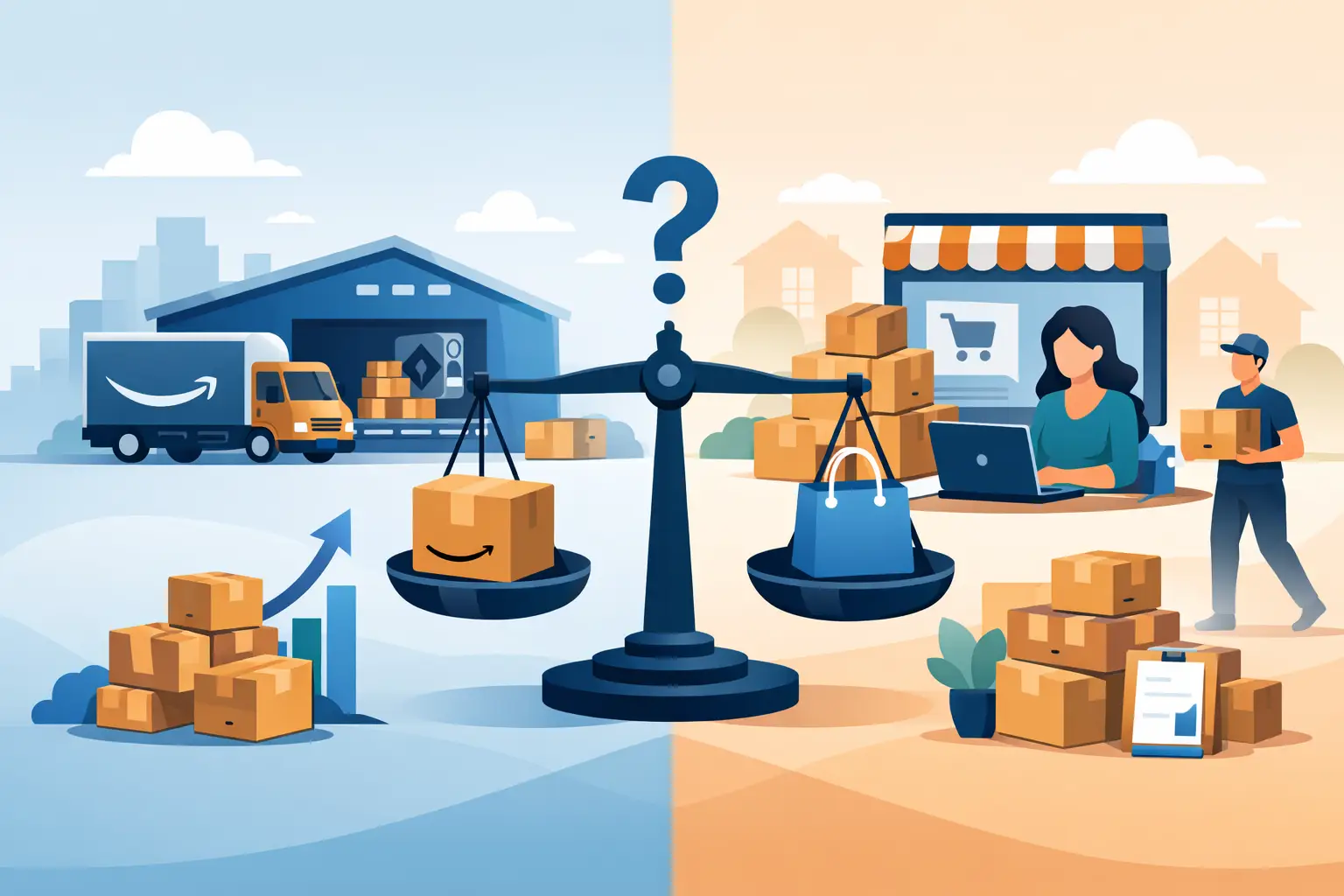
The first purchase order is rarely just an inventory decision. It determines how much control you have over pricing, how exposed you are to competitors, and whether the Amazon business you build can become an asset. That is why the Amazon wholesale versus private label decision deserves more than a quick margin calculation.
Both models can produce revenue. Both can fail when sourcing, cash flow, account health, and advertising are handled without a plan. The better choice depends on your available capital, operating experience, appetite for product risk, and long-term goal: resell proven demand or build a brand that you own.
Amazon Wholesale Versus Private Label: The Core Difference
Amazon wholesale means purchasing established branded products from authorized distributors, manufacturers, or brand owners and reselling them on existing Amazon listings. Demand may already exist, customer reviews may already be present, and the listing may already rank for valuable searches. Your job is to earn and defend the Buy Box while managing replenishment, price discipline, and proof of supply.
Private label means creating or materially differentiating a product under your own brand. You control the supplier relationship, packaging, product positioning, listing, pricing strategy, and brand experience. You also carry the responsibility for validating demand, getting the product right, generating reviews within Amazon policy, and creating visibility through organic ranking and paid media.
The distinction matters because wholesale is primarily a distribution and inventory-management business. Private label is a product-development and brand-building business. Each requires a different operating system.
Where Wholesale Can Create Faster Momentum
Wholesale is often attractive to sellers who want to enter Amazon with products that already have a sales history. Instead of guessing whether customers want a new garlic press, pet accessory, or supplement, you can analyze an existing ASIN’s demand, offer count, pricing history, fulfillment method, and likely Buy Box opportunity before buying inventory.
That can reduce product-market risk. A seller with strong distributor access and disciplined analysis may find repeatable replenishable products without paying for custom packaging, photography, a trademark, or a full product launch. In practical terms, wholesale can move from supplier approval to FBA inventory faster than a private-label project that requires sampling, manufacturing, compliance documentation, freight coordination, and listing creation.
The speed comes with constraints. You do not own the listing, and you usually do not control its images, title, A+ Content, or conversion rate. If another seller lowers the price, your margin can disappear quickly. If Amazon itself enters the offer, or a major retailer joins the listing, the Buy Box can become difficult to win even when your inventory is legitimate and competitively priced.
Wholesale sellers also need to treat authorization as a core commercial requirement, not an administrative detail. Reliable invoices, traceable supply chains, brand approvals, category permissions, and accurate product condition are essential. A product may look profitable in a spreadsheet but create serious account-health risk if the source cannot support an authenticity claim.
Wholesale works best when access is your advantage
Wholesale is strongest when you have a real sourcing edge. That might mean a direct relationship with a brand, access to a distributor that competitors cannot use, favorable payment terms, or an ability to replenish faster than other sellers. Simply finding a popular ASIN with a positive estimated ROI is not a durable strategy if dozens of sellers can buy the same item tomorrow.
Cash flow also deserves close attention. Wholesale often requires significant capital because suppliers may require case-pack quantities, minimum order values, or prepaid terms. The product may sell consistently, yet still pressure the business if inventory turns slowly or funds are spread across too many small opportunities. Strong wholesale operators forecast sell-through, reorder points, storage exposure, and net margin after referral fees, FBA fees, inbound freight, returns, and price changes.
Where Private Label Builds a More Defensible Asset
Private label gives a seller what wholesale generally cannot: control. You can improve the product, choose a better material, solve a common customer complaint, create premium packaging, bundle complementary items, and position the offer for a specific buyer. That creates room to build a differentiated reason to purchase beyond price.
It also gives you control over the retail assets that influence conversion. Your listing can be designed around search intent, customer objections, visual proof, comparison content, and brand positioning. With a trademark and Brand Registry eligibility, you can strengthen the product page with A+ Content, a Storefront, brand-focused advertising, and stronger protection over catalog contributions.
This control can support healthier long-term unit economics, but it is not automatic. A branded product can command a better price only when the product, positioning, and customer experience justify it. Private label sellers still face copycats, rising ad costs, review challenges, quality defects, and shifts in consumer demand. The difference is that they can respond by improving the offer rather than merely matching a competitor’s price.
Private label requires launch capital and patience
The most common private-label mistake is treating sourcing as the finish line. A product is not ready because a supplier can make it. It needs a validated market position, a landed-cost model, quality-control standards, compliant labeling, a packaging plan, and a launch budget that accounts for PPC, promotional activity, and inventory runway.
A lower unit cost does not necessarily create a better business. A low-cost item may attract aggressive competitors, generate insufficient contribution margin after advertising, or fail to cover the cost of returns. Conversely, a more expensive product with clear differentiation may produce a stronger contribution margin and a more stable advertising profile.
Private label also benefits from a more sophisticated content strategy as Amazon search evolves. Keyword placement still matters, but listings increasingly need to answer the questions shoppers ask in conversational search experiences, including Rufus. Clear product attributes, accurate specifications, use-case language, comparison points, and customer-centered images help Amazon understand the offer and help shoppers make a confident choice.
Compare the Economics Before Choosing a Model
The right comparison is not wholesale margin versus private-label margin on a single unit. Compare the full operating economics over time.
Wholesale may produce sales with a lower upfront marketing burden, but its margin can be exposed to Buy Box volatility. Private label may require a larger launch investment, but it can create more control over price, conversion, and repeat purchase behavior. In either model, gross margin is only the starting point. The number that matters is contribution margin after Amazon fees, freight, duties, prep, storage, returns, advertising, discounts, and the cost of capital tied up in inventory.
Control is the second major variable. In wholesale, a high-performing listing can change overnight because another seller alters price or availability. In private label, you control the product page and pricing, but you must earn demand. Sellers who prefer proven demand and faster product selection may accept less control. Founders who want enterprise value, brand recognition, and the ability to expand into related SKUs may accept the longer path of product development.
The third variable is operational complexity. Wholesale requires persistent sourcing, supplier relationship management, replenishment discipline, invoice organization, and Buy Box monitoring. Private label requires supplier development, sampling, inspection, freight planning, listing production, ad management, and ongoing product improvement. Neither is passive. The work simply moves to different parts of the Amazon operating stack.
When a Hybrid Strategy Makes Sense
For some operators, the best answer is not an either-or decision. Wholesale can create practical experience in FBA operations, inventory planning, seller performance, and profitability analysis while a private-label product is being developed. The revenue can help fund a more deliberate brand launch, provided each business line has clear inventory and cash-flow controls.
The hybrid approach only works when it is managed with discipline. Wholesale products should not distract the team from product development, and private-label inventory should not consume capital needed for proven replenishable opportunities. Separate forecasts, supplier records, SKU-level profitability reporting, and reorder rules prevent one model from masking the weaknesses of the other.
Make the Decision Based on Your Real Advantage
Choose wholesale when your strongest advantage is legitimate product access, fast analysis, and operational execution. Choose private label when your strongest advantage is product insight, brand development, and the willingness to invest in a controlled launch. If neither advantage is clear, do not force a purchase order simply because a product appears popular.
Before committing capital, build a SKU-level model that tests the downside: a lower selling price, higher PPC cost, slower sell-through, additional storage fees, and a realistic return rate. Then confirm that the supply chain, compliance documentation, listing strategy, and replenishment plan can withstand that downside. iNNOVEX approaches this decision as a complete marketplace operation, because profitable Amazon growth is built through coordinated execution, not a single sourcing choice.
The useful next step is simple: identify the advantage you can protect for the next 12 months. If it is access, make wholesale systems sharper. If it is differentiation, build a private-label offer customers can recognize, understand, and choose without being persuaded by a discount.