
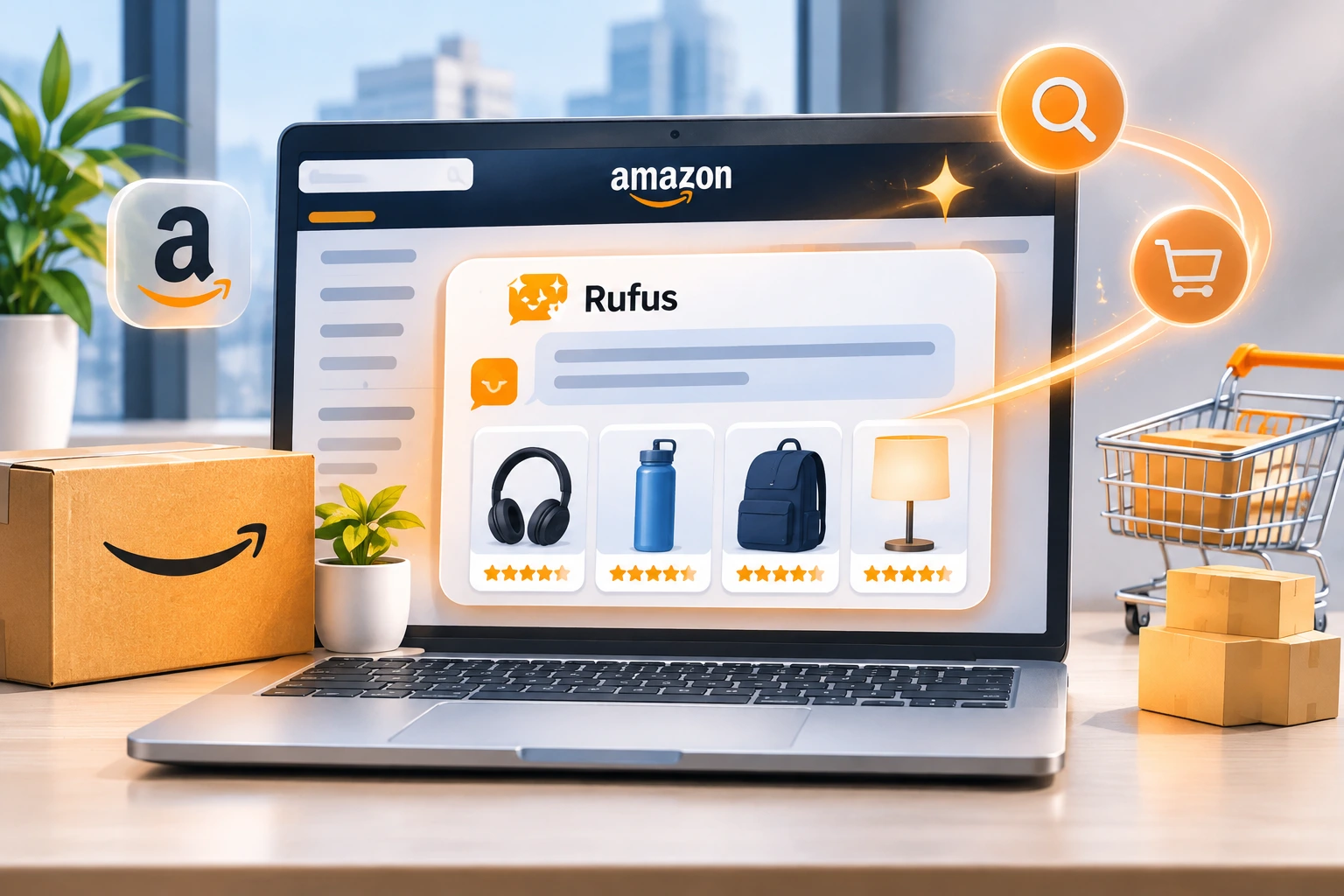
Artificial intelligence is changing how customers search for products, compare alternatives, and make purchasing decisions on Amazon. Instead of entering short keywords and browsing dozens of listings, shoppers can increasingly ask detailed questions and receive personalized recommendations.
One important development is Amazon Rufus, the company’s generative AI-powered shopping assistant.
In May 2026, Amazon renamed Rufus to Alexa for Shopping, combining conversational product discovery with more advanced personalized and agentic shopping features.
Although many sellers still search for information about Amazon Rufus, the updated assistant now offers broader capabilities across product research, recommendations, comparisons, price tracking, and shopping assistance.
This raises an important question: How does Amazon Rufus help shoppers discover products in 2026, and what does this mean for Amazon sellers?
For businesses operating on Amazon USA, UAE, UK, Saudi Arabia, and other marketplaces, understanding AI-powered product discovery is becoming an important part of marketplace strategy.
This guide explains how Amazon Rufus works, what changed with Alexa for Shopping, and how sellers can improve product listings for shoppers using AI-assisted search.
What Is Amazon Rufus in 2026?
Amazon Rufus was Amazon’s generative AI shopping assistant, designed to help customers discover products, ask shopping questions, compare options, and receive recommendations. On May 13, 2026, Amazon renamed and expanded the experience as Alexa for Shopping.
The original Rufus experience launched in 2024 and introduced conversational product research into Amazon’s shopping environment.
Customers could ask natural-language questions rather than relying exclusively on traditional keyword searches.
For example, instead of searching only for “water bottle,” a customer could ask which type of bottle is suitable for keeping drinks cold during outdoor activities.
The assistant could use product-related information to provide explanations and suggest relevant options.
By 2026, Amazon expanded these capabilities to include more personalized recommendations, shopping history, price alerts, product comparisons, and automated purchasing actions.
The service is designed to make shopping more convenient and help customers evaluate products before purchasing.
How Does Amazon Rufus Help Shoppers Discover Products?
Amazon Rufus helps shoppers discover products by interpreting natural-language questions, understanding shopping needs, analyzing relevant product information, and recommending options that may meet the customer’s requirements.
Its successor, Alexa for Shopping, extends these capabilities with greater personalization and additional shopping actions.
For example, a customer looking for children’s educational toys might ask:
“What educational toys are suitable for a four-year-old learning shapes and colors?”
Instead of relying only on the phrase “educational toys,” the assistant can consider the age group, intended learning activity, product attributes, and related shopping information.
It may provide product suggestions or explain important features customers should consider.
Amazon’s published information describes the assistant as using product catalog details, customer reviews, Q&A content, information from across the web, and personalization signals.
The specific information used and recommendations shown may vary by shopper, question, location, and product availability.
This makes accurate and complete product information increasingly relevant to the shopping experience.
How Does Amazon Rufus Understand Customer Shopping Questions?
Amazon’s AI shopping technology uses large language models and other systems to interpret customer questions and generate useful responses.
Traditional Amazon searches often begin with product-specific keywords.
Conversational shopping allows customers to describe a problem, situation, preference, or intended use.
For example:
- “Which lunch box is suitable for office meals?”
- “What are good educational gifts for children aged five?”
- “Which shower hooks work on smooth bathroom tiles?”
- “Compare these two digital microscopes for beginners.”
- “What should I consider when buying thermal underwear?”
The assistant can analyze relevant information and help shoppers narrow down their options.
This changes the way product discovery can begin.
Instead of knowing the exact product name, shoppers can describe their needs and explore suitable categories or products.
However, an AI-generated recommendation does not guarantee that the product is the best choice or that every statement in the response is correct.
Customers should still review the underlying product details.
What Information Does Amazon Rufus Use to Recommend Products?
Amazon explains that its shopping assistant can draw on multiple information sources.
These include:
- Product Titles: Information identifying products and their main characteristics.
- Product Descriptions: Details explaining features, specifications, and intended uses.
- Product Attributes: Structured information such as dimensions, materials, colors, and compatibility.
- Customer Reviews: Shopper feedback about actual product experiences.
- Customer Questions and Answers: Information addressing specific purchasing concerns.
- Shopping Context: Relevant customer preferences and previous interactions where supported.
- External Information: Additional information from across the web when used by the shopping assistant.
These inputs help the system respond to questions and compare relevant products.
However, Amazon does not publicly disclose a complete formula determining which product will appear in every AI recommendation.
Sellers should avoid assuming that repeating particular keywords guarantees placement.
Accurate, helpful product information is a more sustainable approach.
Amazon Rufus vs Traditional Amazon Search: What’s the Difference?
Traditional keyword search and conversational AI shopping serve related but different purposes.
| Feature | Traditional Search | Rufus / Alexa for Shopping |
|---|---|---|
| Customer Input | Keywords and filters | Conversational questions and preferences |
| Product Discovery | Search results and listings | AI-assisted suggestions and explanations |
| Product Comparison | Shopper compares listings | AI-generated comparisons where available |
| Personalization | Personalized results and recommendations | Conversational context and shopping preferences |
| Shopping Actions | Manual selection and checkout | Supported cart, price alert, and shopping actions |
Traditional Amazon search remains important.
Conversational AI provides an additional way for customers to find information and make purchasing decisions.
Sellers should therefore continue optimizing listings for relevant keywords while improving product clarity and usefulness.
What New Shopping Features Did Amazon Introduce in 2026?
Amazon’s May 2026 rebranding and subsequent updates expanded the assistant beyond its original Rufus capabilities.
1. Personalized Product Recommendations
Alexa for Shopping can use relevant preferences and shopping history to personalize responses.
For example, a shopper comparing running shoes may receive recommendations informed by previous shopping interests and the details of the current request.
Personalization means that two customers asking similar questions may not necessarily receive identical recommendations.
2. AI-Powered Product Comparisons
Shoppers can ask the assistant to compare products using relevant features.
For example, a customer may compare two digital microscopes based on screen size, magnification, battery specifications, and intended use.
This can make accurate product attributes especially useful.
If a listing omits important information, customers may have difficulty evaluating its suitability.
3. Price Tracking and Shopping Alerts
Amazon’s updated shopping assistant can help eligible customers explore price history and set price alerts.
This may influence when shoppers decide to purchase.
For sellers, transparent pricing and competitive offers remain important, although price alone does not determine whether an item is recommended.
4. Shopping Based on Activities and Needs
Customers can describe an activity rather than search for one specific product.
For example, someone planning a family camping trip can request product suggestions for that activity.
The assistant may identify relevant categories and products based on the stated requirements.
5. Visual Product Discovery
Amazon’s Lens Live experience combines visual search with AI-assisted shopping questions.
Customers can use supported image-based features to explore products similar to items they see.
This makes clear and accurate product imagery useful for customer understanding, although Amazon does not publish a guaranteed image-based AI recommendation formula.
6. Automated Shopping Assistance
Supported agentic features can help shoppers organize purchases, build carts, track deals, and complete certain shopping tasks.
Availability depends on the region, user account, and specific feature.
These capabilities may change the shopping journey by allowing some customers to move more directly from questions to product selection.
How Does Amazon Rufus Affect Amazon Product SEO?
Amazon Rufus introduced an additional context in which product information can be used to answer customer questions.
Traditional Amazon SEO remains important because shoppers still search using product keywords and browse relevant results.
However, AI-assisted shopping places additional practical value on clear descriptions, accurate product attributes, and answers to common questions.
Amazon’s seller education explicitly recommends addressing frequently asked customer questions in product descriptions to support its AI shopping assistant.
For example, a listing for a reusable water bottle should accurately describe its capacity, material, cleaning requirements, and compatible uses.
A shopper asking whether the bottle is dishwasher safe needs reliable information.
If that specification is missing, the seller loses an opportunity to answer a relevant purchasing question clearly.
Amazon Rufus SEO should focus on helping shoppers understand the product, not attempting to manipulate an undisclosed AI ranking system.
How Can Amazon Sellers Optimize Listings for Rufus and Alexa for Shopping?
Sellers can improve their listings by making product information more complete, accurate, and useful.
1. Write Clear, Descriptive Product Titles
Product titles should identify the item and include relevant distinguishing information within Amazon’s current title requirements.
Avoid excessive keyword repetition and unsupported claims.
A clear title can help customers understand the product immediately.
2. Explain Features and Practical Benefits
Bullet points should describe product specifications and explain why those details matter to shoppers.
For example, instead of stating only “stainless steel,” a seller can accurately describe the product’s material and intended use.
Claims about strength, safety, or performance should be supported by evidence.
3. Complete Relevant Product Attributes
Structured product details can include dimensions, materials, color variations, capacity, compatibility, and other specifications.
These fields help customers compare products and may provide useful context for Amazon’s shopping systems.
Sellers should complete applicable attributes rather than leave important information missing.
4. Address Common Customer Questions
Identify frequent questions about the product before drafting descriptions.
For example:
- What size is the product?
- Which materials are used?
- What surfaces or devices is it compatible with?
- How should it be cleaned or maintained?
- What is included in the package?
- Who is the product suitable for?
Answer these questions accurately in appropriate listing sections without unnecessary repetition.
Do not create misleading or fabricated customer Q&A content.
5. Use Accurate Product Photography
Images should clearly represent the actual item, its dimensions, packaging contents, and relevant features.
For Amazon’s main image, follow the marketplace’s current image requirements.
Additional images may help communicate size, uses, and product details.
Avoid misleading graphics, incorrect product representations, or unsupported claims.
6. Keep Product Information Consistent
Product descriptions, variations, specifications, images, and packaging should not contradict each other.
For example, if a product has a 600 mAh battery, all relevant content should use the correct specification.
Inconsistent information may confuse customers and weaken their confidence.
7. Review Customer Feedback
Analyze genuine customer reviews and return reasons to identify recurring questions or misunderstandings.
Update product information where it is incomplete or inaccurate.
Never fabricate reviews or manipulate customer feedback.
Does Amazon Rufus Change Keyword Research for Sellers?
Keyword research remains relevant, but sellers should also consider conversational search intent.
Traditional keyword research might identify a phrase such as “insulated lunch bag.”
Conversational shopping may involve questions such as “Which lunch bag can keep food cool during a workday?”
These questions reveal customer needs, features, and use cases.
Sellers can use them to identify information that customers expect to find.
However, this does not mean entire conversational questions should be inserted repeatedly into product titles or backend search terms.
A better approach is to organize product information around accurate features and common purchasing questions.
Relevant keywords should still be researched and used naturally within Amazon’s listing rules.
Can Amazon Rufus Help New Products Get Discovered?
AI-assisted shopping may provide additional ways for customers to encounter relevant products.
However, Amazon does not guarantee that newly launched items will receive recommendations through Rufus or Alexa for Shopping.
A new listing may still face challenges related to limited reviews, uncompetitive pricing, product availability, and uncertain conversion rates.
Sellers should focus on building complete product listings and validating customer demand.
Accurate information can help shoppers evaluate products, but it does not replace the need for competitive offers and reliable operations.
Amazon AI shopping assistants should be treated as an additional discovery opportunity, not a guaranteed shortcut to organic rankings or sales.
Does Amazon Rufus Use Customer Reviews to Recommend Products?
Yes. Amazon has publicly explained that its AI shopping assistant can use customer reviews and other product information when answering questions and recommending products.
For example, customer feedback may contain useful information about perceived product comfort, durability, or ease of use.
However, reviews can include different opinions and experiences.
AI-generated summaries may not capture every important detail.
Sellers should focus on product quality, accurate descriptions, and legitimate customer service rather than attempting to influence AI summaries through review manipulation.
Amazon’s customer review policies continue to apply regardless of how review information is used in AI features.
Is Amazon Rufus Available in UAE, USA, UK, and Saudi Arabia?
Amazon’s AI shopping capabilities have been introduced across different regions and products over time.
The May 2026 Alexa for Shopping announcement confirms the updated experience for US Amazon customers.
Amazon has also publicly documented Rufus-related shopping experiences in other markets, including India.
However, availability, branding, languages, and supported features should not be assumed to be identical across Amazon USA, UAE, UK, Saudi Arabia, or other marketplaces.
Sellers targeting multiple countries should verify the customer experience available in each market.
For Amazon UAE and Saudi Arabia, accurate English and Arabic product information remains valuable for customer understanding regardless of which AI shopping features are enabled.
Marketplace-specific functionality should be confirmed rather than inferred from US product announcements.
Will Amazon Rufus Replace Traditional Amazon Search and PPC Advertising?
Amazon’s conversational AI capabilities create additional shopping experiences, but they do not mean that traditional search or PPC advertising has disappeared.
Customers continue to use search keywords, product filters, categories, recommendations, and sponsored advertisements.
Amazon PPC remains a distinct advertising system with its own targeting, bidding, budgeting, and reporting controls.
Rufus and Alexa for Shopping primarily assist with product research and shopping decisions.
Sellers should not confuse the shopping assistant with Amazon Ads Agent, which is an AI-powered tool for advertisers.
A balanced strategy should include high-quality listings, relevant keywords, appropriate advertising, competitive pricing, and reliable inventory.
These activities support customers regardless of whether they discover products through traditional search or conversational shopping.
What Are the Biggest Mistakes Sellers Make When Optimizing for Amazon Rufus?
Common mistakes include:
- Assuming there is a publicly confirmed Rufus ranking formula.
- Repeating keywords excessively in product titles and descriptions.
- Adding unsupported features or exaggerated performance claims.
- Leaving important product specifications incomplete.
- Using misleading or inaccurate product images.
- Ignoring customer questions about compatibility, sizing, and usage.
- Assuming AI recommendations guarantee sales.
- Trying to manipulate reviews or customer feedback.
- Ignoring marketplace-specific product listing requirements.
- Confusing Amazon Ads Agent with the customer shopping assistant.
- Failing to update content when product specifications change.
A customer-first listing strategy is generally more sustainable than speculative AI optimization tactics.
How Can iNNOVEX Enterprises Help Sellers Prepare for AI-Powered Amazon Shopping?
As Amazon continues developing conversational and personalized shopping technology, businesses need product content that accurately communicates what they sell.
At iNNOVEX Enterprises, an Amazon SPN agency, we support sellers with Amazon listing creation, content optimization, advertising, and account management.
Our relevant services include:
- Amazon Listing Creation: Preparing accurate and customer-focused product titles, bullet points, descriptions, and attributes.
- Amazon SEO and Content Optimization: Improving product relevance, clarity, and information completeness.
- Amazon Product Photography: Creating product imagery that communicates accurate features and visual details.
- Amazon A+ Content: Developing enhanced product content for eligible brand owners.
- Amazon Keyword Research: Identifying relevant shopping terms and customer search intent.
- Amazon PPC Management: Managing eligible Sponsored Products and related advertising campaigns.
- Amazon Brand Registry Support: Assisting eligible brands with relevant registration and brand management workflows.
- Amazon Account Management: Coordinating catalog quality, listing updates, inventory, and advertising operations.
We support sellers operating in Amazon UAE, USA, UK, Saudi Arabia, and other international marketplaces.
Our approach focuses on accurate product information, relevant search intent, and customer experience rather than promises of guaranteed AI recommendations.
Want to improve your Amazon product listings for AI-assisted shopping and traditional search? Contact iNNOVEX Enterprises to discuss Amazon listing optimization and account management services.
Frequently Asked Questions About Amazon Rufus in 2026
1. What is Amazon Rufus?
Amazon Rufus was Amazon’s generative AI shopping assistant for product discovery, comparison, and shopping questions. It was renamed Alexa for Shopping in May 2026.
2. Is Amazon Rufus still available in 2026?
Amazon integrated and renamed the experience as Alexa for Shopping on May 13, 2026. Current features and availability depend on the marketplace.
3. How does Amazon Rufus recommend products?
It uses AI to interpret shopping questions and relevant information such as product details, reviews, customer questions, and personalization signals where supported.
4. Can Amazon Rufus improve product discovery?
Yes. AI-assisted shopping can help customers explore products through conversational questions, comparisons, and personalized recommendations.
5. How can sellers optimize listings for Amazon Rufus?
Use accurate product titles, clear descriptions, complete attributes, helpful images, and information that addresses genuine customer questions.
6. Does Amazon Rufus use customer reviews?
Amazon confirms that its shopping assistant can use customer reviews and Q&A information to help answer shopping questions and provide recommendations.
7. Can sellers pay to rank higher in Amazon Rufus?
Amazon has not published a general paid placement formula for Rufus recommendations. Sellers should not assume that increasing PPC bids guarantees placement in conversational answers.
8. Is Amazon Rufus different from Amazon Ads Agent?
Yes. Rufus, now Alexa for Shopping, assists customers with shopping. Amazon Ads Agent supports eligible advertisers with campaign-related workflows and analysis.
9. Is Alexa for Shopping available outside the USA?
Amazon’s shopping AI experiences have varied by market. Sellers should check the current functionality available in their target country rather than assume identical global availability.
10. Will Amazon Rufus replace traditional Amazon SEO?
No. Relevant keywords, accurate product listings, competitive offers, and customer experience remain important. AI-assisted discovery adds another way for customers to explore products.
Conclusion: How Is Amazon Rufus Changing Product Discovery?
Amazon Rufus changed product discovery by allowing shoppers to ask detailed questions, receive AI-assisted recommendations, and compare products through natural conversation.
In 2026, Amazon expanded this experience under the name Alexa for Shopping, introducing deeper personalization and additional shopping capabilities.
For Amazon sellers, the main opportunity is to improve the accuracy, completeness, and usefulness of product information.
Customers using AI shopping assistants may ask detailed questions about dimensions, materials, compatibility, intended uses, and product differences.
Listings that explain these details clearly are better prepared to support informed purchasing decisions.
However, Amazon has not disclosed a universal Rufus ranking formula, and no listing optimization strategy can guarantee AI recommendations.
The strongest long-term approach combines traditional Amazon SEO, reliable product information, competitive offers, relevant advertising, and customer-focused content.
Need professional help optimizing Amazon listings for today’s shopping experience? Visit iNNOVEX Enterprises for Amazon SEO, content optimization, and marketplace management support.
Official Sources and References
- Amazon – Alexa for Shopping Announcement, May 2026
- Amazon – Alexa for Shopping Features, Updated October 2026
- Amazon – Rufus Personalized Shopping Features
- Amazon Seller University – Product Listing Optimization and AI Shopping
- Amazon – Amazon Lens Live and AI Product Discovery
Disclaimer: This article provides general Amazon shopping and listing optimization information as of November 2026. AI shopping features, product names, and regional availability may change. Amazon does not guarantee product recommendations, search rankings, or sales resulting from listing optimization.