

A product can have strong margins, polished packaging, and genuine customer demand, then still lose momentum on Amazon because the operating pieces are disconnected. An Amazon agency should not simply turn on ads or rewrite a title. It should connect the work that determines whether a brand can launch, convert, stay in stock, remain compliant, and grow profitably.
For founders, this distinction is commercial. Amazon rewards execution across many moving parts at once: catalog quality, search relevance, Buy Box eligibility, inventory availability, review velocity, advertising efficiency, and account health. A narrow service provider may improve one metric while creating pressure elsewhere. A better operating model protects the full marketplace business.
What an Amazon Agency Should Own
The right scope depends on where the brand is today. A first-time seller may need company formation, seller account setup, product research, supplier coordination, FBA preparation, freight planning, and a launch-ready catalog. An established brand may already have those foundations but need stronger PPC discipline, A+ Content, inventory forecasting, account management, and international expansion.
What should remain consistent is accountability. An agency should understand how decisions in one area affect performance in another. Lowering price may increase conversion but reduce contribution margin. Increasing ad spend may improve rank while masking weak listing conversion. Ordering too cautiously may protect cash flow but cause a stockout that damages organic momentum and ad efficiency.
This is why a growth partner needs operational visibility, not just access to an advertising console. It should work from a clear commercial view of sales, margins, inventory cover, return rates, advertising cost, and marketplace risks. Revenue alone is not a growth strategy if the business is understocked, over-discounted, or spending heavily to acquire unprofitable orders.
Launch Is an Operating System, Not a Listing Upload
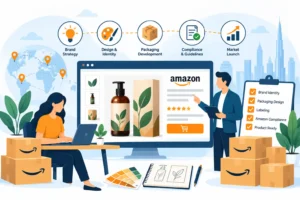
Launching on Amazon begins well before a product page goes live. The legal entity, marketplace registration, tax and banking requirements, trademark pathway, brand setup, packaging compliance, barcode strategy, and FBA preparation all affect how quickly a seller can begin trading without avoidable interruptions.
Product and sourcing decisions matter just as much. A product with an attractive sales estimate can become a difficult business if it is oversized, fragile, restricted, highly seasonal, or exposed to aggressive price competition. Supplier sourcing, sample review, packaging development, quality control, freight, customs, and inbound delivery need to be planned as one chain rather than handed between unrelated vendors.
A capable agency will pressure-test the launch economics before scaling spend. That means estimating landed cost, Amazon fees, fulfillment costs, expected advertising spend, target selling price, and realistic margin. The objective is not to find a product that can sell. It is to build one that can continue selling after promotions, returns, storage fees, and competitive bidding are factored in.
Listings Must Convert Search Demand Into Sales
Amazon SEO is no longer limited to placing high-volume keywords in a title and backend fields. Search relevance still matters, but shopper behavior, conversion signals, product attributes, review quality, price competitiveness, and content clarity all influence performance.
A high-performing listing gives shoppers fast answers. It makes the use case clear, explains material or size details, addresses objections, and differentiates the product without vague claims. Main images earn the click. Secondary images make the purchase easier. A+ Content reinforces trust and comparison shopping. A Storefront can turn a single product visit into a broader brand relationship.
The growing role of conversational product discovery adds another layer. Amazon’s Rufus and AI-led search experiences reward content that is semantically complete and easy to interpret. Rather than writing for isolated phrases, brands need listings that explain what the product is, who it is for, how it is used, which problems it solves, and where it differs from alternatives. This is not a reason to stuff copy with generic claims. It is a reason to create clearer, more structured product information.
Advertising Needs a Profitability Framework
PPC should create controlled demand, not become an expensive substitute for a weak catalog. Sponsored Products, Sponsored Brands, Sponsored Display, and DSP can each play a role, but they serve different commercial purposes. The correct channel mix depends on catalog maturity, budget, repeat purchase behavior, audience size, and whether the immediate priority is rank, profitability, awareness, or defense.
An agency should manage advertising with more than ACoS. Return on ad spend, total advertising cost of sales, contribution margin, new-to-brand performance, organic lift, and stock position provide a more useful picture. A campaign with a higher ACoS may be strategically sound during a launch or ranking push. The same result may be unacceptable for an established SKU with limited margin and stable organic placement.
The work should also be continuous. Search term analysis, bid adjustments, placement testing, negative targeting, budget allocation, creative refreshes, and campaign structure must evolve as competitors, seasonality, and inventory change. The aim is to spend with intent: capture high-intent demand, develop relevant discovery traffic, defend valuable branded searches, and reduce waste without starving products that need momentum.
Inventory and Compliance Are Growth Levers
Many Amazon businesses do not fail because demand disappears. They stall because inventory arrives late, listing variations break, a compliance request goes unanswered, or an account-health issue restricts sales at the worst moment.
Inventory management deserves a seat beside advertising and content. Forecasts should consider current sales velocity, planned promotions, ad-driven demand, manufacturing lead times, freight timing, FBA receiving delays, and safety stock. Stockouts can erase hard-earned ranking gains; excess inventory can create storage costs and force margin-damaging liquidation decisions.
Compliance should be managed proactively. Product documentation, safety records, category requirements, intellectual property concerns, listing claims, and account-performance notifications require organized ownership. When an issue does occur, response quality matters. Reinstatement work is most effective when it is fact-based, timely, and supported by a credible corrective action plan rather than a generic appeal.
Choosing an Amazon Agency for the Right Stage
The best agency is not automatically the largest one or the one promising the lowest ACoS. It is the partner whose capabilities match the constraints holding the business back. A founder launching a new private-label brand needs infrastructure and launch control. A brand with proven products may need conversion optimization, retail media expertise, and disciplined inventory planning. A company entering the US, UK, UAE, Europe, Australia, or Saudi Arabia needs a partner that can coordinate country-specific operating requirements without losing the core brand strategy.
During evaluation, ask how the agency measures profitability, who owns communication with Amazon, how advertising decisions connect to inventory, and what reporting you will receive. Ask whether the team can support listing content, account health, FBA operations, and cross-border growth or whether it will rely on a chain of outside contractors. Fragmentation is not always wrong, but it creates more management burden for the brand and more room for execution gaps.
Credentials also matter. Amazon SPN verification is a meaningful signal of platform alignment, but it should sit alongside transparent processes, relevant category experience, and a demonstrated ability to explain trade-offs. No credible partner should promise guaranteed rankings, unrestricted account approval, or a fixed ROAS before reviewing the catalog, economics, and competitive environment.
Build for Control Before You Scale
Amazon growth becomes more predictable when every decision has an owner and every metric has context. iNNOVEX approaches marketplace growth as a connected operating model: launch infrastructure, supply chain readiness, conversion-focused content, paid media, account operations, and international expansion working toward the same commercial target.
Before adding another SKU, marketplace, or advertising budget, make sure the foundation can support it. Clear unit economics, accurate inventory data, compliant listings, disciplined campaign management, and an accountable operating partner give a brand something far more valuable than a short-term sales spike: the control to keep growing when demand arrives.
Frequently Asked Questions
1. What does an Amazon agency do?
An Amazon agency can support different areas of an Amazon business, including seller account setup, product research, supplier coordination, FBA preparation, listing optimization, A+ Content, PPC advertising, inventory planning, account management, compliance support, and international expansion. The exact scope depends on the agency and the stage of the business.
2. When should I hire an Amazon agency?
An Amazon agency may be useful when managing the marketplace becomes too complex or when growth is being limited by disconnected operations. This can include challenges with product launches, listing conversion, advertising efficiency, inventory planning, account health, compliance requirements, or expansion into new Amazon marketplaces.
3. What should I look for when choosing an Amazon agency?
Look for an agency whose services match your current business needs. Consider its experience with your marketplace and category, approach to profitability, reporting process, communication structure, advertising expertise, listing capabilities, inventory coordination, and ability to connect different areas of Amazon operations.
4. Can an Amazon agency help improve product listing performance?
Yes. An Amazon agency can help improve listing performance by reviewing search relevance, product titles, bullet points, descriptions, images, attributes, A+ Content, and overall product positioning. Effective optimization should focus on helping shoppers understand the product, its use case, key features, and differences from available alternatives.
5. How does Amazon PPC management connect with profitability?
Amazon PPC should be managed alongside product margins, conversion rates, inventory availability, organic performance, and overall advertising costs. Metrics such as ACoS, TACoS, ROAS, contribution margin, search-term performance, and stock position can provide a broader view than advertising sales alone and help guide campaign decisions.
6. Can an Amazon agency help with international expansion?
Depending on its services, an Amazon agency can support expansion into additional marketplaces by helping with marketplace research, listing localization, account setup, product preparation, logistics coordination, inventory planning, advertising strategy, and other operational requirements. Each marketplace may have different commercial, customer, and compliance considerations.
7. Does an Amazon SPN agency guarantee sales, rankings, or advertising results?
No. Amazon SPN status or agency credentials do not guarantee sales, rankings, account approval, or a specific ROAS. Amazon performance can be affected by factors including product demand, competition, pricing, reviews, conversion rate, inventory availability, advertising strategy, marketplace conditions, and the overall economics of the business.




3 thoughts on “What an Amazon Agency Should Actually Manage”
[865085]supplies professional anti-violence equipments and solutions for the whole world with strong and perfect production capacity. anti-violence.org
Finally a betting hub that truly understands what active players need. The odds remain highly competitive and the live tracking tools keep me fully engaged throughout every event. Support agents answered my bonus question within minutes. This is easily my new favorite destination. qt66bet
Man this place really knows how to treat its regulars right. I came for the slots but stayed because of the live dealers and the genuine good energy. Cashouts are quick and I never had to jump through hoops to get my money. Really appreciate the transparent rules and the friendly staff. arguazubetasino