
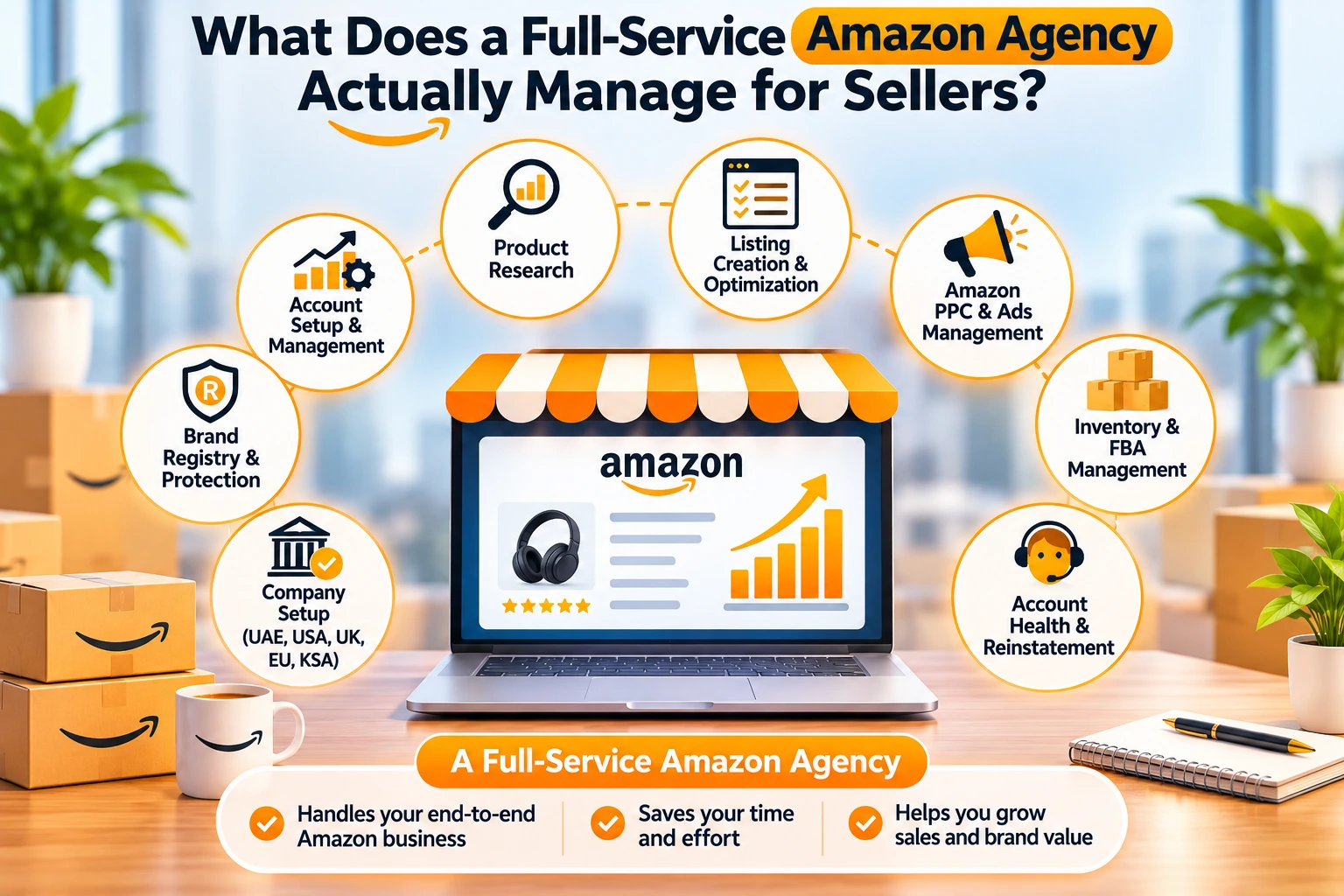
Running a successful Amazon business involves far more than uploading products and waiting for customers to place orders. Sellers must manage product listings, advertising campaigns, inventory, fulfillment, pricing, customer experience, account performance, and numerous other operational responsibilities.
For entrepreneurs managing multiple products or expanding across international marketplaces, handling every activity internally can become increasingly complex.
This is why many businesses consider working with a full-service Amazon agency.
However, one important question often arises before hiring professional support: What does a full-service Amazon agency actually manage for sellers?
Some agencies specialize primarily in Amazon PPC advertising, while others focus on listing creation, product research, account troubleshooting, or brand development.
A full-service Amazon agency generally offers a broader combination of services intended to support the day-to-day management and strategic development of an Amazon selling business.
These services may include seller account setup, catalog management, Amazon SEO, advertising optimization, inventory planning, FBA support, product sourcing coordination, Brand Registry assistance, and performance reporting.
However, not every agency includes every service in its standard package.
The exact responsibilities depend on the agreed contract, the seller’s account permissions, and the services the provider is qualified to deliver.
In 2026, Amazon’s selling environment also includes advanced advertising tools, AI-assisted shopping experiences, detailed account health requirements, and marketplace-specific operational processes.
Sellers need a coordinated strategy rather than isolated marketing activities.
In this comprehensive guide, we explain what full-service Amazon account management involves, how agencies support sellers, which responsibilities remain with the business owner, and how to evaluate an Amazon agency before hiring one.
1. What Is a Full-Service Amazon Agency and How Does It Work?
A full-service Amazon agency is a third-party service provider that helps sellers manage multiple aspects of their Amazon business, typically combining account operations, product listings, advertising, inventory planning, brand development, and performance analysis under one coordinated service arrangement.
Instead of hiring separate specialists for every activity, a seller may work with one agency that coordinates several operational functions.
For example, an agency may help optimize product listings, manage Sponsored Products campaigns, monitor inventory, and review performance reports.
The purpose is to create a more organized management process and reduce the workload associated with everyday marketplace activities.
However, the agency does not automatically own the seller account, inventory, intellectual property, or business.
Those responsibilities remain governed by the seller’s legal ownership, Amazon policies, and the service agreement.
What Is Amazon Full Account Management?
Amazon full account management refers to ongoing support for an Amazon selling account across several relevant functions.
This can include maintaining product information, coordinating advertising campaigns, monitoring account issues, reviewing sales trends, and planning operational improvements.
For example, a business selling twenty private label products may require regular updates to inventory, images, prices, and advertising campaigns.
An account management agency can coordinate these activities according to agreed responsibilities.
The seller typically remains involved in approving major commercial decisions, such as inventory purchases, pricing policies, advertising budgets, and new market entry.
A clear division of responsibilities helps prevent misunderstandings.
What Is the Difference Between an Amazon Agency and an Amazon Consultant?
An Amazon consultant generally provides advice, analysis, recommendations, or specialized support.
For example, a consultant might audit advertising campaigns and recommend improvements.
An agency may offer ongoing execution in addition to strategic advice.
For example, it may implement approved campaign changes, maintain listings, and provide regular operational reporting.
However, the titles are not legally standardized across every provider.
Some consultants also manage accounts, while some agencies provide only limited services.
Businesses should evaluate the actual scope of work instead of relying solely on the provider’s job title.
What Is an Amazon SPN Agency?
The Amazon Service Provider Network, commonly known as SPN, is Amazon’s directory of vetted third-party service providers.
Amazon explains that its network includes providers offering services such as account management, cataloging, advertising optimization, imaging, logistics, accounting, and compliance support.
Service providers must meet Amazon’s relevant standards to participate in the program.
Amazon also monitors providers and provides seller reviews and ratings where available.
However, Amazon explicitly states that listing providers in its network does not constitute an endorsement of their services.
SPN providers are independent companies.
Sellers contract directly with the selected provider and should review the terms carefully.
Why Do Amazon Sellers Hire Full-Service Agencies?
Businesses may hire agencies for several reasons.
Some sellers lack the time required to manage daily operations.
Others need specialized knowledge of advertising, product catalog requirements, fulfillment planning, or marketplace expansion.
A seller may also want coordinated support across several related activities.
For example, improving advertising performance is difficult when the product listing contains incorrect information or inventory frequently runs out.
An agency can help identify these connections and organize a wider improvement strategy.
However, hiring an agency does not guarantee business growth.
Results still depend on customer demand, product quality, competitive conditions, budget, and operational decisions.
Who Can Benefit From Amazon Account Management Services?
Different sellers may benefit from different levels of support.
A new seller may need assistance with account registration, product research, listing creation, and FBA setup.
An established seller may focus on PPC optimization, catalog maintenance, inventory planning, and profitability analysis.
A brand operating across the UAE, USA, UK, and Saudi Arabia may require additional coordination for marketplace-specific listings, advertising, logistics, and reporting.
Businesses with limited internal resources may prefer a broader management arrangement.
However, sellers with a strong in-house team may only require specific services.
The most appropriate approach depends on the business’s existing capabilities and objectives.
2. What Services Does a Full-Service Amazon Agency Actually Manage?
A comprehensive Amazon agency may provide support across the complete selling process, from the early business setup stage to ongoing account optimization.
Amazon’s Service Provider Network identifies numerous service categories, but each provider determines its actual offering.
The following areas represent common full-service Amazon agency responsibilities.
Amazon Seller Account Setup and Verification
The agency may assist sellers with preparing account registration information and understanding Amazon’s verification requirements.
This can include organizing business registration documents, identity information, banking details, and relevant account settings.
For example, a business establishing an Amazon UAE seller account may need to verify its trade license and legal business information.
A company entering Amazon USA may need to review the applicable international seller registration route.
The agency can help organize the process and identify documentation issues.
However, identity verification must be completed truthfully by the appropriate business representatives.
An agency cannot guarantee that Amazon will approve an account.
Amazon Seller Central Account Management
Seller Central is the central platform used to manage Amazon selling operations.
A full-service agency may help with product information, order-related workflows, inventory monitoring, business reports, and operational troubleshooting.
It may also coordinate approved updates to account settings or catalog information within its authorized permissions.
For example, an agency might monitor active listings and investigate why a particular SKU has stopped selling.
It could review inventory status, listing suppression, pricing, and relevant performance data.
The objective is to identify operational problems and help the seller address them.
Amazon Product Listing Creation
Product listing creation is a foundational activity for new products.
An agency may prepare titles, bullet points, descriptions, product attributes, and relevant search terms.
It may also coordinate product images and category information.
For example, a seller offering a rechargeable LED drawing board should provide accurate information about screen size, included markers, charging method, and product materials.
An effective listing helps customers understand what they are buying.
The agency should work from verified product specifications rather than inventing features or copying competitor information.
Amazon SEO and Keyword Optimization
Amazon SEO involves improving listing relevance for customer searches.
An agency may research keywords, identify relevant long-tail phrases, and optimize appropriate listing fields.
The goal is to help customers find products that match their needs.
For example, a product might have strong reviews but limited search visibility because its title and attributes do not accurately describe the item.
The agency can investigate keyword relevance and available performance data.
However, Amazon does not publish a complete organic ranking formula.
No responsible agency should guarantee a specific ranking position.
Amazon PPC Advertising Management
Amazon PPC is a major component of many agency services.
A provider may manage eligible Sponsored Products, Sponsored Brands, and other supported campaign formats.
This can include keyword research, campaign structure, bid adjustments, targeting, budgeting, and performance analysis.
For example, an agency might discover that a campaign receives many clicks from irrelevant search terms.
It could recommend negative targeting or adjustments to the campaign’s keyword strategy.
The objective is to improve the relevance and efficiency of advertising expenditure.
Campaign eligibility and available features vary by marketplace and seller account.
Amazon Product Research and Market Analysis
Some full-service agencies support product research before sellers launch new items.
The process may involve analyzing customer demand, competition, pricing, product characteristics, and estimated profitability.
For example, an agency might evaluate whether a household accessory category has sufficient demand to justify sourcing inventory.
It should also consider the risks associated with manufacturing costs, compliance, and competition.
Product research cannot guarantee future sales.
A responsible analysis should distinguish reliable marketplace data from estimates and assumptions.
Amazon Product Sourcing and Supplier Coordination
Agencies with sourcing capabilities may help businesses identify suppliers and coordinate manufacturing requirements.
This can include supplier comparisons, sample requests, product specifications, packaging discussions, and production updates.
For example, a private label seller may need to confirm that a supplier can manufacture the required product quantity with accurate branding.
The agency can support communication and documentation.
However, the seller should approve financial commitments, product specifications, and supplier contracts.
Independent quality inspections may also be appropriate for higher-risk orders.
Amazon A+ Content Creation
A+ Content provides eligible sellers with additional modules for explaining products through images, formatted text, and supported interactive features.
A full-service agency may help prepare Basic A+ Content and, for eligible brands, Premium A+ Content.
For example, a digital microscope listing may benefit from modules explaining its controls, focus adjustment, screen, and package contents.
The design should remain accurate to the actual item.
Enhanced content can support customer understanding, but it does not guarantee higher search rankings or sales.
Amazon Brand Store Design
A Brand Store is a dedicated destination for eligible brands within Amazon.
An agency may develop Store layouts, organize product collections, prepare imagery, and coordinate navigation.
For example, an educational toy brand might organize products into activity books, learning games, and sensory toys.
The Store can provide a consistent environment for customers exploring related items.
Eligibility depends on Amazon’s relevant brand and account requirements.
Store creation and advertising campaign management should be treated as separate activities when determining the service scope.
Amazon Brand Registry and Trademark Support
Some agencies assist businesses with the processes associated with Amazon Brand Registry and trademark preparation.
This may include reviewing relevant documentation, coordinating trademark-related service requests, and helping eligible brands understand Amazon enrollment requirements.
A trademark application and Brand Registry enrollment are separate processes.
An agency should not guarantee trademark approval or automatically claim to provide regulated legal advice.
Qualified trademark professionals should handle legal matters requiring professional expertise.
Amazon Product Photography and Video
Professional imagery helps customers evaluate products before purchase.
An agency may coordinate main images, lifestyle photographs, infographics, dimension images, and product demonstration videos.
For example, a listing for a set of resistance bands may require accurate visuals showing different thicknesses and resistance ranges.
The images should reflect actual product specifications.
Incorrect dimensions, exaggerated features, or altered product shapes can mislead buyers.
All visuals should comply with the relevant Amazon marketplace requirements.
Amazon Catalog and Variation Management
Managing a large catalog involves keeping product information accurate and organized.
An agency may help correct attributes, manage eligible variations, investigate duplicate information, and support catalog troubleshooting.
For example, a product available in black and silver should maintain accurate images and information for each variation.
An incorrect variation relationship can confuse customers or cause catalog issues.
The agency should review Amazon’s current variation policies before making changes.
Amazon Account Health Monitoring
Account health is an important part of ongoing Amazon operations.
A full-service agency may monitor relevant policy notifications, performance warnings, and listing restrictions.
When an issue arises, it can help the seller review the stated problem and prepare an appropriate response.
For example, Amazon may request documentation related to product authenticity or compliance.
The agency can help organize truthful supporting information.
However, the seller remains responsible for the accuracy of documents and compliance with Amazon policies.
Amazon Account Reinstatement Support
Some agencies provide assistance when seller accounts or listings are suspended or restricted.
They may analyze the notification, identify relevant policy concerns, and help prepare a corrective plan of action when appropriate.
For example, an account restriction may require evidence addressing sourcing, shipping performance, or product compliance.
A professional provider should focus on the actual reason for the restriction.
It should never recommend fabricated invoices or misleading appeals.
Amazon ultimately determines whether an account or listing can be reinstated.
3. How Does a Full-Service Amazon Agency Manage PPC, FBA, Inventory, and Profitability?
Advertising, fulfillment, inventory, and profitability are connected.
An agency that manages these functions together may be able to identify operational problems that are difficult to address through isolated services.
For example, a successful PPC campaign can generate additional demand, but the seller may lose opportunities if inventory becomes unavailable.
Similarly, a product may generate strong sales while earning little profit because of fulfillment and advertising expenses.
Amazon Sponsored Products Campaign Management
Sponsored Products allows eligible sellers to advertise products using supported targeting and bidding options.
Amazon describes the format as cost-per-click advertising.
An agency may organize campaigns by product, keyword intent, marketplace, or business objective.
It may use automatic targeting to discover relevant shopping searches and manual targeting to manage selected keywords or products.
The agency should review campaign performance regularly.
However, the number of campaigns is not itself a measure of advertising quality.
A simpler campaign structure may be appropriate when the product catalog or budget is limited.
Amazon PPC Keyword and Bid Optimization
Advertising optimization involves evaluating which keywords and product targets are generating useful results.
An agency may review impressions, clicks, attributed sales, conversion performance, and advertising costs.
For example, a broad keyword may generate many clicks but few purchases.
The agency might reduce the bid, refine targeting, or investigate the underlying listing.
Conversely, a relevant term generating profitable sales may justify additional attention.
Bid adjustments should reflect the seller’s margins and business goals.
Higher advertising expenditure does not automatically mean better profitability.
Amazon ACOS and TACOS Analysis
Two commonly used advertising metrics are ACOS and TACOS.
ACOS = Advertising Spend ÷ Advertising-Attributed Sales × 100
TACOS = Advertising Spend ÷ Total Sales Revenue × 100
For example, a business spending AED 2,000 on advertising and generating AED 10,000 in attributed sales has an ACOS of 20%.
If its total sales revenue during the same period is AED 20,000, the TACOS is 10%.
These figures provide different perspectives.
ACOS measures spending relative to attributed sales, while TACOS considers total revenue.
Neither metric independently represents actual net profit.
A full-service agency should evaluate advertising results alongside product economics.
Amazon FBA Setup and Shipment Planning
Fulfillment by Amazon allows sellers to send eligible inventory to Amazon’s fulfillment network.
Amazon then handles applicable storage, picking, packing, shipping, customer service, and returns for FBA orders.
An agency may help the seller select eligible products, estimate fulfillment fees, and prepare the Send to Amazon workflow.
It may also coordinate packaging and shipment details with warehouses or freight partners.
However, the agency does not automatically replace the freight forwarder, customs broker, importer, or manufacturer.
The exact responsibilities should be defined in the service agreement.
Amazon Inventory Forecasting
Inventory planning involves estimating future customer demand and replenishment requirements.
A full-service agency may review sales velocity, existing stock, lead times, and expected seasonal demand.
A simplified reorder calculation is:
Reorder Point = Average Daily Sales × Replenishment Lead Time + Safety Stock
For example, a product selling eight units daily with a 30-day replenishment lead time and 40 units of safety stock has an illustrative reorder point of 280 units.
Actual forecasting should consider demand variability, production delays, shipping uncertainty, and inventory already on order.
The objective is to reduce unnecessary stockouts while avoiding excessive inventory commitments.
Amazon Storage and Warehousing Support
Inventory storage can become a significant expense for products with slow sales.
An agency may monitor inventory age, storage charges, and replenishment patterns.
It may also help evaluate whether inventory should be stored in Amazon FBA, Amazon Warehousing and Distribution where available, or an eligible third-party warehouse.
For example, a product with uncertain demand may benefit from a smaller initial FBA shipment.
However, the best approach depends on fulfillment requirements, storage rates, and shipping costs.
Not every agency owns physical warehouses.
Some coordinate external storage providers rather than supplying warehouse services directly.
Amazon Returns and Reimbursement Monitoring
Customer returns can affect product profitability and inventory availability.
For FBA orders, Amazon handles specified fulfillment-related customer service and returns activities.
An agency may review return patterns, investigate applicable discrepancies, and help the seller understand the financial impact.
For example, repeated returns caused by incorrect product dimensions may indicate a listing accuracy problem.
The agency could recommend updating the product images or specifications.
Where Amazon provides reimbursement or investigation procedures, the agency may assist with eligible cases.
Reimbursement is subject to Amazon’s policies and is not guaranteed.
Amazon Product Profitability Analysis
A full-service agency should help sellers understand the difference between sales revenue and actual earnings.
A product may generate strong monthly sales while losing money after fulfillment and advertising costs.
Useful expenses to review include product sourcing, shipping, customs duties, referral fees, FBA charges, storage, returns, advertising, and applicable operating costs.
Product Contribution = Net Sales Revenue − Relevant Variable Product and Selling Costs
For example, if a product generates $40 in net sales revenue and incurs $30 in relevant costs, it retains $10 contribution before any excluded expenses.
That represents a 25% contribution margin under those assumptions.
However, final accounting net profit may be lower after shared overhead, financing, and applicable taxes.
An agency can support analysis, while formal accounting and tax responsibilities should be assigned to appropriately qualified professionals.
Amazon Pricing and Promotion Management
Pricing decisions affect both conversion and profitability.
An agency may review competitor prices, product margins, and promotional opportunities.
It can recommend suitable adjustments and manage approved promotions where authorized.
However, the seller should define pricing limits and approval requirements.
For example, a promotion may increase order volume but generate little additional profit if the discounted price is too low.
Pricing decisions should consider contribution margin and available inventory.
Amazon Logistics and Customs Coordination
For international sellers, logistics may involve manufacturers, freight forwarders, customs brokers, warehouses, and Amazon fulfillment centers.
A full-service agency may coordinate communication between these parties.
For example, a UAE business expanding to Amazon USA may need to arrange international freight and confirm importer-of-record responsibilities.
The agency can support planning and documentation workflows.
However, customs obligations and legal responsibilities depend on the actual importer and relevant laws.
Agencies should not claim that ordinary account management automatically includes regulated customs or tax services.
4. What Responsibilities Remain With the Seller When Hiring an Amazon Agency?
A full-service agency can manage substantial operational work, but it does not automatically assume ownership of the Amazon business.
The seller retains important responsibilities involving legal ownership, product compliance, financial commitments, and commercial decisions.
Understanding these boundaries helps businesses create clearer agency agreements.
Who Owns the Amazon Seller Central Account?
The business registered as the seller remains responsible for its Amazon account.
Hiring an external agency does not transfer ownership of the seller account.
Amazon’s account access guidance distinguishes employees from external service providers.
Sellers can authorize qualifying service providers to access specified functions through the appropriate permissions process.
This is preferable to sharing primary login credentials.
Account ownership and administrative control should remain with the registered business.
How Should You Give an Agency Seller Central Access?
Amazon documents a service-provider authorization process for external agencies and consultants.
In its current US guidance, authorized service-provider access is scoped to approved roles and lasts 365 days before requiring reauthorization.
The seller can control which roles the provider may use and restrict access by country or region.
The exact interface and availability may vary by marketplace.
A business should grant only the permissions necessary for the agreed work.
For example, an agency hired exclusively for advertising does not automatically require access to unrelated financial or administrative functions.
Regularly review permissions and remove access when the relationship ends.
Who Is Responsible for Product Compliance?
The seller remains responsible for ensuring that products meet applicable legal and marketplace requirements.
An agency may help identify requirements or coordinate testing and documentation.
However, product safety, labeling, certification, and import obligations depend on the business and relevant laws.
For example, selling children’s toys may involve different requirements from selling ordinary home accessories.
The seller should verify the appropriate documents and consult qualified professionals where needed.
An agency cannot make a noncompliant product compliant simply by improving its listing content.
Who Makes Inventory Purchasing Decisions?
Inventory purchasing involves financial commitments and operational risk.
An agency may recommend quantities based on sales trends and replenishment forecasts.
However, the seller should approve purchase orders, manufacturing agreements, and significant inventory investments unless a clearly authorized arrangement states otherwise.
For example, a product might have promising demand but require a large minimum order quantity.
The agency can provide analysis, while the business owner evaluates whether the investment is financially appropriate.
Clear approval procedures help prevent misunderstandings.
Who Controls Amazon Advertising Budgets?
An agency may manage campaign execution, but the seller should establish the advertising budget and financial limits.
The contract should explain which budget changes the agency can make independently and which require approval.
For example, increasing daily campaign budgets substantially can increase total advertising expenditure.
The seller should understand the potential financial consequences.
A professional agency should provide transparent reporting and explain significant changes.
Who Is Responsible for Amazon Seller Fees and Agency Charges?
Amazon selling fees and agency management charges are separate expenses.
The seller generally pays applicable Amazon fees, advertising expenses, inventory costs, and other business charges.
The agency receives compensation according to its contract.
Some agencies charge fixed monthly fees, while others use project-based or performance-linked pricing.
Additional services may have separate charges.
A seller should review all expected expenses before agreeing to full-service management.
Can an Amazon Agency Guarantee Sales or Rankings?
No responsible agency can guarantee specific sales volumes, organic ranking positions, or account approvals.
Amazon selling performance depends on many factors outside the agency’s control.
These include customer demand, competition, product quality, pricing, marketplace policies, and inventory availability.
An agency can help organize strategy and improve execution.
However, advertising results and organic search performance remain variable.
Treat promises of guaranteed first-page rankings or guaranteed account reinstatement with caution.
What Should an Amazon Agency Agreement Include?
A written agreement should clearly define the services being provided.
It should explain which marketplaces and seller accounts are included, which tasks the provider will perform, and how performance will be reported.
It should also describe approval responsibilities, communication procedures, fees, termination terms, and the handling of confidential information.
Ownership of created content and access to business data should be addressed.
For example, product images, advertising data, and listing content may remain important to the business after the agency relationship ends.
Both parties should understand the applicable rights and obligations.
5. How Do You Choose the Right Full-Service Amazon Agency in 2026?
Choosing an agency is a business decision that should be based on relevant capabilities, documented services, communication quality, and transparent commercial terms.
A provider that performs well for one seller may not be suitable for every brand or marketplace.
Check the Agency’s Amazon Experience
Review the agency’s experience with the relevant product category and marketplace.
A seller operating on Amazon UAE may face different fulfillment, tax, and compliance requirements from a seller operating on Amazon USA.
Ask which services the agency has actually delivered and which activities it coordinates through external specialists.
Experience should be evaluated through relevant evidence, not simply broad marketing statements.
Verify Amazon SPN Participation Where Claimed
If an agency describes itself as an Amazon SPN provider, the seller can review the official Service Provider Network.
Amazon allows sellers to filter providers according to service type, location, language, and reviews.
SPN participation indicates that a provider has met Amazon’s relevant participation standards.
However, Amazon does not endorse individual providers or guarantee their performance.
Sellers should still conduct independent due diligence.
Ask for a Detailed Scope of Work
The phrase “full-service management” can mean different things.
One agency might include listing optimization, PPC management, and reporting.
Another might also offer inventory forecasting, supplier coordination, Brand Store design, and logistics support.
Before hiring, request a written description of the included services.
Ask whether new product launches, A+ Content, photography, account appeals, and marketplace expansion require additional fees.
Clear expectations reduce disputes later.
Review the Agency’s Reporting Process
A professional Amazon agency should provide reporting relevant to the seller’s objectives.
Useful metrics may include sales revenue, advertising expenditure, ACOS, TACOS, conversion trends, inventory availability, and product-level contribution.
However, reporting requirements depend on the engagement.
A PPC-only agreement may have a narrower dashboard than a complete account management arrangement.
The seller should understand how frequently reports will be delivered and how important issues will be escalated.
Evaluate Communication and Decision-Making
Good communication is essential when multiple activities are managed together.
For example, a planned advertising promotion may need to be delayed if inventory is insufficient.
The agency should have a process for coordinating such decisions.
Ask who will be responsible for day-to-day communication and how urgent issues are handled.
Determine which changes require seller approval.
A clear operating process can be more valuable than vague promises of constant availability.
Compare Pricing Models Carefully
Agency pricing may use monthly retainers, fixed project fees, advertising management charges, or performance-linked arrangements.
Each model has advantages and limitations.
A fixed retainer may provide predictable service costs.
Project-based fees may suit specific tasks such as listing creation or Brand Store design.
Performance-linked fees require clear definitions of the metrics used.
For example, a percentage-of-sales arrangement may create different incentives from a profitability-focused model.
Evaluate total expected costs and how they align with the business’s objectives.
Be Cautious About Guaranteed Results
Avoid choosing an agency solely because it promises guaranteed rankings, sales, or account reinstatement.
Such outcomes depend on Amazon systems and factors the agency cannot fully control.
A more credible provider explains the intended process, the available evidence, and the risks.
It should distinguish realistic improvement opportunities from uncertain results.
Transparency is particularly important when account health, product compliance, or large advertising budgets are involved.
Full-Service Amazon Agency vs In-House Team
Businesses can manage Amazon operations internally, through an agency, or by combining both approaches.
An in-house team may provide direct control over daily decisions and closer familiarity with company operations.
An external agency may offer access to several specialized skills without requiring a large internal department.
However, agencies also require coordination and contractual oversight.
The appropriate option depends on the seller’s budget, product catalog, growth plans, and available personnel.
A hybrid model can be useful when a company retains strategic decision-making internally while outsourcing specialized execution.
What Should You Expect During the First 90 Days?
The first stage of a full-service engagement should focus on understanding the account and establishing clear priorities.
During the initial period, an agency may review active listings, advertising campaigns, inventory, profitability, and account health.
It should identify urgent issues and agree on measurable objectives.
The next stage may involve implementing approved listing improvements, refining advertising, and addressing operational problems.
Later reviews can assess available performance data and adjust the plan.
Ninety days is a useful planning horizon, not a guaranteed timeframe for results.
Some problems can be addressed quickly, while others require additional time and external approvals.
Sample Amazon Agency Responsibility Matrix
The following table illustrates how responsibilities may be divided in a full-service arrangement.
| Business Activity | Agency Role | Seller Role |
|---|---|---|
| Product Listings | Create and optimize approved content | Provide accurate specifications |
| Amazon PPC | Manage approved campaigns | Approve budgets and goals |
| Inventory Planning | Forecast and recommend quantities | Approve purchases and financing |
| FBA Logistics | Coordinate agreed shipment workflows | Authorize shipments and relevant parties |
| Account Health | Monitor and support responses | Maintain truthful compliance records |
| Product Compliance | Assist with coordination | Ensure legal compliance |
| Performance Reports | Prepare and explain reports | Review commercial results |
This table is illustrative. Actual responsibility allocation must be agreed in the service contract.
6. How Can iNNOVEX Enterprises Help Sellers With Full-Service Amazon Management?
Managing Amazon successfully requires coordination across multiple disciplines.
Product content, advertising, fulfillment, inventory, and account operations influence the overall customer experience.
At iNNOVEX Enterprises, an Amazon SPN agency and business setup service provider, we support businesses seeking professional assistance with Amazon marketplace operations.
Our services cover different stages of the seller journey, from business establishment and account setup to advertising, inventory, and ongoing account support.
We work with businesses targeting Amazon UAE, USA, UK, Saudi Arabia, and other international marketplaces.
Amazon Seller Account Setup and Business Formation
We support eligible businesses with Amazon seller account registration workflows and business setup requirements.
This can include preparing relevant business information, coordinating documentation, and helping clients understand the required account processes.
For businesses entering new markets, legal and tax obligations should be confirmed with qualified professionals.
Amazon Listing Creation and Content Optimization
We help sellers develop accurate product listings designed around customer needs and relevant search intent.
This includes product titles, bullet points, descriptions, product attributes, and listing improvement opportunities.
We also support enhanced content development for eligible brands.
Amazon PPC Advertising Management
Our advertising services support relevant campaign planning, keyword research, targeting, performance analysis, and optimization.
We help sellers evaluate advertising efficiency in the context of their business goals.
Actual advertising outcomes depend on product competitiveness, budgets, customer demand, and other factors.
Amazon FBA and Inventory Management
We support fulfillment planning, inventory monitoring, and related Amazon FBA workflows.
This can include evaluating replenishment requirements and coordinating appropriate shipment processes.
Where relevant, we also support warehousing and logistics coordination.
Amazon Product Research and Sourcing
We help businesses investigate potential product opportunities and coordinate sourcing activities.
Our support can include evaluating product characteristics, supplier arrangements, and relevant commercial considerations.
Final purchasing and manufacturing decisions remain with the business owner.
Amazon Brand Registry, A+ Content, and Brand Stores
We support eligible brands with Amazon Brand Registry processes, enhanced product content, and Brand Store development.
These services help businesses present their products and collections more professionally.
Trademark rights and legal matters should be handled with the appropriate qualified professionals.
Amazon Account Health and Reinstatement Support
We assist sellers in reviewing account performance concerns and relevant Amazon notifications.
Where appropriate, our support can include organizing documentation and preparing responses related to account or listing restrictions.
Final decisions about account status remain with Amazon.
Amazon Shipping, Logistics, and Customs Coordination
For sellers operating internationally, we support relevant shipping and logistics workflows.
This may involve coordinating freight, warehousing, FBA preparation, and customs clearance activities with the appropriate parties.
Legal import responsibilities and regulatory compliance must be confirmed for each shipment arrangement.
Frequently Asked Questions About Full-Service Amazon Agencies
1. What does a full-service Amazon agency do?
A full-service Amazon agency may manage seller account operations, product listings, Amazon SEO, PPC campaigns, inventory planning, fulfillment coordination, branding, and performance reporting under an agreed service contract.
2. Does an Amazon agency manage everything in Seller Central?
Not automatically. An agency can access only the functions authorized by the seller and should perform only the services included in its agreement.
3. Can an Amazon agency manage PPC advertising?
Yes. Many agencies manage eligible Sponsored Products and other supported Amazon advertising formats, including keyword research, bids, budgets, and performance analysis.
4. Does a full-service Amazon agency handle FBA shipping?
Some agencies coordinate FBA shipment creation, inventory preparation, and logistics. Physical freight, customs clearance, and warehousing may involve separate providers.
5. Can an Amazon agency help improve product rankings?
An agency can research keywords, improve product information, and analyze search performance. However, no agency can guarantee a specific organic ranking position.
6. Is an Amazon SPN agency officially endorsed by Amazon?
No. Amazon vets participating Service Provider Network companies, but explicitly states that it does not endorse any individual provider or guarantee its services.
7. How much does full-service Amazon account management cost?
Pricing varies by provider, marketplace, product catalog, scope, and commercial arrangement. Agencies may charge monthly retainers, project fees, or performance-linked compensation.
8. Do I need to share my Amazon password with an agency?
No. Sellers should use Amazon’s supported service-provider authorization process, where available, and grant appropriate role-based permissions instead of sharing primary credentials.
9. Who is responsible for Amazon product compliance?
The seller remains responsible for applicable legal and marketplace requirements. An agency may assist with documentation or coordination but does not automatically assume the seller’s compliance obligations.
10. Can a full-service Amazon agency manage multiple marketplaces?
Some agencies support several marketplaces, including Amazon UAE, USA, UK, and Saudi Arabia. The actual countries and services covered should be specified in the agreement.
Conclusion: Is Hiring a Full-Service Amazon Agency Worth It?
A full-service Amazon agency helps sellers coordinate multiple aspects of their marketplace business, including product content, advertising, fulfillment planning, inventory, account operations, and performance analysis.
For some businesses, this can reduce the operational workload associated with managing Amazon internally.
However, the benefits depend on the agency’s capabilities, the services included, and the seller’s commercial objectives.
A professional agency should explain its responsibilities clearly, use authorized account access, provide transparent reports, and avoid promises of guaranteed rankings or sales.
The seller should retain appropriate control over financial decisions, product compliance, business ownership, and strategic priorities.
When these responsibilities are clearly divided, agency support can become a useful part of a structured Amazon operating model.
At iNNOVEX Enterprises, we support Amazon businesses with seller account setup, product listing optimization, PPC management, FBA operations, sourcing, brand development, logistics coordination, and account management.
Looking for a full-service Amazon agency to help manage your marketplace operations?
Contact iNNOVEX Enterprises to discuss your Amazon seller account, advertising strategy, inventory requirements, and business growth objectives.
Official Amazon Sources and References
- Amazon – Service Provider Network
- Amazon – What Is the Service Provider Network?
- Amazon – Seller Central Management Tools
- Amazon – Authorize a Service Provider
- Amazon – Fulfillment by Amazon
- Amazon Ads – Sponsored Advertising FAQ
- Amazon – Selling Tools and Brand Solutions
Disclaimer: This guide provides general information as of November 2026. Agency service scope, Amazon policies, account permissions, advertising eligibility, and marketplace requirements can vary. Service providers are independent businesses, and commercial results are not guaranteed. Sellers should review service agreements and obtain qualified legal, tax, or regulatory advice where required.