Amazon PPC advertising is an essential tool for sellers who want to increase product visibility, reach potential customers, and generate sales. However, one of the first decisions advertisers face when launching Sponsored Products campaigns is whether to select automatic or manual targeting.
Should Amazon sellers start with automatic campaigns or manual PPC campaigns?
Some sellers prefer automatic targeting because Amazon identifies relevant shopping queries and products. Others choose manual campaigns because they want greater control over keywords, bids, and targeting.
Both strategies can support Amazon advertising, but they serve different purposes and require different management approaches.
For businesses selling on Amazon UAE, USA, UK, Saudi Arabia, and other marketplaces, choosing the appropriate campaign structure can influence keyword discovery, advertising costs, conversion performance, and budget efficiency.
In this comprehensive guide, we compare Amazon auto vs manual campaigns in 2026, explain how each targeting strategy works, and share a practical approach for launching, analyzing, and optimizing Sponsored Products advertising.
Amazon Auto vs Manual Campaigns: Which Should Sellers Use First?
Beginners with limited advertising data can start with Amazon automatic targeting to discover relevant customer searches, while sellers with reliable keyword research or existing performance data can launch manual campaigns immediately. For many businesses, combining both campaign types provides a more balanced advertising strategy.
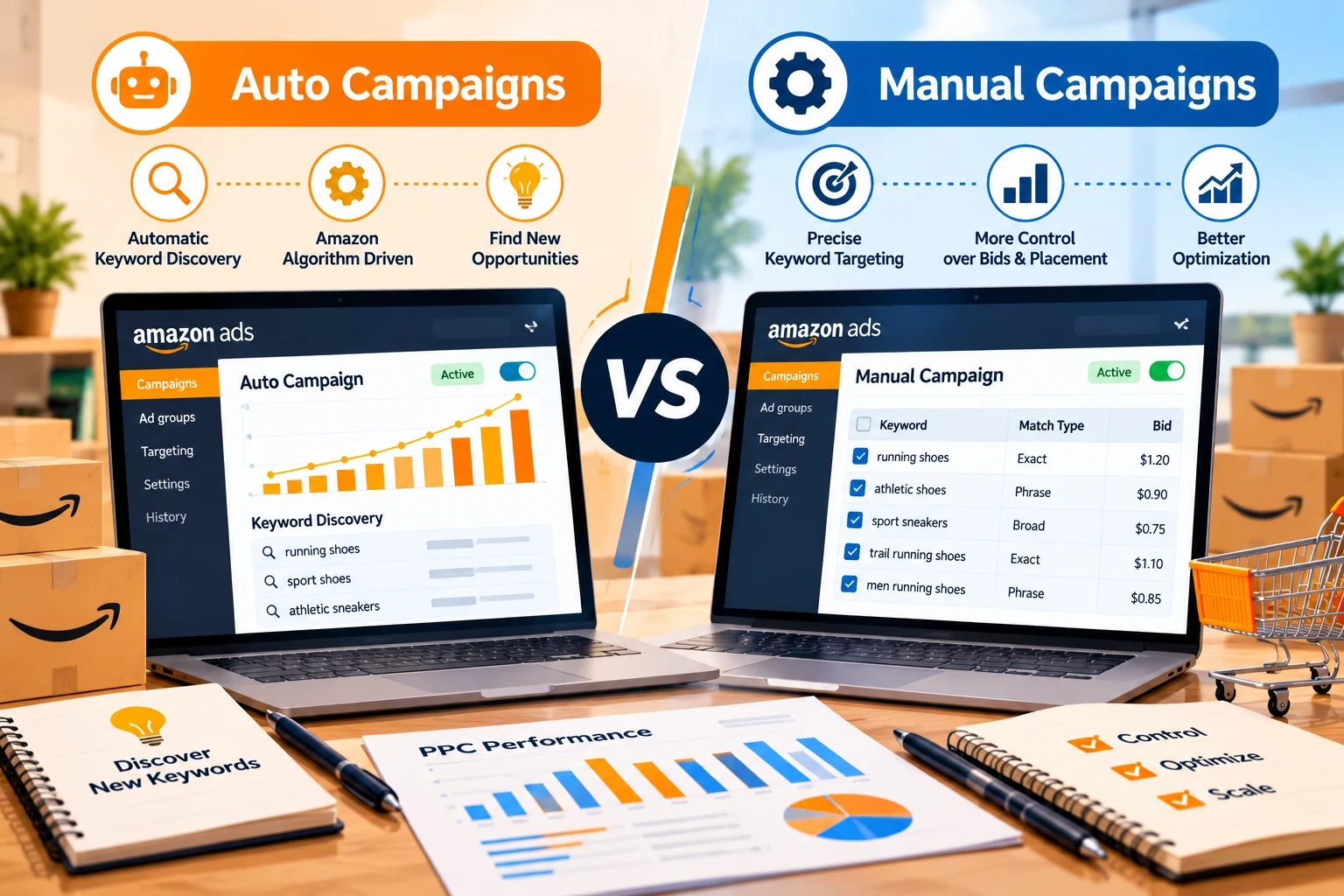
Automatic targeting allows Amazon to match sponsored advertisements with potentially relevant shopping queries and products based on product information and shopping signals.
Manual targeting allows advertisers to select specific keywords or product targets and manage bids at a more detailed level.
Amazon’s official advertising guidance recommends automatic campaigns as an accessible starting point for new advertisers and encourages using search term insights to develop manual targeting.
However, automatic campaigns are not mandatory before manual campaigns.
A seller launching a well-researched product may already know the most relevant search terms and can test them through manual exact or phrase campaigns from the beginning.
The best approach depends on product maturity, available keyword data, advertising budget, and campaign objectives.
What Is an Amazon Automatic PPC Campaign?
An Amazon automatic campaign is a Sponsored Products advertising campaign in which Amazon determines eligible targeting opportunities using information about the advertised products and relevant shopping behavior.
Instead of selecting every keyword manually, the advertiser allows Amazon’s targeting system to match advertisements with customer searches and products.
Automatic targeting can help identify relevant shopping queries that sellers may not discover through conventional keyword research.
It can also provide insights into product placements and related items.
However, automatic targeting does not mean the campaign manages itself.
Sellers must still choose budgets, evaluate bids, monitor search terms, and adjust targeting settings according to performance.
Automatic campaigns may generate irrelevant traffic, so regular analysis remains important.
How Does Amazon Automatic Targeting Work?
Amazon evaluates information about the advertised product and uses its advertising systems to identify potentially relevant opportunities.
For example, if a seller advertises a stainless steel insulated water bottle, an automatic campaign may match the product with shopping searches involving insulated bottles, travel drinkware, or comparable products.
The actual matches depend on Amazon’s systems and available advertising inventory.
Amazon provides four automatic targeting groups that help advertisers distinguish different kinds of opportunities.
What Are the Four Amazon Automatic Targeting Groups?
| Targeting Group | How It Works |
|---|---|
| Close Match | Matches advertisements with shopping terms closely related to the advertised product. |
| Loose Match | Matches advertisements with broader shopping terms related to the product. |
| Substitutes | May show advertisements to shoppers viewing products similar to the advertised product. |
| Complements | May show advertisements alongside products that complement the advertised item. |
Each targeting group may produce different CPC, conversion, and advertising sales results.
For example, close match targeting may reach shoppers using directly relevant searches, while complement targeting may introduce the product to customers browsing related accessories.
Sellers should review the performance of these groups separately when supported by their campaign settings and reporting.
Amazon provides options for adjusting targeting group bids, helping advertisers allocate spending according to results.
What Is an Amazon Manual PPC Campaign?
An Amazon manual PPC campaign is a Sponsored Products campaign in which the advertiser selects the keywords or products they want to target.
Manual targeting gives sellers more control over advertising strategy and target-level bidding.
For example, a seller advertising a magnetic building tile set may target searches such as “magnetic building tiles,” “magnetic construction toys,” or other relevant phrases.
Manual campaigns can also target selected competing or complementary products through product targeting.
The effectiveness of manual targeting depends on keyword relevance, campaign settings, bid competitiveness, listing quality, and product conversion.
Choosing keywords manually does not guarantee that advertisements will appear for every search or generate sales.
What Are Amazon Manual Keyword Match Types?
Amazon Sponsored Products supports broad, phrase, and exact keyword match types.
Each match type controls how closely customer shopping queries must relate to the selected keyword.
Broad Match: Allows advertisements to match a wider range of relevant searches, including applicable variations and related wording.
Phrase Match: Uses more controlled matching around a selected phrase, including permitted variations under Amazon’s matching rules.
Exact Match: Provides tighter targeting around the selected keyword and close variations.
For example, a seller advertising insulated coffee mugs may use broad match for keyword discovery and exact match for search terms with proven conversion performance.
Exact match does not always mean that only an identical word-for-word query can trigger the advertisement.
Sellers should review actual search term reports to understand which queries generated paid clicks.
Amazon Automatic vs Manual Campaigns: Key Differences
Understanding the difference between automatic and manual Sponsored Products campaigns helps sellers choose the right campaign structure for their business.
| Feature | Automatic Campaign | Manual Campaign |
|---|---|---|
| Target Selection | Amazon determines targeting | Advertiser selects targets |
| Keyword Research | Useful for discovery | Uses researched or discovered keywords |
| Setup Complexity | Generally simpler | Requires more targeting decisions |
| Bidding Control | Targeting group controls | Keyword or product-level controls |
| Discovery Opportunities | Can identify new queries and products | Depends on selected targeting strategy |
| Negative Targeting | Supported | Supported |
| Ideal Starting Point | Limited historical advertising data | Existing keyword research or performance data |
Neither campaign type guarantees better performance.
The best results depend on the relevance of the traffic generated and the product’s ability to convert shoppers into customers.
What Are the Advantages of Amazon Automatic Campaigns?
Automatic campaigns offer several advantages for sellers beginning Amazon PPC advertising.
The first advantage is a relatively simple setup process.
Advertisers can launch without preparing a comprehensive manual keyword list.
Another benefit is the ability to discover customer searches and product placements that may not have been considered during initial research.
Automatic targeting can also support ongoing discovery after manual campaigns are established.
However, these benefits do not mean automatic campaigns are always more efficient.
Broadly matched or unsuitable targeting opportunities can generate clicks without enough sales.
Sellers should evaluate actual advertising data before increasing budgets.
Automatic campaigns are most valuable when their search term insights contribute to better targeting and informed advertising decisions.
What Are the Advantages of Amazon Manual Campaigns?
Manual campaigns provide more control over keyword selection, product targeting, and bids.
Advertisers can focus on specific search terms associated with their product’s features and intended customers.
For example, a seller offering a winter thermal base layer may target keywords describing the size, material, garment type, and intended use.
Manual exact campaigns can help isolate selected high-relevance searches, while phrase and broad campaigns may support further discovery.
Manual product targeting also enables sellers to advertise against relevant product ASINs or categories.
These capabilities make manual campaigns useful for structured testing and optimization.
However, performance depends on correct targeting decisions.
Poorly researched manual keywords can waste advertising budget just as easily as unsuitable automatic targeting.
Should Beginners Start With Automatic Amazon PPC Campaigns?
For many new advertisers, automatic targeting is a practical first step.
Amazon’s official Sponsored Products getting-started guidance recommends automatic targeting for an initial campaign.
This approach can help sellers understand how their product matches customer shopping queries.
However, beginners should not depend exclusively on automatic campaigns.
A small manual campaign containing highly relevant researched keywords can also provide useful information.
For example, a new seller launching a stainless steel lunch box may already know several accurate product-related keywords.
These can be tested manually while an automatic campaign discovers additional opportunities.
The decision should reflect available budget, product relevance, and advertising experience.
Automatic targeting is a useful starting method, not a mandatory first stage before manual advertising.
Can You Run Amazon Auto and Manual Campaigns Together?
Yes. Amazon sellers can run automatic and manual Sponsored Products campaigns simultaneously, and Amazon recommends using a combination of targeting approaches.
A combined structure can support discovery and more controlled targeting.
For example, an automatic campaign can identify relevant customer searches while a manual campaign targets selected keywords with established or expected commercial relevance.
Both campaigns can operate independently with their own budgets and settings.
However, sellers should monitor overlapping targets and spending patterns.
Running both types does not automatically mean that every advertisement will receive twice the exposure or that sellers will pay twice for a single click.
Campaign selection is governed by Amazon’s advertising systems and auction rules.
The key is to establish a clear purpose for each campaign and review how the combined structure performs.
How Should You Structure Amazon Auto and Manual PPC Campaigns?
A simple advertising structure can help sellers separate keyword discovery from performance-focused targeting.
For example, a seller may create an automatic discovery campaign, a manual exact keyword campaign, a manual phrase campaign, and a separate product targeting campaign.
Not every seller needs all these campaigns immediately.
The appropriate structure depends on inventory, advertising data, product count, and available budget.
For beginners, launching fewer well-organized campaigns may be easier to manage than creating numerous campaigns with overlapping objectives.
Campaign names should clearly identify the advertised product, marketplace, targeting type, and purpose.
A clear structure makes reports easier to interpret and can support more consistent optimization.
How Much Budget Should You Allocate to Auto vs Manual Campaigns?
There is no universal budget percentage that every Amazon seller should allocate to automatic or manual campaigns.
A new product may require more discovery spending, while an established product may justify a larger allocation to proven manual targets.
Consider a hypothetical seller with AED 100 available daily for Sponsored Products.
| Campaign | Allocation | Daily Budget |
|---|---|---|
| Automatic Discovery | 30% | AED 30 |
| Manual Exact | 40% | AED 40 |
| Manual Phrase | 20% | AED 20 |
| Manual Product Targeting | 10% | AED 10 |
| Total | 100% | AED 100 |
This example is an illustrative budget allocation rather than an official Amazon recommendation.
Daily campaign budgets are spending controls and do not guarantee that the assigned amount will be spent or that sales will occur.
A seller should adjust budgets based on relevant clicks, conversion, ACOS, product margin, and available inventory.
How Do You Find Keywords From Amazon Automatic Campaigns?
One of the most useful features of automatic targeting is the ability to analyze customer shopping queries through the Sponsored Products search term report.
The report shows terms that generated at least one advertising click during the selected reporting period.
It can help sellers identify searches associated with attributed sales and those that consume advertising spend without meeting their objectives.
To use the report:
- Open the Amazon Ads campaign manager.
- Select the relevant Sponsored Products automatic campaign.
- Open the available search terms section or download the appropriate report.
- Review clicks, spending, attributed orders, attributed sales, and ACOS.
- Identify search terms that accurately match the advertised product.
- Consider adding promising search terms to manual campaigns.
- Review inefficient or irrelevant terms for appropriate negative targeting.
Amazon updated its Sponsored Products search term report guidance in May 2026, including information about search terms associated with non-search advertising contexts.
Sellers should understand that a search term report does not necessarily represent every advertising impression or provide a complete picture of customer behavior.
When Should You Move Keywords From Auto to Manual Campaigns?
A useful time to consider manual targeting is when automatic campaign data reveals searches that match your product and demonstrate promising performance.
For example, if an automatic campaign repeatedly generates profitable orders from a specific search term, the seller may add that term to a manual exact campaign for more controlled bidding.
However, there is no universal rule requiring a keyword to receive a fixed number of sales before it can be added manually.
Consider search relevance, traffic volume, CPC, attributed orders, conversion rate, and profit margin.
A term with strong relevance but limited data may still be worth testing through a controlled manual campaign.
After creating a manual target, sellers can evaluate whether its independent bidding and budget settings improve campaign management.
Keyword harvesting is an ongoing optimization process, not a one-time transfer of every search term from automatic campaigns.
Should You Add Negative Keywords After Moving Terms to Manual Campaigns?
Negative keywords can help prevent advertisements from showing for selected customer shopping searches.
Some sellers add a search term as a negative exact target in an automatic campaign after moving it into a manual exact campaign.
This approach may help separate targeting responsibilities, but it is not automatically necessary or beneficial for every account.
Applying negative keywords can reduce useful discovery opportunities if done incorrectly.
Before excluding a term, consider whether the automatic campaign still provides valuable traffic and whether the manual campaign can consistently capture relevant opportunities.
Clearly irrelevant queries may be stronger candidates for negative targeting.
Amazon supports negative phrase and negative exact targeting for Sponsored Products, as well as applicable negative product targeting.
Use these controls to support defined performance objectives rather than applying blanket exclusions.
Which Campaign Type Generates Lower ACOS?
Neither automatic nor manual campaigns inherently guarantee lower ACOS.
An automatic campaign may achieve strong advertising efficiency when Amazon identifies highly relevant shopping opportunities.
A manual campaign may perform poorly if the advertiser targets expensive, irrelevant, or overly competitive keywords.
ACOS = Advertising Spend ÷ Advertising-Attributed Sales × 100
The relevant question is whether each campaign generates sales at an acceptable cost relative to the product’s contribution margin.
For example, an automatic campaign with 18% ACOS can be more efficient than a manual campaign with 35% ACOS for the same product and comparable objectives.
However, another account may experience the opposite result.
Compare campaigns using similar reporting periods and consider product availability, pricing, conversion, attribution, and search relevance.
What Should You Do if Automatic Campaigns Get Clicks but No Sales?
An automatic campaign receiving clicks without orders may be attracting unsuitable traffic or directing customers to an uncompetitive product offer.
Start by reviewing search term relevance and automatic targeting group performance.
Check the product’s main image, title, price, reviews, available variations, and delivery experience.
Analyze CPC, total spend, and the number of clicks accumulated before making large decisions.
Consider reducing bids for inefficient groups or excluding clearly irrelevant targets.
However, do not automatically assume that manual targeting will resolve a product detail page problem.
If both automatic and manual campaigns attract relevant clicks but fail to convert, listing quality, customer expectations, and product-market fit may require greater attention.
How Should Sellers Optimize Manual Amazon PPC Campaigns?
Manual campaigns require regular keyword and product target analysis.
Review each target’s clicks, spend, orders, attributed sales, and ACOS.
Identify targets that generate satisfactory results and assess whether additional budget or bid adjustments may capture relevant traffic.
For underperforming targets, determine whether the problem is high CPC, insufficient conversion, weak relevance, or limited data.
Use negative targeting where appropriate and consider more precise match types for search terms with proven relevance.
Amazon’s dynamic bidding options may also be relevant, depending on campaign objectives and risk tolerance.
Avoid frequent major adjustments that make it difficult to understand which changes influenced performance.
Optimization should focus on sustainable advertising outcomes rather than simply maximizing impressions.
How Often Should You Review Automatic and Manual Campaign Performance?
Advertising campaign performance should be monitored regularly, but not every metric requires immediate action.
Daily checks can identify budget exhaustion, unexpected spending, or unavailable products.
Weekly reviews can evaluate search terms, keyword targeting, bids, and conversion performance.
Longer reporting periods can help identify sustained trends in ACOS, ROAS, total advertising sales, and profitability.
Amazon’s dynamic bidding guidance recommends reviewing bids approximately every two weeks, while the appropriate cadence depends on campaign spending and data volume.
Sellers should also account for attribution windows and reporting delays before deciding that recent traffic has failed to convert.
A structured review process reduces the risk of reacting to random short-term changes.
What Are the Biggest Mistakes When Using Auto and Manual Campaigns?
Common campaign management mistakes include:
- Running automatic targeting without reviewing search terms: Irrelevant traffic can continue consuming the budget.
- Launching manual campaigns with poorly researched keywords: Greater targeting control does not compensate for weak keyword relevance.
- Using identical bids for every target: Different keywords and products can produce different results.
- Adding negative keywords too aggressively: Broad exclusions may block relevant searches.
- Duplicating campaigns without clear objectives: Overlapping structures can complicate budget allocation and reporting.
- Ignoring product listing quality: Advertising clicks may not convert when the product offer is weak.
- Evaluating campaigns too quickly: Small data samples can produce misleading results.
- Using the same budget for every product: Different products have different margins, demand, and competitive conditions.
- Focusing exclusively on ACOS: Sellers may overlook total sales, contribution margin, and longer-term business objectives.
Avoiding these problems requires a consistent PPC strategy supported by relevant advertising and product performance data.
How Can iNNOVEX Enterprises Help With Amazon Auto and Manual PPC Campaigns?
Choosing between automatic and manual targeting is only one part of developing an effective Amazon advertising strategy.
Sellers must also understand keyword relevance, campaign structure, bidding, budget allocation, conversion performance, and product profitability.
At iNNOVEX Enterprises, we help Amazon sellers evaluate and manage Sponsored Products advertising across multiple marketplaces.
Our relevant services include:
- Amazon PPC Audit: Reviewing automatic and manual campaign performance, keyword relevance, and inefficient spending.
- Amazon PPC Management: Campaign setup, monitoring, bid optimization, and advertising reporting.
- Sponsored Products Management: Automatic targeting, manual keyword targeting, product targeting, and negative keyword management.
- Amazon PPC Keyword Research: Identifying relevant search terms and opportunities for controlled advertising.
- Amazon PPC Campaign Structure: Organizing campaigns according to products, match types, objectives, and budgets.
- Amazon PPC Campaign Optimization: Analyzing CPC, conversion rates, ACOS, ROAS, and campaign efficiency.
- Amazon Listing Optimization: Improving product detail pages to support customer purchasing decisions.
- Amazon Account Management: Coordinating advertising activities with inventory and marketplace operations.
Our approach focuses on building advertising strategies that match the product’s commercial potential and the seller’s business goals.
We support businesses operating on Amazon UAE, USA, UK, Saudi Arabia, and other marketplaces.
Not sure whether your Amazon business needs automatic, manual, or combined PPC campaigns? Contact iNNOVEX Enterprises to discuss an Amazon PPC audit or professional campaign management strategy.
Frequently Asked Questions About Amazon Auto vs Manual Campaigns
1. Are Amazon automatic campaigns better than manual campaigns?
Not necessarily. Automatic campaigns simplify targeting and support keyword discovery, while manual campaigns provide greater control. The better approach depends on product data, budget, and business objectives.
2. Should beginners use automatic or manual Amazon PPC first?
Automatic targeting is often the simplest starting point for beginners. However, manual targeting can also be launched immediately when reliable keyword research is available.
3. Can Amazon auto and manual campaigns run at the same time?
Yes. Sellers can run both campaign types simultaneously to support discovery and more controlled targeting.
4. Does Amazon automatically choose keywords in manual campaigns?
No. In manual targeting, sellers select keywords or product targets. Amazon determines eligible matching according to the selected targeting settings and advertising systems.
5. What are the four automatic targeting groups on Amazon?
The four groups are close match, loose match, substitutes, and complements. They represent different types of query or product targeting opportunities.
6. Is manual PPC cheaper than automatic PPC?
Not automatically. CPC and advertising efficiency depend on competition, bidding, relevance, and campaign performance rather than targeting type alone.
7. When should I create manual campaigns from automatic search terms?
Consider creating manual targets when automatic campaign data reveals relevant customer searches or products with promising performance and sufficient evidence to justify testing.
8. Should I pause automatic campaigns after launching manual campaigns?
Not necessarily. Automatic campaigns may continue discovering new queries and product opportunities. Pause or reduce them according to performance and strategy.
9. Can negative keywords be used in automatic campaigns?
Yes. Amazon Sponsored Products supports negative keyword targeting in automatic and manual campaigns.
10. Which campaign type is best for new Amazon product launches?
A combination can be useful. Automatic targeting supports discovery, while manual targeting tests researched keywords. The appropriate allocation depends on the product and available budget.
Conclusion: Should Amazon Sellers Start With Auto or Manual Campaigns?
Amazon automatic and manual campaigns serve complementary purposes, and sellers should select their starting strategy based on available advertising data, budget, and product objectives.
Automatic targeting can help beginners discover customer search terms and identify potential product targeting opportunities.
Manual targeting provides greater control over selected keywords, bids, and product targets.
For many Amazon businesses, a combined approach can provide both discovery and structured optimization.
However, campaign performance depends on traffic relevance, pricing, product listing quality, customer demand, and advertising efficiency.
Rather than assuming that one campaign type is always superior, sellers should monitor search term reports, evaluate conversion performance, and adjust advertising allocation according to actual results.
Need help structuring or optimizing your Amazon Sponsored Products campaigns? Explore professional Amazon PPC management services at iNNOVEX Enterprises.
Official Sources and References
- Amazon Ads – Sponsored Products Targeting Guide
- Amazon Ads – Sponsored Products Best Practices
- Amazon Ads – Keyword Targeting Guide
- Amazon Ads – Sponsored Products Search Term Reports
- Amazon Ads – Dynamic Bidding Guide
Disclaimer: This article provides general Amazon advertising guidance as of October 2026. Advertising features, targeting options, reporting definitions, and campaign policies may change or vary by marketplace. Financial examples are illustrative and do not guarantee advertising performance.