Getting traffic to an Amazon product listing is only half the challenge of selling online. A product can generate hundreds of page views, attract clicks from Amazon Sponsored Products campaigns, and appear in relevant search results without producing enough orders to cover its operating costs. For sellers who have already invested in product sourcing, inventory, photography, and advertising, this situation can be particularly frustrating.
The product appears to have customer interest, but that interest is not translating into purchases. Shoppers visit the detail page, examine the offer, and leave without completing an order. Meanwhile, advertising charges may continue accumulating, competitors may capture the demand, and inventory remains unsold.
This raises an important question: Why is my Amazon listing getting views but no sales, and what should I fix first?
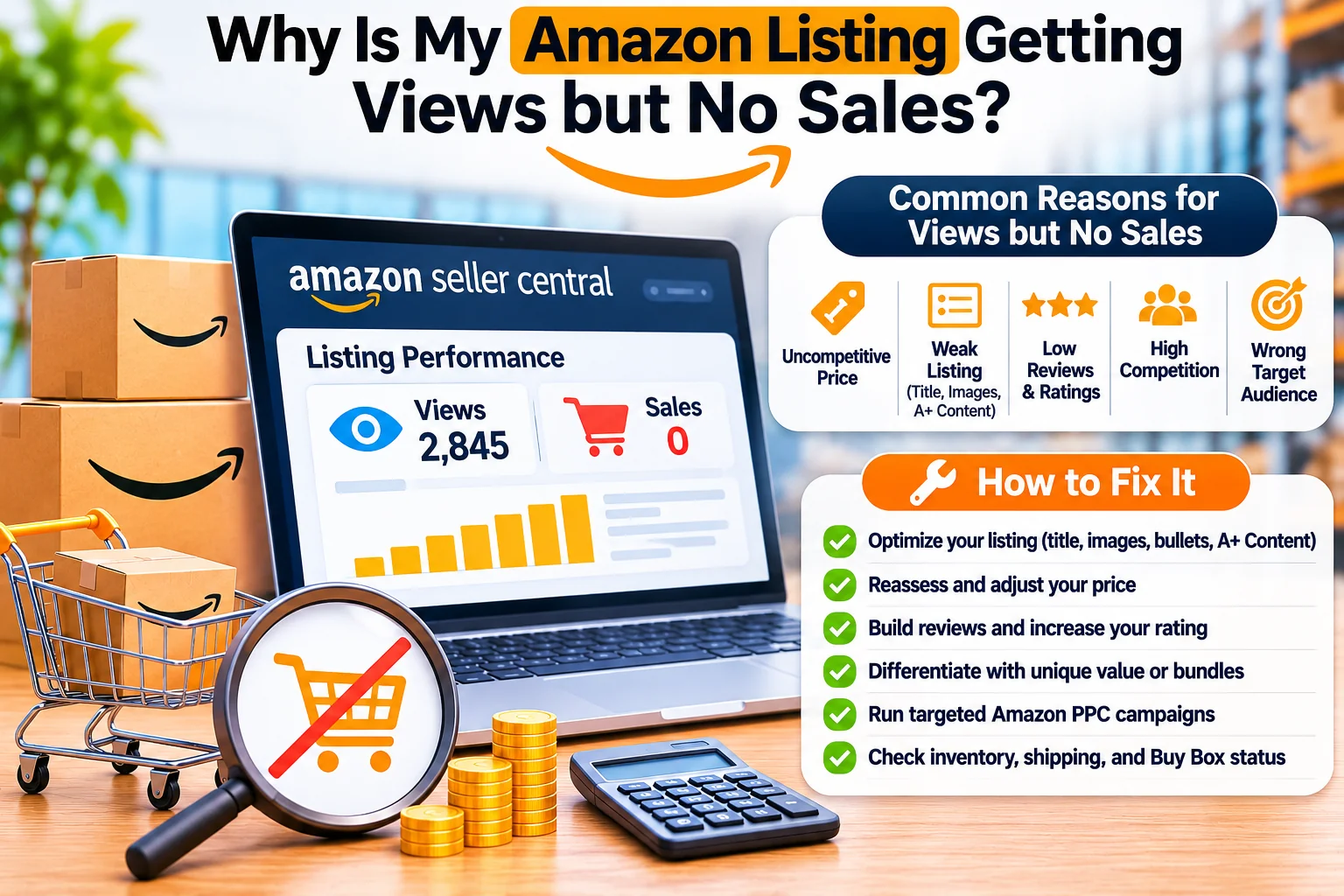
In most cases, the problem is related to conversion rather than visibility alone. Customers may be arriving through irrelevant search terms, encountering unclear product information, comparing an uncompetitive price, questioning the quality of the images, or discovering that the offer does not meet their delivery expectations.
A product can also generate traffic but fail to convert because of limited customer reviews, poor product differentiation, unexpected variations, incomplete technical specifications, or a mismatch between advertising promises and the actual listing.
If an Amazon listing receives views but few or no orders, the seller should investigate traffic quality, product detail page conversion, pricing, customer trust, and offer availability before simply increasing advertising expenditure.
Amazon’s published listing optimization guidance specifically identifies high product views combined with low sales as a potential signal that product content needs improvement. Amazon Ads also recommends reviewing the product detail page when advertising generates clicks without purchases.
However, no single explanation applies to every seller. A new product receiving 20 visits without an order is different from an established product receiving 2,000 visits without sales. The first may have insufficient data for a reliable conclusion, while the second deserves immediate investigation.
For private label businesses, the issue is especially important because advertising costs, fulfillment fees, product sourcing, and customer acquisition expenses all influence profitability. A listing that attracts visitors but converts poorly can generate activity without building a sustainable business.
This guide explains why Amazon products receive traffic without sales, how to evaluate conversion data, which listing elements influence purchasing decisions, and how to improve performance through coordinated Amazon SEO, advertising, pricing, and product development.
Why Does an Amazon Listing Get Views but No Sales?
An Amazon product listing converts when a visitor decides that the item offers sufficient value, credibility, convenience, and relevance to justify a purchase. Customers typically compare products based on visible information such as price, images, reviews, features, delivery estimates, and the overall shopping experience.
A seller may successfully attract traffic without satisfying these purchasing requirements.
For example, a product advertised as a rechargeable educational drawing board might attract shoppers searching for large electronic writing tablets. If the product has a smaller usable writing area than those shoppers expect, the listing may receive clicks but few orders.
The traffic is real, but the offer does not match the visitor’s original intention.
A different seller may have a suitable product but fail to explain its benefits clearly. Customers may see the product images without understanding the included accessories, dimensions, material quality, or practical applications.
In that situation, the product may meet customer needs, but the listing fails to communicate enough information to support a purchasing decision.
The distinction is important because better traffic targeting cannot completely solve a weak product page, just as a beautiful listing cannot turn consistently irrelevant traffic into profitable sales.
Understand the Difference Between Traffic and Conversion
Traffic describes visits or interactions with a product listing. Conversion describes the proportion of those visits that result in a purchase or another defined outcome.
In Amazon Seller Central, Business Reports provide metrics such as Sessions, Page Views, Units Ordered, and Unit Session Percentage, depending on the report and marketplace.
These metrics should not be treated as identical.
A page view generally represents a view of a product detail page, while a session represents a customer visit within Amazon’s reporting definitions. One session may contain multiple page views.
Unit Session Percentage expresses units ordered relative to sessions, which makes it useful for evaluating product-level selling performance. However, because one session can generate more than one ordered unit, it is not always identical to the percentage of individual visitors who completed a purchase.
For example, a product receiving 1,000 sessions and generating 20 ordered units has a Unit Session Percentage of 2%.
If the same product generates 50 ordered units from 1,000 sessions, the metric increases to 5%.
These figures describe performance within a reporting period rather than guaranteeing that every product should achieve a particular benchmark.
Actual conversion patterns depend on product category, price, demand, marketplace, and customer expectations.
Why More Amazon Traffic Does Not Always Mean More Sales
A seller might assume that increasing product views from 500 to 1,000 should approximately double sales. This is not necessarily true.
Traffic volume matters only when the visitors are sufficiently interested in buying the product being offered.
For example, a broad advertising keyword such as “kids toys” may attract customers looking for many unrelated products. A listing for a specific phonics learning activity might receive some clicks from those shoppers, but many visitors will be interested in different toys.
A more specific search such as “phonics word building flash cards” may produce fewer visits while attracting shoppers with clearer purchase intent.
The second phrase can be commercially more relevant even if its search volume is lower.
This is why Amazon product research and customer demand analysis should examine buyer intent rather than focusing only on the largest available keyword volumes.
The goal is to attract visitors whose expectations match the actual product.
Determine Whether the Problem Is Serious Enough to Investigate
An Amazon listing receiving views without sales does not automatically indicate a serious defect.
Conversion data becomes more useful when the reporting period and traffic sample are sufficiently meaningful.
For example, receiving 15 sessions without a purchase provides limited information about the product’s long-term potential.
A seller should not completely redesign the listing based on such a small sample.
However, repeated periods of substantial traffic without orders can indicate that something is preventing customers from purchasing.
Compare the current reporting period with earlier performance, similar products, and relevant marketplace conditions.
Consider whether the product was recently launched, whether inventory availability changed, and whether advertising introduced a new type of traffic.
A conversion problem should be assessed through evidence rather than assumptions about what a successful listing ought to achieve.
Check Whether Your Product Is Actually Purchasable
Before rewriting the title or replacing images, confirm that customers can purchase the product normally.
An active listing does not necessarily guarantee that every visitor sees a suitable purchasing option.
Check the selling price, offer availability, variation selection, shipping configuration, and any restrictions affecting the ASIN.
For example, a product may receive visits even when a particular size or color is unavailable. Shoppers interested in that variation may leave without buying another option.
A seller-fulfilled product may have limited delivery coverage or an unattractive delivery estimate.
An FBA product may have inventory in transfer or another operational state affecting fulfillment timing.
These are offer-level issues rather than problems that can be solved through keyword optimization alone.
The first stage of troubleshooting should establish whether customers can complete a normal purchase under the conditions they expect.
What Are the Main Reasons Amazon Product Listings Receive Views but No Orders?
Low conversion usually results from one or several weaknesses in the relationship between customer expectations and the product offer. A listing may attract relevant shoppers but lose them because of pricing. Another may offer competitive pricing but fail to communicate its features clearly.
Rather than making several changes at once, identify which factors are most likely to be influencing the buying decision.
Product Pricing Does Not Match the Perceived Value
Price is one of the most visible product comparison factors on Amazon.
Customers frequently compare similar products before choosing an offer. If the product appears substantially more expensive than alternatives without communicating a meaningful advantage, visitors may leave without ordering.
For example, suppose several competing storage organizers sell near AED 45 while a new private label version is listed at AED 85.
The higher price may be justified by better materials, additional components, or improved durability. However, if those differences are not visible in the product content, shoppers may perceive the item as overpriced.
The seller should compare products with similar specifications and package quantities rather than simply matching the lowest price in the category.
Lowering the price is not automatically the right solution. Discounts can improve competitiveness while reducing profitability.
A sustainable pricing decision must consider sourcing cost, freight, Amazon fees, advertising expenditure, and the product’s intended market position.
For new sellers, understanding the real costs of starting an Amazon private label business helps establish whether a proposed selling price can support profitable customer acquisition.
The Main Image Fails to Create Confidence
The main product image affects how shoppers interpret the item before and after opening the listing.
An unclear photograph may make a product appear smaller, cheaper, less complete, or different from what the buyer expects.
For example, a resistance band set may include five bands with different resistance levels. If the main image does not clearly show the actual contents, customers may struggle to understand what is included.
Similarly, a product image that exaggerates size or changes the real design can create misleading expectations.
Amazon requires images to comply with marketplace and category rules, and the actual product must be represented accurately.
Secondary images should provide additional context through dimensions, materials, use cases, package contents, and practical benefits.
A professional image sequence is not merely decorative. It helps customers evaluate whether the item meets their requirements.
Product Titles and Descriptions Are Unclear
A listing may contain relevant search keywords yet fail to explain the product in language that customers understand.
For example, a title overloaded with repeated features may appear optimized for search while making the actual product difficult to identify.
Customers need to understand what the item is, how it works, and what differentiates it from alternatives.
A clear title should identify the product and important attributes without unnecessary repetition.
Bullet points should explain meaningful features, supported benefits, and relevant specifications.
Descriptions should answer questions that may otherwise prevent a purchase.
For businesses managing several SKUs, a structured Amazon product listing seller guide can support consistent product information and improve the quality of listing preparation.
Good copy should not rely on exaggerated claims, unsupported performance promises, or vague phrases that could describe almost any competing item.
Customers Cannot See a Meaningful Product Difference
A private label product does not automatically become attractive because it carries a new brand name.
When customers see several similar items with comparable features, they may choose the one with stronger reviews, a lower price, or faster delivery.
A new brand needs to explain why its product deserves attention.
Differentiation may come from better material quality, useful accessories, improved sizing, more practical packaging, or a combination of features that solves a specific customer problem.
For example, a bathroom hook that supports two razors and additional accessories may offer an advantage over a single-purpose holder.
However, the difference must be genuinely supported by the product and clearly presented.
If customers cannot identify the advantage within a reasonable amount of time, they may continue comparing alternatives.
Product differentiation should influence sourcing, imagery, copywriting, and advertising rather than being added as an unsupported marketing statement after manufacturing.
Limited Reviews Reduce Customer Trust
Customer reviews and ratings can influence the confidence shoppers place in a product.
A new listing with few reviews may face stronger competition from established products with substantial feedback.
However, review volume is not the only consideration.
Customers also read negative feedback to understand potential product limitations.
For example, reviews mentioning weak packaging, incorrect dimensions, missing accessories, or difficult assembly may reveal why visitors hesitate to purchase.
Sellers should treat legitimate customer feedback as product development information.
When reviews identify a recurring issue, verify whether the problem originates in manufacturing, packaging, instructions, or inaccurate listing content.
Amazon’s review policies prohibit manipulation and certain incentive practices. Sellers should use permitted methods for requesting feedback rather than attempting to manufacture positive reviews.
A product with fewer reviews can still compete when its value proposition and customer experience are strong, but expectations should remain realistic.
Delivery Estimates Are Less Attractive Than Competitors
Customers shopping on Amazon often evaluate delivery convenience alongside price and quality.
A product with a long estimated delivery period may lose orders to similar items available sooner.
For example, a seller-fulfilled product may require several days of handling before shipment, while a competing FBA item offers a faster delivery estimate.
Even if the product information is accurate and the price is competitive, the difference in delivery time may influence the buying decision.
Sellers should review the customer-facing offer rather than relying only on the inventory quantities displayed in Seller Central.
Check whether the relevant variation is available and whether fulfillment settings are accurate.
For international sellers, inventory planning is particularly important because delayed replenishment can affect normal availability.
A reliable offer depends on both marketing quality and operational execution.
Wrong Variations or Package Quantities Create Confusion
Variation relationships allow customers to choose among eligible options such as colors or sizes, but the options must accurately represent the products being sold.
An incorrect variation image, unexpected quantity, or inconsistent description can discourage purchases.
For example, a shopper searching for a silver adhesive hook set may open a listing and see black images associated with the selected variation.
The customer may hesitate because the detail page appears unreliable.
Similarly, a product title advertising a four-pack while the selected variation contains two units creates uncertainty.
These problems should be corrected through accurate catalog management.
Avoid combining unrelated products into variation families simply to consolidate reviews or traffic.
Clear variation information helps customers understand exactly what they will receive.
The Product Does Not Match the Market’s Actual Needs
Sometimes the listing itself is reasonably strong, but the product offer lacks sufficient appeal.
A seller may have selected an item based on broad category demand without identifying what customers specifically want.
For example, a product may have attractive packaging but omit an accessory that competing products commonly include.
A new seller might also enter a category where established brands offer substantially stronger specifications at comparable prices.
These problems are difficult to solve through title changes alone.
The seller should examine customer reviews, competitor products, search intent, and relevant product attributes.
It may be necessary to improve the next manufacturing order, redesign packaging, create a more useful bundle, or adjust product positioning.
Understanding the differences between Amazon private label, wholesale, and dropshipping business models can also help sellers evaluate the degree of product control and differentiation available within their chosen approach.
How Do Amazon PPC Campaigns Generate Clicks but No Sales?
Amazon advertising can create visibility quickly, but advertising traffic must still be relevant to the product and its purchasing audience.
Sponsored Products operates primarily through a cost-per-click model, meaning sellers can incur advertising charges when customers click an eligible advertisement.
A campaign generating many clicks without purchases may indicate weak traffic targeting, an uncompetitive product offer, or a detail page that does not satisfy customer expectations.
It is important to distinguish these causes before increasing or reducing bids.
Broad Keywords Attract Irrelevant Customers
Broad keyword targeting can expose a listing to customer searches that do not match the product closely enough.
For example, a seller advertising a phonics learning book against a very broad term such as “educational toys” may attract shoppers seeking electronic games, puzzles, science kits, or construction toys.
Some customers may click the advertisement out of curiosity but leave after recognizing that the product is not what they intended to buy.
The campaign produces activity without sufficiently qualified demand.
A useful advertising review examines customer search terms, targeting types, clicks, spending, and attributed sales.
More specific terms may align better with actual product features and buying intent.
However, low-volume phrases should not automatically replace every broader keyword.
Campaign strategy should reflect the product’s goals, data volume, and budget.
Sellers learning campaign fundamentals can use the Amazon PPC basics presentation to better understand targeting, campaign structure, and advertising metrics.
Automatic Campaigns Need Search-Term Analysis
Automatic targeting can help discover relevant customer searches and product opportunities.
However, not every search associated with an automatic campaign will be commercially useful.
A seller may discover that some searches generate clicks without producing orders.
The correct response depends on the available data.
A few clicks without sales are not automatically sufficient evidence that a keyword should be excluded.
However, consistently expensive and irrelevant traffic may justify negative targeting or other campaign adjustments.
Review which searches describe the actual product and which reflect a different purchase intention.
Strong search terms may be candidates for further evaluation in manual campaigns.
This process connects advertising discovery with product relevance rather than treating traffic volume as the only objective.
High CPC Can Make Weak Conversion Expensive
Cost per click influences the financial consequences of low conversion.
Suppose a campaign receives 200 clicks at an average cost of AED 2.50.
The advertising spend would be AED 500.
If those clicks generate no attributed sales during the reporting period, the immediate campaign results show spending without attributed revenue.
However, advertising attribution windows and reporting delays should be considered before making definitive conclusions.
A seller should also investigate whether purchases are occurring through other channels and whether the campaign supports an intentional awareness objective.
For performance campaigns focused on direct sales, sustained spending without conversion requires attention.
The solution may involve adjusting targeting, improving the listing, reviewing price competitiveness, or reducing exposure to unproductive searches.
Simply increasing the budget does not correct the underlying issue.
Sponsored Products Traffic May Reveal Listing Weaknesses
A useful distinction is whether visitors fail to click the advertisement or click but fail to purchase.
Low impressions may indicate limited delivery or targeting eligibility.
Low click-through rate may suggest problems with the product’s search-result presentation, including price, image, title, or relevance.
When advertisements receive clicks but few orders, the issue may involve the product detail page or the suitability of the traffic.
Amazon Ads specifically advises sellers to examine product content and customer experience when campaign engagement does not translate into purchases.
For example, a main image may attract interest, but the secondary images may fail to demonstrate the product’s value.
The correct diagnosis connects advertising metrics with listing quality.
A structured Amazon private label PPC launch strategy should therefore define traffic objectives, product readiness, conversion monitoring, and profitability limits together.
Advertising and Organic Performance Should Be Evaluated Separately
A product can receive organic search traffic and sponsored advertising traffic during the same reporting period.
These visitors may behave differently.
For example, a shopper searching for the exact product type may have a stronger purchasing intention than someone clicking a broad display placement.
Amazon Ads provides metrics such as impressions, clicks, spend, and attributed sales.
Seller Central Business Reports provide broader product-level information, including sessions and units ordered.
These reporting systems have different definitions and attribution rules.
Do not divide advertising orders by total Seller Central sessions and describe the result as an official Amazon Ads conversion metric.
Instead, analyze each reporting source according to its actual definitions.
Comparing the direction of traffic and sales trends can still help identify whether the problem is associated with advertising, the offer, or both.
ACOS Cannot Be Interpreted Without Product Margin
Advertising Cost of Sales, commonly called ACOS, compares advertising spend with attributed advertising sales.
ACOS = Advertising Spend ÷ Advertising-Attributed Sales × 100.
For example, an advertising campaign spending AED 300 and generating AED 1,000 in attributed sales has an ACOS of 30%.
Whether that performance is commercially acceptable depends on the product’s economics.
A product with a narrow contribution margin may not support that advertising cost.
A product with a higher margin or a specific launch objective may be evaluated differently.
When a campaign generates no attributed sales, the standard ratio does not provide a meaningful finite ACOS figure.
The seller should analyze spend, clicks, attribution timing, and product conversion instead of reporting a misleading percentage.
Amazon advertising optimization should be connected with actual product margins, not simply an arbitrary ACOS target.
How Can You Improve Amazon Listing Conversion Rates in 2026?
Improving conversion requires identifying and removing the barriers that prevent customers from purchasing.
The right changes depend on whether the issue involves traffic relevance, product content, customer trust, pricing, fulfillment, or the product itself.
A structured optimization process is more reliable than changing every listing element simultaneously.
Amazon’s official listing guidance recommends reviewing product images and descriptions when listings receive substantial views but generate relatively few sales.
The objective is to present accurate information that helps customers understand the product and make an informed purchasing decision.
Improve the Main Image and Secondary Images
Images should communicate both product identity and practical value.
The main image must follow the relevant Amazon category rules and clearly represent the item customers will receive.
Secondary images can explain dimensions, materials, features, compatible uses, and included accessories.
For example, a rechargeable LED drawing board may benefit from an image identifying its actual dimensions, another showing the included markers, and another demonstrating how the board is used.
A household storage accessory may require photographs showing installation, supported surfaces, and real product scale.
Avoid exaggerating physical dimensions, digitally changing product components, or including unsupported claims.
Professional imagery should reduce purchasing uncertainty rather than create unrealistic expectations.
Write Product Copy Around Customer Questions
Amazon listing copy should answer the questions customers are likely to ask before buying.
For example, someone considering a suction cup holder may want to know whether it requires drilling, which surfaces are suitable, and whether it can be removed.
Someone evaluating a handheld microscope may want to know its screen size, power source, focus controls, and included accessories.
These questions should guide the title, bullet points, description, and enhanced content.
Keyword research remains useful, but keywords should be integrated naturally into accurate explanations.
Avoid repeating the same phrase merely to increase keyword density.
Clear product information can support both traditional search relevance and the conversational questions shoppers ask AI-assisted discovery tools.
However, there is no verified technique that guarantees special placement in Amazon’s AI shopping experiences.
Use A+ Content Where Eligible
A+ Content can help eligible sellers explain their products through enhanced imagery, formatted content, and supported modules.
For a technical product, A+ Content may clarify how the item works, what is included, and which features distinguish it from other options.
For a private label brand, it may also communicate relevant brand information and product comparisons.
Amazon’s published research has associated A+ Content with improvements in sales under certain conditions, but these results do not guarantee the same outcome for every listing.
The value of enhanced content depends on its quality, product relevance, and customer usefulness.
A+ Content should not contradict the standard listing or make claims that lack evidence.
For example, a product with a verified 1,000 mAh battery should not be described as having a different capacity simply to make the marketing more attractive.
Review Price Positioning and Offer Value
Price optimization should begin with a comparison of similar products and their actual specifications.
A seller should examine package quantity, materials, customer ratings, delivery, and included accessories before deciding whether a price difference is justified.
For example, a product may appear expensive because competitors sell single units while the new listing includes a larger bundle.
If the listing does not explain the bundle clearly, shoppers may not recognize the additional value.
Improving the communication of package contents can sometimes be more appropriate than immediately discounting the product.
Where pricing is genuinely uncompetitive, a seller may need to review manufacturing costs, logistics, or positioning.
Promotions can support specific objectives, but they should be evaluated against contribution margin.
A price reduction that increases sales while destroying profitability is not necessarily a successful optimization.
Improve Product Differentiation Before the Next Inventory Order
A listing cannot manufacture genuine product advantages that do not exist.
If competing items consistently offer stronger specifications, better accessories, or more convenient designs, the seller may need to improve the product itself.
Customer reviews and competitor comparisons can reveal opportunities.
For example, buyers may complain that an existing product’s packaging is difficult to open or that instructions are unclear.
A new brand may be able to offer a more practical experience through improved packaging or better documentation.
These changes should be verified and implemented through manufacturing rather than merely promised in the listing.
For businesses preparing new SKUs, a detailed Amazon product launch strategy for private label brands should connect customer insights with sourcing, listing development, advertising, and inventory decisions.
Consider Amazon Manage Your Experiments
Amazon provides Manage Your Experiments for eligible brands and products.
The tool allows qualifying sellers to test different versions of supported product content, including titles, images, bullet points, descriptions, and A+ Content, depending on eligibility and available features.
Amazon explains that eligible products must belong to enrolled brands and have sufficient recent traffic to support statistically useful experiments.
For example, a seller may want to understand whether an alternative main image improves customer response.
Rather than replacing multiple listing elements based only on intuition, a controlled experiment can provide additional evidence.
However, experiments are not appropriate for every product or every stage of its lifecycle.
A listing with insufficient traffic may not meet eligibility requirements, and results must be interpreted according to the test conditions.
Do not assume that a winning test version will guarantee continued performance under every market condition.
Use Brand Analytics to Understand Customer Behavior
For eligible brands, Amazon Brand Analytics provides aggregated information about customer search and purchasing behavior.
The Search Query Performance dashboard can help sellers examine relevant search queries and supported metrics such as impressions, clicks, cart additions, and purchases.
For example, a product may receive substantial search impressions but relatively few clicks.
That situation suggests a different problem from a product receiving strong clicks but few purchases.
The first may require examining search-result presentation, while the second may justify a deeper review of the product detail page and offer.
However, analytics must be interpreted in context.
Low conversion may reflect price competition, product availability, traffic relevance, or other conditions rather than a single weak listing element.
The objective is to identify meaningful patterns and test plausible improvements.
How Do You Diagnose Amazon Views Without Sales Using Seller Central Data?
A reliable diagnosis requires more than checking the number of product views.
Sellers should combine Business Reports, advertising data, inventory information, customer feedback, and product-level economics.
Each source answers a different question.
Business Reports help show whether the product is attracting visits and generating ordered units.
Advertising reports help evaluate campaign delivery, targeting, and attributed results.
Inventory and listing tools help establish whether the offer is available and accurate.
Customer reviews can reveal concerns about the product experience.
Financial records help determine whether a proposed solution is commercially sustainable.
Begin With Sessions and Unit Session Percentage
Open the appropriate Business Reports in Seller Central and select the relevant marketplace and reporting period.
Review the product’s sessions, page views, units ordered, and Unit Session Percentage.
Compare the current period with earlier performance.
For example, suppose a product receives 800 sessions and generates 16 ordered units.
Its Unit Session Percentage would be 2%.
If the seller previously generated 40 ordered units from a similar number of sessions, the decline deserves investigation.
However, the comparison should account for changes in price, advertising campaigns, inventory availability, seasonality, and traffic sources.
An isolated metric rarely explains the entire problem.
Check Whether Traffic Quality Has Changed
A sudden increase in visits without corresponding sales may reflect a change in the type of shoppers reaching the listing.
For example, a new broad-match PPC campaign may introduce visitors searching for loosely related products.
A seasonal promotion may attract customers comparing prices without intending to buy immediately.
A change in keyword targeting can also affect the balance between high-intent and exploratory traffic.
Review relevant advertising search-term reports and product-level trends.
Do not treat all sessions as if they originated from the same keyword or placement.
The objective is to establish whether the additional traffic is commercially relevant.
Compare Product Performance Against Similar Offers
Conversion problems become easier to interpret when the product is evaluated alongside genuinely comparable alternatives.
Review selling price, package quantity, images, materials, features, review sentiment, and delivery conditions.
Avoid comparing a premium bundle directly with a basic single-unit product without accounting for their differences.
For example, a product may receive fewer orders because its main image fails to communicate that additional accessories are included.
Alternatively, a higher-priced item may need stronger evidence of durability or performance.
Competitor analysis should help the seller understand customer expectations, not encourage copying protected content or making unsupported claims.
A realistic improvement plan focuses on the product’s actual strengths and limitations.
Review Cart Additions Where Data Is Available
Eligible sellers may have access to Brand Analytics reports that include cart addition information.
These metrics can provide another perspective on the shopping journey.
For example, a product receiving clicks but relatively few cart additions may be failing to convince visitors that it meets their needs.
A product receiving cart additions but fewer purchases may require investigation of offer conditions and other purchasing barriers.
However, Amazon does not necessarily provide a complete customer-level explanation for abandoned purchases.
Sellers should avoid claiming that every cart addition without a purchase results from a particular issue.
The data is useful for forming hypotheses, not proving individual customer motivations.
Build a Product Conversion Audit
A practical audit should establish whether the product is available, whether the traffic is relevant, and whether customers receive sufficient information to make a purchase.
Start with the current listing status and customer-facing offer.
Then review image quality, title clarity, bullet points, product specifications, A+ Content, price competitiveness, reviews, and delivery estimates.
Examine advertising search terms and the relationship between traffic and attributed sales.
Finally, compare the product’s economics with the cost of potential changes.
For example, investing in improved photography may be reasonable when a product already receives relevant traffic but lacks clear visual explanations.
However, additional photography may not solve a product whose main problem is an unsuitable price or incorrect advertising targeting.
Each proposed improvement should address a specific observed weakness.
Prioritize Changes According to Business Impact
Not every listing issue deserves the same attention.
An unavailable product or incorrect variation can prevent purchases directly and should be investigated promptly.
A misleading main image may create substantial uncertainty and may also raise compliance concerns.
A less effective secondary image may be important but could represent a lower-priority optimization opportunity.
Sellers should evaluate the likely impact, cost, and confidence associated with each change.
For example, correcting an inaccurate package quantity may be more urgent than experimenting with minor title wording.
A coordinated Amazon marketplace growth strategy for private label sellers should connect product conversion improvements with inventory, advertising, profitability, and long-term brand development.
Measure Results After Each Meaningful Improvement
After implementing a change, allow an appropriate observation period before deciding whether it worked.
Consider the amount of traffic, the timing of the change, and other events occurring during the same period.
For example, a price reduction introduced during a major shopping event may coincide with higher sales, but the event itself can also affect demand.
Likewise, improved conversion following a new image may be influenced by advertising targeting or stock availability.
When supported and eligible, controlled testing can provide stronger evidence.
Otherwise, sellers should document changes and evaluate trends carefully.
Avoid declaring a guaranteed improvement from a small number of orders.
The objective is to build a repeatable optimization process rather than rely on isolated successes.
How Can iNNOVEX Enterprises Help Turn Amazon Product Views Into Sales?
Amazon conversion problems often involve several connected activities.
A product may need clearer images, more relevant advertising traffic, better pricing, stronger product differentiation, or improved inventory availability.
Addressing only one activity without reviewing the others can produce limited results.
At iNNOVEX Enterprises, an Amazon SPN agency, we support sellers with marketplace management, listing optimization, product research, advertising, inventory planning, and brand development.
Our approach focuses on evaluating product performance and identifying opportunities that align with the seller’s commercial objectives.
For example, a new private label business may need help understanding why an item receives clicks but fails to generate orders.
An established brand may require a deeper review of advertising efficiency, listing content, and customer behavior across several ASINs.
The correct support depends on the product, marketplace, business stage, and available data.
Amazon Listing Optimization and Product Content
We support businesses with accurate product titles, descriptions, bullet points, relevant attributes, product images, and eligible enhanced content.
The objective is to help customers understand the product and make informed purchasing decisions.
For example, a listing may benefit from clearer dimension images, better explanations of included accessories, or a more accurate presentation of key features.
Content optimization should reflect the physical product and comply with the relevant Amazon marketplace requirements.
Amazon PPC Campaign Analysis
Our PPC services support relevant keyword research, campaign structure, targeting, bid analysis, and performance monitoring.
For products receiving clicks without sales, the priority is to determine whether the campaigns attract suitable customers and whether the detail page supports conversion.
Advertising performance should be evaluated in the context of product margins and business objectives.
We do not treat increasing ad spend as an automatic solution to weak sales.
Amazon Product Research and Market Positioning
We help sellers evaluate customer demand, competitive conditions, product differentiation, and relevant commercial considerations.
This is particularly important when a product struggles despite substantial traffic.
Sometimes the appropriate improvement involves changes to the next manufacturing order rather than only editing the existing listing.
Product development decisions should be based on reliable evidence, supplier capabilities, and the seller’s financial circumstances.
Amazon Account Management and Performance Monitoring
For businesses managing multiple products, regular account analysis can help identify weak conversion trends before they become expensive.
Our account management support can include reviewing relevant marketplace data, catalog information, inventory availability, and advertising performance.
For example, a sudden decline in orders may be associated with a pricing change, stock issue, listing update, or shift in advertising traffic.
A coordinated review makes it easier to prioritize the actual business problem.
Amazon Growth Support for International Sellers
Marketplace expansion requires careful attention to customer expectations, product pricing, language, fulfillment, and competition.
A product that performs well in one country may require a different positioning strategy elsewhere.
For example, customer demand and purchasing considerations may vary between Amazon UAE and Amazon USA.
Our services support businesses operating across relevant international marketplaces.
Sellers exploring regional growth can also review the iNNOVEX Amazon UAE sales growth case study for additional context on marketplace performance improvement.
Individual results depend on each business’s circumstances and should not be treated as guaranteed outcomes.
Frequently Asked Questions About Amazon Views but No Sales
Why is my Amazon listing getting views but no sales?
Common causes include irrelevant traffic, weak product images, unclear descriptions, uncompetitive pricing, limited customer trust, poor differentiation, and fulfillment conditions that do not meet buyer expectations.
What is a good Amazon conversion rate?
There is no universal conversion rate that applies to every Amazon category. Evaluate the relevant reporting metric against your product’s history, market conditions, traffic sources, and profitability.
Why does my Amazon PPC campaign get clicks but no orders?
The advertising may be attracting irrelevant searches, or the product detail page may not convince visitors to purchase. Review search terms, targeting, price, content quality, and attributed sales.
Can changing Amazon product images increase sales?
Clearer images can help customers understand a product and may improve conversion. However, outcomes depend on the original problem, product competitiveness, and other factors.
Does lowering my Amazon product price guarantee more sales?
No. A lower price may improve competitiveness, but it can also reduce margins. Pricing should reflect product value, relevant competition, and operating costs.
Can I get Amazon sales without many reviews?
Yes. Products with limited review history can generate sales, although established competitors with stronger customer feedback may have an advantage. Accurate content, value, and customer experience remain important.
How do I check Amazon listing conversion performance?
Review relevant Seller Central Business Reports, including sessions, ordered units, and Unit Session Percentage. Use advertising and Brand Analytics data where available for additional context.
Does Amazon A+ Content improve conversion?
Useful A+ Content can help explain products and support customer decisions. However, access depends on eligibility, and improved conversion is not guaranteed.
Should I increase PPC spending when my listing gets views but no sales?
Not automatically. First investigate traffic relevance, listing quality, pricing, customer trust, and product availability. Additional spending on an unresolved problem can increase losses.
Can an Amazon agency help improve conversion?
An experienced agency can evaluate product listings, advertising, customer search behavior, and marketplace operations. It can recommend and implement appropriate improvements, but no provider can guarantee a specific conversion rate or sales result.
Conclusion: Fix the Reason Shoppers Are Not Buying
An Amazon listing receiving views but no sales is not necessarily suffering from a lack of visibility. It may already be reaching customers while failing to convert their interest into purchases.
The correct response begins with understanding the quality of the traffic and the product’s customer-facing offer.
Review whether shoppers can purchase the item, whether its price is competitive, whether the images and descriptions communicate the real benefits, and whether advertising targets relevant searches.
Use Seller Central reports and supported Amazon analytics tools to identify meaningful patterns.
Avoid treating a small number of visits as proof that the product has failed, but investigate sustained traffic without orders before increasing advertising budgets.
For some products, better listing content and more relevant traffic may improve performance. For others, a deeper product development or pricing decision may be necessary.
The long-term objective is not simply generating more product views. It is creating a commercially sustainable offer that attracts suitable customers, communicates genuine value, and generates orders at an acceptable cost.
As an Amazon SPN agency, iNNOVEX Enterprises provides Amazon listing optimization, PPC management, product research, account management, and marketplace growth support for businesses selling across UAE, USA, UK, Saudi Arabia, and other marketplaces.
Businesses requiring coordinated launch and conversion support can explore our Amazon agency in UAE for global private label launches.
If your Amazon listing receives traffic but consistently fails to generate sales, the next productive step is to audit the product’s traffic, offer, content, and profitability before committing to additional advertising expenditure.