An Amazon product listing can rank for popular keywords, generate thousands of impressions, and attract a steady flow of visitors without producing profitable sales. For many sellers, the problem is not a complete lack of search visibility. It is attracting shoppers whose needs do not closely match the product being offered.
A seller might target a broad keyword with substantial search demand, invest heavily in advertising, and discover that the resulting clicks rarely convert into orders. Another seller may focus on a smaller group of specific product searches and generate more relevant traffic with a lower advertising budget.
The difference often comes down to keyword intent, product relevance, customer expectations, and the quality of the offer.
High-converting Amazon keywords are search terms that attract shoppers who are more likely to purchase a specific product because the search closely matches its features, intended use, price range, or buying requirements.
Finding these keywords requires more than choosing phrases with the highest estimated search volume. Sellers need to understand how customers search, which products they compare, what motivates their purchasing decisions, and whether the listing can satisfy those expectations.
For example, a business selling a rechargeable children’s digital microscope may discover that a broad term such as “microscope” attracts customers searching for laboratory equipment, professional instruments, and advanced optical devices.
A more specific phrase describing a handheld digital microscope for children may attract fewer shoppers but align more closely with the actual product.
That difference matters because irrelevant traffic can increase advertising costs without producing enough sales to justify the expenditure.
In 2026, Amazon sellers have access to several research methods that can help identify commercially relevant keywords. Amazon Brand Analytics provides insights into customer searches and purchasing behavior for eligible brands. Product Opportunity Explorer helps sellers investigate customer demand and product niches. Sponsored Products search term reports provide evidence about searches and contexts associated with advertising activity.
Competitor analysis, customer reviews, search suggestions, and product-level performance data can add further context.
However, no research method guarantees that a keyword will convert profitably. Search demand changes, competitors adjust their offers, customer preferences evolve, and product pricing influences purchasing decisions.
The objective is to build a keyword strategy based on evidence rather than assumptions.
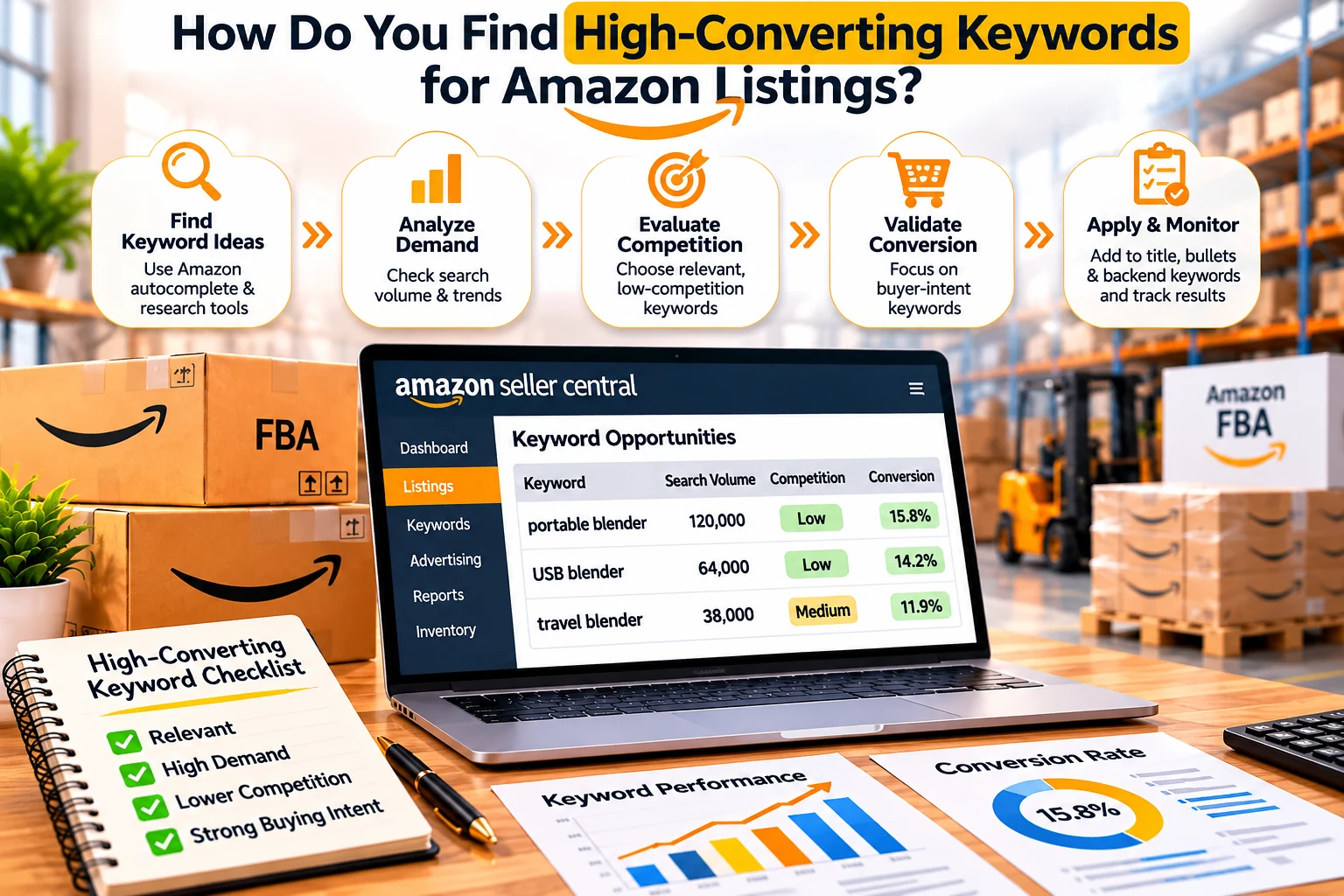
This guide explains how to find high-converting Amazon keywords, distinguish purchase-intent searches from broad discovery terms, analyze Amazon’s first-party data, optimize listing content, and use PPC campaigns to identify search terms that support sustainable sales.
What Makes an Amazon Keyword High-Converting?
A high-converting keyword is not necessarily the keyword with the largest search volume or the highest estimated ranking difficulty. It is a phrase that connects a customer’s intention with a product that can satisfy that intention.
When someone searches on Amazon, the wording often reveals what type of product they want, which characteristics matter, and how specifically they have defined their requirements.
For example, a shopper searching for “bathroom accessories” may be exploring many unrelated products. The same shopper searching for “suction razor holder for shower” has expressed a more specific requirement.
A product designed as a suction-mounted razor holder may be more relevant to the second search.
However, specificity does not automatically guarantee a higher conversion rate. The listing must still offer an attractive combination of price, quality, reviews, delivery, and product information.
Keyword relevance creates the opportunity for conversion, while the product offer and detail page influence whether the shopper actually buys.
This distinction should guide every Amazon keyword research decision.
Understand Customer Search Intent
Amazon keyword research begins with understanding what customers want to accomplish.
Some searches are broad and exploratory. Others identify a product category, a particular feature, or a specific use case.
A shopper searching for “educational toys” may be comparing several product types.
Someone searching for “phonics word family flash cards” is looking for a more defined product.
The second search may be more relevant to a seller offering phonics learning cards, but the conversion opportunity still depends on whether the product matches the expected age range, design, quantity, and educational features.
Sellers should group keywords according to the customer need they express.
Product-type terms explain what the item is. Feature-based terms describe characteristics such as material, size, or functionality. Use-case terms indicate where or how the product will be used. Compatibility terms identify products designed for particular devices or situations.
A useful research process asks whether the customer using a particular phrase would reasonably expect to find the product being sold.
If the answer is uncertain, the keyword may need further validation before receiving a significant advertising budget.
Why High Search Volume Does Not Guarantee Sales
Search volume describes how frequently a query is used within the reporting system and period being measured.
It does not establish how many customers will buy a particular product.
For example, a broad search may attract many shoppers with different intentions.
The search results may include several product categories, price ranges, and established brands.
A new seller targeting the broad phrase may receive limited exposure or attract visitors who are not interested in the actual product.
By contrast, a more specific search may have lower demand but a closer relationship to a particular item.
That can make the term commercially useful, especially when advertising costs and competition are manageable.
Sellers should evaluate keyword volume alongside product relevance, competitive conditions, and available conversion evidence.
For businesses preparing new private label products, the iNNOVEX Amazon private label product research guide provides additional context for connecting customer demand with product selection.
The objective is to discover which customers are searching for products like yours, not simply which phrases generate the largest number of searches.
Long-Tail Keywords Can Reveal Specific Buying Requirements
Long-tail keywords are more specific search phrases, often containing several words that describe a product or requirement.
They may include attributes such as material, quantity, size, compatibility, mounting method, or intended application.
For example, a seller offering a wall-mounted bathroom accessory might investigate searches involving waterproof construction, adhesive installation, or particular surface compatibility.
These phrases can reveal what shoppers care about.
However, only attributes that accurately describe the product should be targeted.
A waterproof keyword is inappropriate if the item has not been designed or verified for the relevant conditions.
Similarly, a product should not be advertised as compatible with a specific device without reliable evidence.
Amazon Ads notes that more specific long-tail terms can be useful for reaching relevant customers and may support stronger conversion performance.
Nevertheless, lower search volume can limit the number of available opportunities.
A balanced keyword strategy usually combines relevant product-category terms with more specific phrases rather than relying entirely on one type.
Product Relevance Is More Important Than Keyword Density
Keyword density is not a reliable substitute for relevance.
Repeating the same product phrase throughout the title, bullets, and description does not make an unrelated item suitable for a customer’s search.
A listing should describe the actual product in clear language.
For example, if a product is a rechargeable writing board, the listing should communicate its actual charging method, dimensions, included accessories, and relevant features.
Adding unrelated phrases simply because they have high search demand can mislead shoppers and reduce advertising efficiency.
Amazon’s official SEO guidance emphasizes relevant product terms and accurate listing information.
The purpose of optimization is to help Amazon and customers understand what the product is.
An effective listing should cover the most important attributes without sacrificing readability.
High-converting keywords should therefore be selected as part of the broader product communication strategy rather than inserted mechanically.
How Do You Find High-Converting Keywords Using Amazon’s Research Tools?
Amazon provides several tools that can help sellers identify search demand and investigate customer behavior.
The most useful sources depend on whether the business is researching a new product, managing an established listing, or analyzing existing advertising activity.
Different tools answer different questions.
Product Opportunity Explorer helps investigate niches and potential demand.
Brand Analytics provides aggregated search and purchasing insights for eligible brands.
Advertising reports help identify searches and targeting contexts associated with actual campaign activity.
These sources should be interpreted according to their own definitions.
Use Amazon Product Opportunity Explorer
Amazon Product Opportunity Explorer is designed to help sellers investigate customer demand and potential product opportunities.
Eligible sellers can explore niches through categories, keywords, products, and available recommendations.
Amazon explains that the tool analyzes customer search, browsing, and purchasing behavior to help identify which products customers tend to consider or buy after searching for particular terms.
For keyword research, this can provide a useful starting point.
For example, a seller researching household organization may discover related search groups that focus on different materials, installation methods, or storage requirements.
These groups can help identify phrases associated with particular customer needs.
However, niche-level demand does not prove that every keyword will convert for a specific ASIN.
A search term may be popular because customers prefer a different price point, brand, or product configuration.
The seller must compare the niche data with the actual product being offered.
Product Opportunity Explorer should therefore support the research process rather than replace listing-level validation.
Analyze Amazon Brand Analytics
Amazon Brand Analytics provides several dashboards for eligible brand owners.
The Search Query Performance dashboard helps brands understand search activity associated with their products.
Available metrics include query volume, impressions, clicks, cart additions, and purchases.
These measurements can reveal how customers interact with products across different stages of shopping.
For example, a brand may identify a search query that generates substantial impressions but comparatively few clicks for its products.
That result may justify reviewing the product’s search-result presentation or relevance.
Another query may generate fewer impressions but a stronger pattern of clicks and purchases.
That term may deserve further investigation for listing content and advertising.
However, the reporting scope must be understood carefully.
Brand-level metrics and ASIN-level metrics are not interchangeable, and query volume across Amazon should not be described as the number of searches received by one listing.
For brands managing several products, Search Query Performance can help identify relevant language and opportunities that may not be obvious from broad keyword research.
Use the Top Search Terms Dashboard
Amazon’s Top Search Terms dashboard provides a broader perspective on customer searches.
Amazon explains that it lists keywords customers use to find products, together with associated leading products, categories, and brands.
This can help sellers understand the competitive environment surrounding particular searches.
For example, a seller considering a keyword may discover that its associated leading products belong to a different product type than originally expected.
That finding can indicate that the phrase is less suitable than its search volume suggests.
A different keyword may be closely associated with products that share the seller’s important features.
The dashboard can therefore support relevance analysis and competitor research.
However, a leading product’s presence does not mean the new seller will achieve the same performance.
The data should be used to understand customer behavior and the products customers currently favor.
It should not be treated as proof of guaranteed sales potential.
Review Search Catalog Performance
Search Catalog Performance provides insights into how customers interact with a brand’s products across search-related shopping stages.
Amazon describes the dashboard as a way to identify potential drop-off points affecting discoverability and conversion.
For example, an ASIN may receive considerable search exposure without generating a proportional number of clicks.
This can suggest that the listing’s main image, title, price, or product positioning deserves investigation.
Another ASIN may attract clicks but generate relatively few purchases.
That can indicate a different issue involving product detail page content, reviews, offer value, or customer expectations.
The tool does not reveal every individual customer’s motivation.
Instead, it provides aggregate measurements that can help sellers form hypotheses.
Keyword selection should be connected to these observations because attracting a shopper is only the first stage of earning an order.
Examine Amazon Search Suggestions
Amazon’s search interface can reveal useful variations of customer language.
Begin with the primary product category and explore more specific searches involving actual attributes.
For example, a seller offering reusable bathroom hooks could investigate how customers describe the mounting method, material, quantity, and intended location.
Search suggestions can help identify relevant wording that sellers may overlook when preparing their first listing.
However, search suggestions are not verified monthly search volume figures.
They should be treated as research ideas that require additional evaluation.
Some suggested phrases may be associated with different products or customer needs.
Before targeting a term, examine the products appearing for that query.
The keyword should accurately describe the item and make commercial sense for the seller.
Use Customer Reviews as a Keyword Research Source
Customer reviews can reveal how buyers naturally describe products.
For example, reviews may repeatedly mention a specific feature, application, accessory, or product limitation.
These observations can help sellers understand which attributes are important to customers.
A buyer may use a phrase that differs from the manufacturer’s technical description.
That language may be useful when developing listing copy, provided it accurately represents the product.
However, a phrase appearing in a review is not automatically a popular or high-converting keyword.
Review analysis is primarily qualitative.
Sellers should combine it with search data and performance information before assigning priority.
Customer language can also guide product improvements.
If buyers consistently mention confusion about size or compatibility, clearer product attributes and images may be more valuable than simply adding another keyword.
How Can Amazon PPC Search Term Reports Reveal Keywords That Actually Convert?
Keyword research becomes more commercially useful when sellers can evaluate actual campaign performance.
Amazon Sponsored Products provides reports that help identify customer searches and other relevant targeting contexts associated with advertising activity.
The search term report is particularly useful because it provides evidence about clicks and attributed outcomes.
However, a keyword target and the actual search term associated with an advertisement are different concepts.
A seller may target a broad keyword while the advertisement appears for several different customer searches.
Understanding this difference is essential for efficient PPC optimization.
Understand the Difference Between Keywords and Search Terms
A keyword is a targeting expression selected by the advertiser.
A search term is the actual customer query or, in certain Amazon Ads contexts, a term inferred from the placement context.
For example, a seller may target the broad keyword “shower holder.”
The advertisement could become eligible for related searches that vary in wording and customer intention.
Some searches may be relevant to a specific suction-mounted razor holder, while others may refer to different bathroom products.
Amazon’s May 2026 search term report documentation explains that Sponsored Products reports can include customer searches and inferred matching terms for applicable non-search contexts.
This means sellers should not assume that every reported search term represents an exact phrase typed into Amazon’s search box.
The report remains useful, but interpretation must reflect Amazon’s reporting definitions.
A responsible PPC strategy evaluates the actual terms and contexts associated with campaign performance rather than treating every keyword target as one uniform audience.
Identify Search Terms Associated With Orders
A practical starting point is to review search terms associated with attributed advertising sales.
For each relevant term, evaluate clicks, spending, attributed orders, attributed revenue, and the reporting period.
For example, a search term may generate 40 clicks and five attributed orders.
Another may generate 60 clicks without attributed sales.
The first term provides stronger evidence of conversion within the observed sample.
However, the results must be interpreted according to attribution timing, campaign context, and data volume.
A single order from a small number of clicks is not sufficient to establish a permanently high-converting keyword.
Likewise, zero orders from a small sample do not automatically justify excluding a relevant search.
The objective is to identify recurring patterns supported by enough data to inform reasonable decisions.
Sellers developing campaigns can review the iNNOVEX Amazon PPC basics presentation for additional guidance on advertising structure and performance measurement.
Calculate Keyword Conversion Performance Correctly
A simplified advertising conversion calculation compares attributed orders with clicks.
Advertising Conversion Rate = Attributed Orders / Ad Clicks × 100.
Suppose a search term generates 100 clicks and six attributed orders during a suitable reporting period.
Its illustrative advertising order conversion rate would be 6%.
A second search term generating 50 clicks and five attributed orders would have an illustrative rate of 10%.
However, the second term does not automatically deserve a larger budget.
The seller should also consider average order value, advertising cost, contribution margin, conversion variability, and the number of available searches.
Amazon’s reported advertising conversion definitions and attribution rules should take priority when comparing official campaign metrics.
A keyword converting well at an expensive cost per click may generate less profit than a moderately converting term with lower acquisition costs.
Conversion rate should be evaluated as one component of commercial performance.
Compare ACOS and Conversion Together
Advertising Cost of Sales measures advertising spend relative to attributed advertising revenue.
ACOS = Advertising Spend / Advertising-Attributed Sales × 100.
For example, a search term generating $500 in attributed sales from $100 in advertising spend has an ACOS of 20%.
Whether that result is profitable depends on the product’s actual economics.
A keyword may convert frequently but still produce unacceptable advertising costs when the cost per click is high.
Another term may convert less frequently while generating stronger contribution because its acquisition cost is lower.
Sellers should therefore avoid ranking keywords entirely by conversion rate.
A useful prioritization process considers relevance, attributed sales, conversion performance, ACOS, and the expected profit after relevant costs.
For private label brands, the iNNOVEX Amazon private label PPC launch strategy explains how campaign planning connects with product launches and advertising economics.
The objective is profitable customer acquisition rather than maximizing clicks or orders without regard to margin.
Use Automatic Targeting for Discovery
Automatic targeting can help eligible Sponsored Products campaigns discover additional relevant traffic opportunities.
Amazon uses product information and its targeting systems to determine where the advertisements may appear.
Sellers can then review available search term data to identify searches and contexts associated with useful results.
For example, an automatic campaign may reveal a specific long-tail query that consistently produces attributed sales.
The seller may decide to investigate that term for manual targeting.
However, automatically discovered terms should be reviewed for product relevance and performance.
A term that generated a single order may not justify aggressive bidding without additional evidence.
Automatic campaigns can support discovery, but they still require appropriate budget controls and ongoing review.
Use Broad, Phrase, and Exact Match Strategically
Amazon Sponsored Products supports broad, phrase, and exact match keyword targeting in applicable manual campaigns.
Broad match provides wider opportunities for related searches.
Phrase match offers a more focused relationship to the selected phrase.
Exact match is generally more restrictive while allowing Amazon’s supported matching variations.
No match type guarantees a purchase.
A seller may use broader targeting to discover relevant terms, then evaluate stronger-performing searches for more focused campaigns.
For example, a phrase describing a specific product feature might perform more consistently when targeted through an appropriate phrase or exact match structure.
However, the decision should depend on actual results, not a universal rule that exact match is always profitable.
Review bids, placements, traffic levels, and campaign objectives before making changes.
Use Negative Targeting to Reduce Irrelevant Spending
Negative targeting can help prevent advertising from appearing for searches or products that do not match campaign objectives.
For example, a seller offering a household accessory may discover that certain searches consistently refer to a different product type.
Excluding clearly irrelevant traffic can improve spending efficiency.
However, negative keywords should be selected carefully.
A broad negative term may unintentionally prevent advertisements from appearing for valuable related searches.
Sellers should distinguish genuinely irrelevant terms from relevant terms that have not yet generated enough data.
Amazon’s search term reporting guidance identifies negative keyword and product targeting as supported uses of performance information.
A well-managed campaign uses negative targeting to refine relevance rather than simply excluding every search that has not produced an immediate order.
Where Should You Place High-Converting Keywords in an Amazon Listing?
Discovering relevant keywords is only useful when the listing communicates those terms accurately.
Amazon product detail pages contain several fields that help describe the item, including titles, bullet points, descriptions, product attributes, and backend search terms where applicable.
The objective is not to place every keyword in every field.
Instead, sellers should prioritize the most important information and use each field for its intended purpose.
Amazon’s published keyword research guidance recommends integrating relevant keywords into product information while avoiding unnecessary repetition and misleading terms.
Prioritize the Product Title
The product title should identify the item clearly and communicate important characteristics.
For example, a seller offering a rechargeable handheld digital microscope may include the product type and verified distinguishing features.
The title should not become a collection of unrelated high-volume search phrases.
Customers use the title to understand what is being sold and determine whether the product meets their needs.
Amazon’s title policies and category requirements must also be followed.
A useful title often includes the primary product identity, a meaningful feature, and relevant specifications where appropriate.
However, there is no universal title formula that guarantees ranking or conversion.
Sellers should balance keyword relevance with accuracy and readability.
The iNNOVEX Amazon product listing seller guide provides further context for organizing product information before publication.
Use Bullet Points to Explain Features and Benefits
Bullet points should explain the product’s most relevant features and how those features serve customer needs.
For example, a reusable wall hook might have specific installation requirements, compatible surfaces, and an actual supported load capacity.
These details may correspond to customer searches, but they also help buyers decide whether the product is suitable.
A bullet should provide useful information rather than simply repeat the title.
Avoid unsupported claims about durability, safety, or performance.
For technical products, exact specifications can be more persuasive than vague promotional language.
A listing that clearly explains dimensions, materials, accessories, and limitations can reduce purchasing uncertainty.
Keyword research should identify which details customers care about, while verified product information determines what the seller can truthfully claim.
Use Product Attributes to Improve Accuracy
Structured product attributes are important for catalog accuracy and relevant product discovery.
Depending on the category, attributes may describe material, color, dimensions, quantity, compatibility, power source, or other characteristics.
For example, a product with several variations should accurately distinguish the sizes and colors available.
A customer looking for a specific material may rely on the catalog information as well as the visible title.
Incorrect attributes can create confusion and may trigger catalog quality problems.
Sellers should review the required fields for the actual product type and marketplace.
Do not enter a popular attribute simply because it appears frequently in keyword research.
Product information must reflect the physical item.
Optimize Backend Search Terms Carefully
Backend search terms can help sellers include relevant terms that do not need to appear repeatedly in visible listing copy.
Amazon’s official guidance explains that sellers can edit the Generic Keyword field through Seller Central’s product information workflow.
Requirements and limits can vary by marketplace and field.
A commonly documented general search term limit is 250 bytes for relevant Amazon search term attributes, but sellers should confirm the actual current limit displayed in their listing interface.
Bytes are not always equivalent to characters, particularly when using non-ASCII text.
Avoid unnecessary repetition, competitor trademarks used improperly, misleading claims, and irrelevant keywords.
Backend terms should not be treated as an opportunity to hide unrelated searches.
A strong backend strategy supports accurate product discovery while respecting Amazon’s requirements.
Write for Human Customers and AI-Assisted Discovery
Amazon shopping experiences increasingly use product information to support different methods of discovery, including conversational shopping assistance.
This makes clear semantic descriptions valuable.
For example, a customer may ask whether a product works on a particular surface or includes a specific accessory.
Accurate listing attributes and helpful descriptions make it easier for the product information to address such questions.
However, sellers should not assume that adding question phrases or special formatting guarantees exposure in an AI shopping experience.
Amazon does not publish a complete formula for every recommendation or search result.
The practical approach is to describe the product clearly, explain compatibility, identify relevant limitations, and avoid vague claims.
This supports customers using traditional searches as well as those exploring products through more conversational interactions.
Avoid Common Keyword Optimization Mistakes
Several practices can reduce the quality of a keyword strategy.
One is selecting keywords based solely on estimated search volume.
Another is adding terms that do not accurately describe the product.
Repeatedly changing titles without understanding performance can also create unnecessary instability in listing management.
Sellers should avoid copying competitors’ content or inserting brand names that are not relevant to their own product.
Another common mistake is ignoring profitability when choosing advertising targets.
A keyword generating orders may still be unsuitable if customer acquisition costs exceed the product’s available margin.
Reviewing common Amazon private label mistakes that cause failure can help businesses recognize how weak research and poor execution affect broader marketplace results.
How Do You Build a Profitable Amazon Keyword Strategy and Measure Results?
A high-converting keyword strategy should be developed as an ongoing process rather than a one-time list created before a product launch.
Customer searches change, competitors adjust their pricing, and products gain or lose relevance as market conditions evolve.
The seller should use available evidence to refine keyword priorities while maintaining consistent product information.
A useful strategy connects research, listing optimization, advertising, and performance measurement.
Organize Keywords by Relevance and Intent
Begin with a master list of terms that accurately describe the product.
Group them according to their relationship with the item.
Primary product terms identify what the product is.
Feature-related terms describe characteristics such as size, material, or functionality.
Use-case terms describe where or how customers use the product.
Long-tail terms capture more specific purchasing requirements.
For example, a seller offering a silicone sorting board might group searches around the product type, actual shapes, included components, and relevant learning activities.
However, the seller should avoid unrelated educational claims or terminology that misrepresents the product.
Each selected term should have a reason for being included.
The goal is to build a structured keyword portfolio rather than accumulate the largest possible list.
Prioritize Keywords Using Commercial Evidence
A useful prioritization framework considers search relevance, demand, conversion evidence, advertising cost, and competitive conditions.
For example, one keyword may have substantial search volume but only moderate relevance.
Another may have lower volume but direct evidence of purchases from a relevant campaign.
The second may deserve greater attention, provided the conversion performance and economics are supported by sufficient data.
A third keyword may be relevant but too expensive to target aggressively under the current product margin.
These distinctions help sellers allocate limited resources.
A keyword should not receive a larger budget solely because a research tool assigns it a high volume score.
Commercial evidence matters.
Connect Keyword Performance With Product Profitability
Advertising success should be evaluated using the product’s contribution margin.
For example, suppose an item sells for $30 and retains $12 after relevant non-advertising variable costs.
The seller must consider how much of that contribution can reasonably be spent on acquiring a customer.
A keyword generating sales at an average advertising cost of $15 per attributed order would exceed the illustrative $12 contribution before advertising.
That result may not support sustainable direct-response profitability.
However, businesses may evaluate certain acquisition activities differently when pursuing clearly defined long-term objectives.
The important point is that spending decisions should be intentional.
Sellers should understand the financial consequences rather than interpreting every attributed order as a success.
A well-designed Amazon marketplace growth strategy for private label sellers connects keyword optimization with pricing, inventory, advertising, and margin management.
Monitor Keyword Performance Over Meaningful Periods
Keyword performance can fluctuate because of seasonality, competition, pricing changes, inventory availability, and advertising conditions.
A seller should avoid making major decisions based on one unusually strong or weak day.
Review performance over a period appropriate to the amount of available traffic and the product’s sales cycle.
For example, a low-volume keyword may require more time to provide useful evidence than a frequently searched product term.
Attribution reporting delays should also be considered.
When changes are made, document which keywords, bids, listing fields, or campaign settings were adjusted.
This makes it easier to interpret subsequent results.
The purpose is not to eliminate uncertainty but to make decisions based on consistent evidence.
Use Listing Performance to Guide Product Improvements
Keyword data can reveal more than advertising opportunities.
It can also identify customer requirements that the product does not currently satisfy.
For example, shoppers may repeatedly search for a particular size or compatibility feature that competing products offer but the current item lacks.
If the demand is meaningful, the seller may consider a future variation or product improvement.
However, the decision should be supported by sourcing feasibility, expected margin, compliance requirements, and actual customer interest.
Adding a keyword to the listing cannot substitute for manufacturing the feature.
A coordinated Amazon product launch strategy for private label brands can connect these research insights with practical product development and launch decisions.
How iNNOVEX Enterprises Supports Amazon Keyword Research and Optimization
At iNNOVEX Enterprises, an Amazon SPN agency, we support sellers with product research, keyword analysis, listing optimization, Amazon PPC, and marketplace management.
For businesses launching a new product, keyword research can help identify relevant buying terms and shape the product listing before advertising begins.
For established sellers, performance data can help evaluate which searches generate relevant traffic and where conversion or advertising efficiency needs attention.
Our services support sellers targeting Amazon UAE, USA, UK, Saudi Arabia, and other marketplaces.
The appropriate strategy depends on the product category, customer demand, competition, available analytics, and business objectives.
Keyword research should be connected to the wider product experience rather than treated as an isolated technical task.
What Sellers Should Expect From a Keyword Optimization Partner
A professional Amazon service provider should explain how keyword research is conducted, how relevance is evaluated, and how performance is measured.
It should distinguish estimated search volume from observed conversion data.
It should also identify which information comes from Amazon’s first-party tools and which figures are third-party estimates.
For example, an agency may recommend targeting a particular phrase because it accurately describes the product and has demonstrated useful advertising performance.
That explanation is more meaningful than simply stating that the keyword is popular.
The provider should also evaluate product margins and the customer-facing listing before recommending substantial campaign expenditure.
Sellers considering a broader operating arrangement can review the iNNOVEX full-service Amazon agency for private label sellers page.
Frequently Asked Questions About High-Converting Amazon Keywords
What are high-converting Amazon keywords?
High-converting Amazon keywords are relevant search terms that attract shoppers who are more likely to purchase a particular product. Actual performance depends on the product, customer intent, offer, and market conditions.
How do I find keywords that generate Amazon sales?
Use available Amazon Brand Analytics data, Product Opportunity Explorer, Sponsored Products search term reports, customer search suggestions, and relevant competitor analysis. Validate research findings against actual performance whenever possible.
Are long-tail keywords better for Amazon conversions?
More specific keywords can attract shoppers with clearer requirements, but they do not always convert better. Evaluate their relevance, demand, competition, and observed results.
How do I calculate Amazon keyword conversion rate?
For a suitable advertising analysis, divide attributed orders by clicks and multiply by 100. Follow Amazon’s reporting definitions and attribution rules when comparing official campaign metrics.
Can Amazon Brand Analytics show converting search terms?
Brand Analytics provides search and purchase-related measurements for eligible brands. Search Query Performance can help identify queries associated with customer interactions and purchases within its reporting scope.
What is the difference between an Amazon keyword and a search term?
A keyword is the expression selected for targeting, while a search term is the customer query or applicable inferred context associated with ad delivery. One keyword target can match multiple search terms.
Should I target keywords with the highest search volume?
Not automatically. High-volume keywords may be broad or highly competitive. Relevance, conversion evidence, acquisition cost, and product margins are equally important.
Where should I place keywords in Amazon listings?
Use relevant phrases naturally in the title, bullets, description, product attributes, and eligible backend fields according to Amazon’s current requirements.
Can Amazon PPC help find high-converting keywords?
Yes. Sponsored Products search term reports can reveal searches and targeting contexts associated with attributed sales, helping sellers evaluate relevant terms for future optimization.
Can an Amazon agency guarantee high keyword rankings?
No. An agency can support research, content optimization, advertising, and performance analysis, but Amazon does not guarantee particular rankings or sales outcomes.
Conclusion: Find Keywords That Match Buyers, Not Just Search Volume
The most effective Amazon keyword research strategy focuses on customer relevance and commercial performance.
High search volume can create opportunities, but it does not guarantee that a product will attract suitable shoppers or convert profitably.
Sellers should begin by understanding their product’s actual features, intended uses, and competitive advantages.
Amazon Product Opportunity Explorer and Brand Analytics can help identify relevant customer behavior.
Sponsored Products search term reports can provide additional evidence about advertising performance.
Customer reviews, search suggestions, and competitor analysis can reveal language that shoppers use when evaluating products.
These insights should guide accurate listing content and carefully managed advertising campaigns.
The goal is to attract customers whose needs match the product and provide enough useful information to support an informed purchase.
Over time, keyword priorities should be reviewed against conversion performance, advertising costs, inventory availability, and contribution margins.
A term that generates sales but consistently exceeds the product’s available margin is not automatically a profitable keyword.
Similarly, a highly specific term with excellent relevance may not generate sufficient demand to support the business on its own.
The strongest keyword strategies balance discovery, relevance, conversion, and profitability.
As an Amazon SPN agency, iNNOVEX Enterprises supports sellers with Amazon keyword research, listing optimization, PPC management, product research, and marketplace growth services.
Businesses interested in evaluating regional performance can also explore the iNNOVEX Amazon UAE sales growth case study for additional context.
If your Amazon products receive impressions or clicks but struggle to generate profitable orders, start by reviewing the terms attracting customers and the evidence showing which searches match your product’s real value.
A carefully researched keyword strategy creates a stronger foundation for relevant visibility, informed advertising decisions, and sustainable Amazon business development.