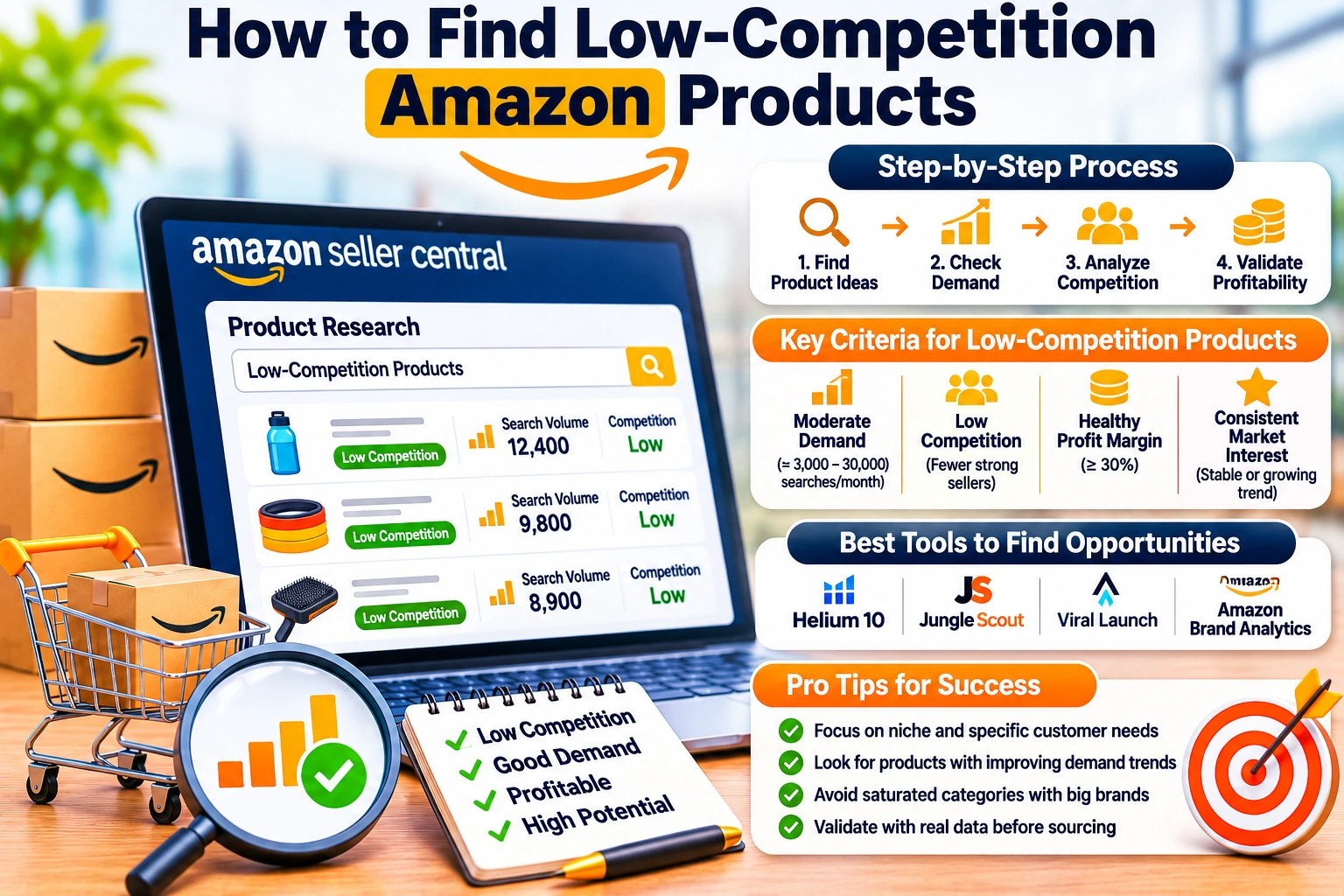
Finding a profitable product to sell on Amazon is one of the most important decisions a new seller will make. The wrong product can consume an entire launch budget before the business generates consistent orders. The right product, supported by realistic margins and a clear competitive advantage, can provide a foundation for building a sustainable private label brand.
The challenge is that popular Amazon categories often contain established sellers with thousands of reviews, competitive prices, professional advertising campaigns, and well-developed product listings. Entering these markets without meaningful differentiation can require substantial advertising expenditure before a new seller gains traction.
This is why many entrepreneurs search for low-competition Amazon products. They want to identify opportunities where customer demand exists but existing sellers are not fully satisfying the market.
However, a product with few competitors is not automatically a good opportunity. Competition may be limited because customer demand is weak, profitability is unattractive, supply is difficult, or regulatory requirements create significant barriers.
The best way to find low-competition Amazon products is to identify niches with measurable customer demand, evaluate the strength of competing offers, discover unmet customer needs, and validate profitability before investing in inventory.
Amazon’s Product Opportunity Explorer can help sellers evaluate search behavior, market demand, existing products, and opportunities that may not be fully addressed by current listings. Best Sellers lists, customer reviews, competitor comparisons, and Amazon fee estimates provide additional evidence.
For example, a broad search for bathroom organizers may reveal intense competition among established brands. However, a more specific customer need involving a particular installation method, material, or space-saving configuration may reveal a narrower opportunity.
The objective is not simply to find a keyword with fewer search results. It is to discover a product opportunity where a new seller can offer a genuine advantage that customers are willing to pay for.
In 2026, successful Amazon product research also requires understanding fulfillment costs, advertising competition, product compliance, customer expectations, and how shoppers discover products through both traditional searches and conversational shopping experiences.
For businesses planning to launch on Amazon USA, UAE, UK, Saudi Arabia, or other marketplaces, market-specific research is essential. A product with limited competition in one country may face stronger competitors, different demand, or additional compliance obligations in another.
This guide explains how to research low-competition Amazon products, evaluate demand and competition, identify underserved niches, calculate realistic profitability, and decide whether a product deserves further investment.
What Makes an Amazon Product Low Competition but Still Profitable?
Low competition is a relative concept rather than an official Amazon product classification. A niche may be easier to enter when relevant customer searches are not dominated by highly established products, when existing offers leave important needs unsatisfied, or when a new brand can present a more useful alternative.
However, evaluating competition requires more than counting the products appearing on a search results page.
A search may display hundreds of results, but only a small group of products may closely match the customer’s specific requirements. Alternatively, a search with relatively few results may be controlled by several exceptionally strong competitors.
The commercial question is whether a new seller has a realistic opportunity to attract customers while maintaining enough contribution margin to support the business.
Understand the Difference Between Low Competition and Low Demand
A low-competition niche may contain few sellers because demand is limited. For example, a highly specialized accessory designed for an uncommon use case may attract very few monthly searches.
A seller entering that niche might face little direct competition but struggle to generate enough orders to cover sourcing, storage, advertising, and account management costs.
By contrast, a broader category may contain substantial demand and significant competition. Within that category, specific customer needs may remain underserved.
A useful research strategy looks for the intersection of demand and opportunity rather than pursuing the lowest possible number of competitors.
For example, customers may regularly search for a product designed for compact spaces, but many existing listings may feature oversized alternatives.
If the unmet need is sufficiently common and a practical product can be manufactured profitably, the niche may deserve investigation.
The research should establish that customers actually want the proposed solution rather than assuming that an interesting idea will generate demand.
Search Demand Must Be Supported by Evidence
Amazon sellers can use several information sources to investigate demand.
Amazon’s Product Opportunity Explorer provides data about customer search behavior, purchase patterns, and product niches for eligible sellers.
Amazon Best Sellers lists reveal products performing well within particular categories, although their ranking does not directly disclose exact unit sales.
Amazon Movers & Shakers can highlight products experiencing changes in sales rank, but short-term movement should not be confused with sustainable demand.
Other useful evidence includes relevant customer reviews, search suggestions, advertising search-term performance, and available marketplace analytics.
The strongest product opportunities are supported by several independent observations.
For example, a niche showing customer interest over a meaningful period, recurring buyer complaints, and multiple competing products generating sales may be more credible than an isolated keyword spike.
Sellers should also consider whether demand is seasonal, driven by a temporary trend, or dependent on a particular event.
Why Fewer Reviews Can Indicate an Opportunity
Review patterns are one useful signal when evaluating competition.
If several relevant products generate visible sales activity despite having relatively modest review histories, a new seller may have an opportunity to compete.
Amazon’s 2026 product research guidance identifies lower review counts among products with meaningful demand as a possible indication of reduced competition.
However, review count is only an indicator.
A product with few reviews may be newly launched, poorly performing, restricted, or associated with a brand that attracts customers through other channels.
A competitor with thousands of reviews may still be vulnerable if customers consistently report unresolved product problems.
Rather than applying a universal review threshold, compare review patterns across the most relevant products within the specific niche.
The question is whether buyers are choosing relatively new or less-established offers, not simply whether the search results contain low review numbers.
Evaluate the Strength of Existing Brands
Competition involves more than product count and reviews.
An established brand may have strong customer recognition, professional photography, competitive sourcing costs, and efficient advertising campaigns.
It may also offer several variations that satisfy different customer preferences.
For example, a new seller researching reusable storage products may find that the leading competitors control most of the relevant customer attention through well-developed brands.
Even if the keyword appears promising, the new product may need a stronger reason to be selected.
Examine competitor price positioning, delivery estimates, product specifications, main images, Brand Stores, review quality, and the clarity of their product differentiation.
Also consider whether Amazon Retail or established national brands occupy a significant share of the relevant market.
The best opportunity is not necessarily a niche with no strong competitors. It may be a niche where strong competitors have overlooked a meaningful customer requirement.
Define a Realistic Competitive Advantage
A product opportunity becomes more credible when the seller can identify a practical way to improve the customer experience.
Differentiation may involve materials, dimensions, packaging, compatibility, durability, included accessories, installation methods, or improved instructions.
For example, customers may repeatedly complain that a household accessory is difficult to install or incompatible with common surfaces.
A manufacturer capable of producing a better installation design could provide a meaningful product advantage.
However, the improvement must be technically achievable and commercially worthwhile.
Adding expensive features that customers do not value can reduce profitability without improving conversion.
Before ordering inventory, sellers should identify which product differences matter to buyers and how those improvements will be communicated through the listing.
For a structured approach, the iNNOVEX Amazon private label product research guide provides additional context for connecting demand analysis with product selection.
How Can You Find Low-Competition Amazon Products Using Amazon Research Tools?
Product research becomes more reliable when sellers begin with actual Amazon customer behavior rather than a random collection of trending product ideas.
Amazon provides several tools and research surfaces that can help identify demand patterns, explore product niches, and compare existing offers.
Each tool serves a different purpose, so the results should be combined rather than treated as interchangeable.
Start With Amazon Product Opportunity Explorer
Product Opportunity Explorer is one of the most relevant official tools for researching Amazon product opportunities.
Amazon explains that the tool helps sellers identify potential gaps in the market using Amazon customer search and purchasing data.
Eligible sellers can explore niches, search terms, existing products, customer behavior, and other available indicators.
A niche represents a collection of related customer searches and products rather than a single keyword.
For example, searching around home organization products may reveal different customer needs involving storage size, installation type, or specific room applications.
The research should focus on how customers describe their needs and whether available products satisfy those needs.
Amazon also provides information about unmet demand in relevant Product Opportunity Explorer experiences.
These opportunities may involve search groups with comparatively weak conversion against a benchmark, suggesting that customers are searching but not consistently finding suitable offers.
However, low conversion is not proof that a new product will succeed. It may also reflect price sensitivity, limited demand quality, or unrealistic customer expectations.
The next step is to investigate why existing products are not converting.
Use Amazon Best Sellers Lists to Validate Demand
Amazon Best Sellers lists provide a starting point for exploring categories where products are already generating sales.
Sellers can review relevant categories and identify the types of products appearing frequently.
However, the objective should not be to copy whichever item currently holds the highest rank.
Popular products can attract substantial competition, and their established sales history may make entry difficult for an undifferentiated new brand.
Instead, explore related subcategories and customer needs.
For example, a broad home improvement category may contain highly competitive products, while a specialized accessory within the category may offer different competitive conditions.
Look for products that repeatedly appear in relevant subcategories and investigate their pricing, reviews, and attributes.
Best Sellers Rank can provide a useful relative indicator, but it does not directly establish exact sales volume or profitability.
Different product categories and marketplaces also have different demand patterns.
Use Movers & Shakers Without Chasing Every Trend
Amazon Movers & Shakers highlights products experiencing significant changes in sales ranking over a recent period.
It can be useful for discovering emerging interest, seasonal demand, and product categories that deserve further research.
However, a rapid change in ranking does not necessarily indicate a durable opportunity.
For example, a seasonal decoration may rise quickly before a major event and then experience a substantial decline in demand.
A new electronic accessory may attract temporary attention because of a promotion rather than a long-term change in customer preferences.
Sellers should compare short-term observations with historical demand patterns where reliable data is available.
Research the customer problem behind the trend and whether the demand is likely to continue after the initial increase.
Avoid committing to large inventory orders solely because a product appeared on a trending list.
Analyze Amazon Search Suggestions
Amazon’s search interface can provide useful clues about the language customers use when looking for products.
Begin with a broad product category and observe relevant search suggestions.
Then explore more specific terms involving features, materials, sizes, or applications.
For example, instead of researching only “storage organizer,” a seller might investigate searches relating to particular spaces, mounting methods, or materials.
These searches can reveal different purchase intentions.
However, search suggestions should not be treated as verified monthly search volume data.
They are useful for discovering possible keyword variations and understanding search language.
Use additional tools to assess actual demand and competition.
A seller should also distinguish genuine customer needs from phrases that are too broad or unrelated to the proposed product.
Study Amazon Customer Reviews for Unmet Needs
Customer reviews are an important source of qualitative product research.
Rather than reading only positive feedback, examine recurring complaints about relevant competing products.
For example, buyers may mention weak materials, confusing instructions, incorrect dimensions, limited compatibility, or missing components.
These observations may reveal a problem that manufacturers could address.
However, one negative review does not establish a widespread market opportunity.
Look for repeated patterns across several relevant products.
Consider whether the issue affects the product’s functionality, the quality of its packaging, or customer expectations created by inaccurate listings.
A recurring complaint becomes more useful when the seller can design a practical solution that customers will recognize and value.
The strongest differentiation ideas connect real customer dissatisfaction with a feasible product improvement.
Use Brand Analytics When Your Account Is Eligible
Amazon Brand Analytics can provide additional search and purchase information for qualifying brand owners.
Available dashboards include Search Query Performance and other tools designed to help brands understand customer behavior.
For an established seller planning additional SKUs, this information can reveal related customer interests and potential opportunities.
For example, a brand selling bathroom accessories may identify search terms associated with complementary products or different installation requirements.
However, Brand Analytics access depends on eligibility and the marketplace.
The data should also be interpreted within its defined reporting scope.
Brand Analytics does not directly guarantee that a niche is profitable or that a new product will achieve a particular ranking.
Use the insights to develop research hypotheses and validate them through competitor analysis and product economics.
Use Third-Party Product Research Tools Carefully
Third-party tools can help organize product research by estimating sales, analyzing keyword demand, tracking prices, and comparing competitors.
However, sellers should understand which figures are estimates rather than Amazon-confirmed transactions.
Different tools may use different models and assumptions.
A product estimated to generate hundreds of monthly orders should not automatically be treated as proven to achieve that sales volume.
Use third-party estimates alongside Amazon’s available first-party data, customer reviews, competitor observations, and realistic financial calculations.
If several sources point toward a similar opportunity, confidence may increase.
However, no tool eliminates uncertainty.
Product selection remains a commercial judgment involving demand, differentiation, costs, compliance, and the ability to execute a launch.
How Do You Analyze Amazon Competitors Before Selecting a Product?
Finding a promising keyword is only the beginning.
Before investing in a product, sellers should examine the competitors customers currently encounter when searching for that item.
The purpose is to understand what buyers expect, what existing sellers offer, and where a new business could create a meaningful advantage.
Competitor analysis should be specific to the intended marketplace and product configuration.
Study the Most Relevant Search Results
Search Amazon using the product’s most relevant buying terms.
Review the listings that closely match the proposed item.
Do not treat every sponsored placement or loosely related search result as a direct competitor.
For example, a specialized shower accessory may compete most directly with products offering a similar mounting method and function.
A large bathroom shelf may appear in the same broad search but serve a different customer need.
Record the relevant competitors’ product types, prices, package quantities, materials, and distinguishing features.
Consider the relative strength of established brands and newer sellers.
A niche may appear attractive when the existing products have gaps that a new seller can address.
However, competitive weakness should be supported by evidence rather than assumptions based on a single search.
Compare Review Counts and Review Quality
Review analysis can reveal the level of customer trust and the problems buyers experience.
Look for products with substantial review histories, but also examine whether relatively new products attract interest.
For example, a category dominated by products with thousands of positive reviews may present a more difficult entry environment than one where several relevant products have modest review histories.
However, the number of reviews should not be considered in isolation.
A newer product with strong branding and attractive pricing may still be a formidable competitor.
Likewise, a heavily reviewed product may contain recurring complaints about features that customers value.
The goal is to identify the combination of customer satisfaction, product quality, and market strength.
Avoid using arbitrary review-count rules as automatic approval criteria.
Examine Competitor Pricing and Package Value
Price competition is affected by more than the headline selling price.
A product may contain additional accessories, stronger materials, a longer warranty where offered, or a different quantity.
For example, a two-pack of wall hooks and a four-pack should not be compared as identical retail products.
A seller should calculate the effective value offered by relevant competitors.
Determine whether the proposed item can provide similar or better value while supporting a suitable margin.
If competing products are sold at prices below your realistic landed and fulfillment costs, the niche may not be commercially attractive.
The solution is not necessarily to manufacture a cheaper copy.
A better product configuration, improved sourcing arrangement, or different customer segment may provide a more sustainable approach.
Evaluate the Quality of Competitor Listings
Product page quality can indicate whether competitors are communicating effectively.
Review the main image, supporting images, title, bullet points, descriptions, and any enhanced content.
For example, a product may have strong sales demand but poor dimension images.
Customers may repeatedly ask whether the item fits a particular space.
A new seller could potentially provide clearer size information and a product designed to address that uncertainty.
However, improving listing presentation does not automatically create a competitive advantage if the underlying product is identical and the established sellers have stronger reviews or pricing.
The seller should identify both product-level and content-level opportunities.
A useful competitive strategy communicates a genuine difference rather than relying only on better graphic design.
Look for Gaps in Customer Satisfaction
An underserved niche may have existing demand but lack products that adequately solve a recurring customer problem.
For example, several products may be inexpensive but difficult to assemble.
Others may be well designed but too large for a particular use.
The seller should examine whether these weaknesses are repeated across multiple competitors.
Then investigate whether a manufacturer can address the issue.
A product improvement that customers cannot easily see or understand may be difficult to monetize.
The differentiation should be reflected in actual specifications and clearly presented in product images and descriptions.
For sellers considering custom manufacturing, the iNNOVEX private label sourcing from China to Amazon FBA guide explains how sourcing decisions connect with production and fulfillment planning.
Investigate Barriers That Make a Niche Difficult to Enter
Some niches have few competitors because entry requires specialized manufacturing, intellectual property rights, testing, or regulatory approvals.
For example, a product involving batteries, children, cosmetics, or health-related claims may require additional compliance work.
A low number of competing ASINs should not automatically be interpreted as a market gap.
The seller should investigate the legal and operational reasons behind limited supply.
Review product restrictions, relevant certifications, labeling requirements, and applicable intellectual property concerns before purchasing inventory.
A product with promising demand can become financially unattractive when compliance and manufacturing costs are included.
In certain cases, established competitors may have legitimate technical advantages or protected product designs.
Entering those markets without proper preparation can create significant risk.
How Do You Validate Demand, Profit Margins, and Product Risks Before Launching?
A product should not be selected based solely on customer searches or weak competitors.
The opportunity must remain commercially attractive after manufacturing, transportation, Amazon fees, advertising, returns, and operational costs.
This is where many promising product ideas fail.
A low supplier quotation may appear attractive until the seller calculates the full landed cost and customer acquisition expense.
Calculate the Real Landed Cost
Landed cost includes more than the price paid to the manufacturer.
Relevant costs may include packaging, inspection, freight, customs duties, customs handling, inbound transportation, and other expenses required to make inventory ready for sale.
For example, a supplier may quote $4 per unit, but the final landed cost may be substantially higher after packaging and transportation.
The seller should calculate these expenses before selecting the final selling price.
For international sellers, currency movements and shipping arrangements can also affect the result.
Avoid evaluating a product using only an initial supplier quote.
The financial model should reflect the actual destination marketplace and intended fulfillment method.
Estimate Amazon Selling and FBA Fees
Amazon charges applicable selling and fulfillment fees according to the product, marketplace, and services used.
Referral fees depend on the relevant fee category.
FBA fulfillment charges can be affected by size and weight.
Storage and other applicable charges may also affect profitability.
Amazon provides an official Revenue Calculator that sellers can use to estimate costs and compare fulfillment approaches.
The tool is especially useful when evaluating a potential product before purchasing inventory.
For example, a large lightweight item may still create different fulfillment economics from a compact product of similar retail value.
A seller should verify dimensions and weights rather than relying on assumptions.
Amazon’s 2026 FBA fee guidance emphasizes using current fee estimates when calculating product economics.
Estimate Contribution Margin Before Advertising
A simplified product contribution calculation can help identify whether the opportunity deserves further investigation.
Contribution Before Advertising = Net Sales Revenue – Product Landed Cost – Relevant Amazon and Selling Costs.
Suppose a product sells for $25 and incurs $8 in landed product cost, $4 in referral and fulfillment fees, and $2 in other relevant variable expenses.
The illustrative contribution before advertising would be $11 per unit.
If the seller then spends $6 to acquire the sale through advertising, the remaining contribution would be $5 before any excluded operating expenses.
This example does not represent a universal margin target.
The appropriate result depends on the business model, tax treatment, expected returns, overhead, and working capital requirements.
Sellers should distinguish contribution margin from formal accounting net profit.
Understanding how much it costs to start an Amazon private label business can help founders plan beyond the initial manufacturing quotation.
Calculate Break-Even ACOS
For products relying on advertising, break-even ACOS can help establish a practical spending limit.
A simplified calculation is:
Break-Even ACOS = Contribution Before Advertising / Attributed Sales Revenue × 100.
For example, if a $25 product provides $11 contribution before advertising, the illustrative break-even ACOS would be 44%.
This calculation assumes that all relevant variable costs have been included and that the attributed sale value is appropriate for the analysis.
However, a business operating at its break-even ACOS may have no remaining contribution to cover excluded costs or generate profit.
A lower target may therefore be necessary.
The expected advertising cost should be considered before committing to a highly competitive niche.
A product that appears profitable before PPC may become unattractive when realistic acquisition costs are introduced.
Evaluate Inventory Risk and Replenishment Requirements
Product research must consider how much inventory the seller needs to order.
A manufacturer may offer an attractive unit price only when the business commits to a large minimum order quantity.
That requirement can create financial exposure if demand has not been validated.
For example, ordering 5,000 units of an unfamiliar product may tie up substantial capital even when the unit cost appears low.
The seller should estimate expected demand, production lead time, freight duration, Amazon receiving, and future replenishment requirements.
A smaller initial order may reduce risk, although it can produce higher per-unit costs.
A larger order may improve manufacturing economics but increase storage and cash flow pressure.
There is no universally correct first shipment quantity.
The decision depends on the confidence in demand estimates and the business’s financial capacity.
Review Product Compliance and Intellectual Property
Amazon sellers must comply with applicable product and marketplace requirements.
Before selecting a product, investigate whether it requires testing, certification, warnings, special labeling, or category approval.
For example, children’s products and battery-powered devices may have additional requirements.
The exact obligations depend on the product and destination market.
A business should also review relevant trademark, design, and patent considerations.
A product with limited direct competition may be associated with legitimate intellectual property protections.
Avoid assuming that a supplier’s willingness to manufacture the item establishes the right to sell it.
Qualified legal and regulatory professionals may be necessary for higher-risk categories.
These investigations should happen before placing a substantial inventory order.
Check Whether the Product Can Become a Sustainable Brand
A private label business benefits when its first product creates opportunities for related products and customer recognition.
For example, a seller launching a useful household organizer may later introduce compatible accessories or additional sizes.
However, adjacent products should be selected according to real customer demand rather than assuming that every catalog expansion will succeed.
The brand should have a coherent market position and realistic product development plan.
Consider whether the product offers a defensible customer benefit, whether suppliers can maintain quality, and whether the niche allows suitable pricing.
A single profitable SKU can be valuable, but a coordinated brand strategy may create additional growth opportunities.
Before launch, review the common Amazon private label mistakes that cause failure, including weak research, underestimated costs, and insufficient differentiation.
How Do You Launch a Low-Competition Amazon Product Without Wasting Your Budget?
Even a well-researched product can fail when the launch is poorly coordinated.
Demand, competition, and profitability analysis provide the business case, but execution determines whether the product reaches customers with the right content, inventory, and advertising.
A responsible launch strategy should begin before the first units reach Amazon.
Validate the Physical Product Before Manufacturing
A promising niche should lead to a product specification that can be tested.
Request samples from suitable suppliers and evaluate the actual materials, dimensions, functionality, packaging, and included components.
Compare the samples against the customer problems identified during research.
For example, if the product opportunity involves improved durability, the seller should verify that the proposed design genuinely performs better under relevant conditions.
Do not rely solely on supplier photographs or marketing descriptions.
Where appropriate, arrange independent inspections or testing.
Changes are generally easier to make during sampling than after thousands of units have been manufactured.
A strong research process connects the original market opportunity with measurable product improvements.
Create a Listing Around High-Intent Keywords
Amazon search optimization should begin with relevant customer language.
Use the product’s primary type, distinguishing attributes, and supported use cases to develop a clear listing.
For example, a specialized storage product might be described using its actual mounting method, size, material, and compatibility.
The title should identify the product accurately.
Bullet points should explain why the features matter.
Images should demonstrate real dimensions and included components.
Backend search terms, where applicable, should support relevant discovery without unnecessary repetition.
Do not add unrelated high-volume keywords simply to attract more visitors.
A product selected for a narrow customer need should communicate that need clearly throughout the listing.
Sellers preparing their first listings can review the Amazon product listing seller guide for additional listing development considerations.
Build the Advertising Plan Around Product Economics
Advertising can help eligible sellers attract initial traffic, but it should be planned according to the product’s expected contribution margin.
Sponsored Products may be used to reach relevant searches and evaluate customer response.
Automatic targeting can help discover additional search terms, while manual targeting can provide more control over selected keywords and products.
The appropriate structure depends on marketplace competition, budget, and product readiness.
For example, a niche product may benefit from specific high-intent keywords rather than relying entirely on broad category terms.
However, highly specific keywords may have limited demand, so the strategy should balance relevance and reach.
Monitor advertising performance using actual search terms, clicks, spending, and attributed sales.
Do not assume that a product selected for low competition requires no advertising.
A structured Amazon private label PPC launch strategy helps connect customer acquisition with product economics.
Coordinate Inventory With Launch Timing
A product should not be launched on the assumption that delivery to Amazon means every unit is immediately available.
FBA inventory may need time for check-in, receiving, and internal distribution.
The seller should monitor actual stock availability before committing to major promotions.
For example, running substantial advertising while most inventory remains in receiving can create operational complications.
At the same time, a seller should avoid sending excessive inventory merely because a product appears promising in research tools.
Launch quantities should reflect realistic demand estimates, manufacturing lead times, and available working capital.
Replenishment planning becomes especially important when the product begins generating consistent sales.
The objective is to maintain enough inventory to serve customers without creating unnecessary storage costs.
Measure Launch Performance Before Expanding
A successful product launch should be evaluated using several metrics rather than sales revenue alone.
Useful measures include conversion performance, advertising spend, attributed sales, inventory availability, returns, and contribution margin.
For example, a product may generate strong initial revenue while spending more on advertising than its margin can support.
Another product may receive limited traffic but convert well, suggesting that additional relevant exposure could be worth testing.
Use Seller Central reports and available advertising data to understand which issue deserves attention.
Avoid expanding to additional variations or marketplaces before the original product’s economics are reasonably understood.
A sustainable Amazon product launch strategy for private label brands should connect initial testing with longer-term growth decisions.
How Can iNNOVEX Enterprises Help Find and Launch Low-Competition Amazon Products?
Finding low-competition Amazon products requires a coordinated understanding of customer demand, market gaps, product differentiation, sourcing, compliance, advertising, and profitability.
A product research tool can identify possible opportunities, but it cannot independently determine whether a business should invest in manufacturing and inventory.
The commercial decision requires evaluating the complete selling process.
At iNNOVEX Enterprises, an Amazon SPN agency, we support businesses with Amazon product research, private label development, sourcing coordination, listing optimization, FBA planning, and marketplace management.
Our services help sellers investigate potential product opportunities and organize the operational work required for a launch.
We support businesses targeting Amazon UAE, USA, UK, Saudi Arabia, and other international marketplaces.
Amazon Product Research and Competitor Analysis
We help sellers evaluate market demand, relevant competitors, product attributes, customer feedback, and possible differentiation opportunities.
The purpose is to identify products worth investigating further rather than promising that a particular niche will guarantee sales.
For example, a research project may compare several product ideas based on customer demand, competition strength, sourcing feasibility, and estimated profitability.
The final decision should reflect the seller’s capital, experience, and appetite for risk.
Amazon Private Label Product Sourcing
Our sourcing support can involve supplier research, sample coordination, packaging requirements, and relevant manufacturing discussions.
For new private label brands, accurate product specifications and genuine differentiation are particularly important.
The seller should approve material decisions, manufacturing commitments, and supplier agreements.
Independent testing or quality inspections may be appropriate depending on the product.
Amazon Listing Creation and Product Positioning
We support product listing development using relevant search intent, accurate specifications, and customer-focused content.
This can include product titles, bullets, descriptions, attributes, images, and eligible enhanced content.
For low-competition niches, the listing should explain the specific need that makes the product relevant.
A generic listing that fails to communicate differentiation can undermine an otherwise promising product opportunity.
Amazon PPC and Product Launch Support
Our Amazon advertising services support relevant campaign planning, keyword targeting, and performance evaluation.
We help businesses assess advertising in relation to expected product margins and marketplace competition.
Advertising outcomes depend on customer demand, product competitiveness, budget, and other factors.
No agency can guarantee organic rankings, low advertising costs, or a particular number of orders.
Amazon FBA and Inventory Planning
We support relevant FBA shipment workflows, inventory monitoring, and replenishment planning.
These activities help businesses coordinate product availability with launch schedules and future demand.
A product with promising sales potential can still encounter problems when inventory is delayed or excessive stock consumes available capital.
Fulfillment decisions should therefore be considered during product research rather than after manufacturing.
Amazon Brand Development and International Expansion
For businesses building long-term private label operations, product selection should fit a broader brand strategy.
This may involve trademark planning, Brand Registry eligibility, consistent product presentation, and related product development.
Our services support relevant marketplace and administrative processes.
Qualified professionals should handle legal and regulatory matters requiring specialized advice.
Businesses exploring a wider service arrangement can review our full-service Amazon agency for private label sellers page.
Frequently Asked Questions About Low-Competition Amazon Products
What is the best way to find low-competition Amazon products?
Start with Amazon Product Opportunity Explorer, examine customer demand and existing products, analyze competitor reviews and pricing, identify unmet needs, and validate profitability before investing in inventory.
Are low-competition Amazon products always profitable?
No. Limited competition may reflect weak demand, high costs, product restrictions, or an unattractive market. Profitability depends on the complete economics and customer response.
Can beginners find low-competition Amazon FBA products?
Yes. Beginners can research potential niches using Amazon’s available tools and customer information. However, selecting a product still requires careful evaluation of costs, compliance, competition, and execution risk.
How do I know whether an Amazon niche has enough demand?
Review relevant search behavior, available Product Opportunity Explorer data, competitor sales indicators, demand history, and customer feedback. Use several signals instead of relying on one estimate.
Does a low review count mean low competition?
Not necessarily. Lower review counts can be one opportunity signal, but sellers should also assess brand strength, pricing, product quality, advertising, and actual demand.
What is Amazon Product Opportunity Explorer?
It is an Amazon research tool for eligible sellers that provides insights into customer searches, product niches, purchasing behavior, and potential market opportunities.
Can I find low-competition products without paid research tools?
Yes. Amazon Best Sellers lists, search suggestions, product reviews, and other available Amazon resources can provide useful initial research. Paid tools may offer additional estimates and workflow features.
How much profit margin should an Amazon product have?
There is no universal margin suitable for every business. Calculate the full landed cost, Amazon fees, expected advertising expenses, returns, and other relevant costs before setting a target.
Should I choose a trending product with low competition?
Only after investigating whether demand is sustainable. A short-term trend may create temporary sales opportunities but also significant inventory risk.
Can an Amazon agency help find profitable products?
An agency can support research, competition analysis, sourcing, profitability modeling, and launch planning. However, no provider can guarantee that a researched product will become profitable.
Conclusion: Find an Opportunity, Not Simply a Product With Few Competitors
The best low-competition Amazon products are not necessarily the products with the fewest search results or the lowest review counts.
They are products supported by credible demand, manageable competition, genuine customer needs, practical differentiation, and sustainable economics.
Amazon Product Opportunity Explorer, Best Sellers lists, customer reviews, and other research tools can help identify possible opportunities.
However, these findings should be validated through competitor analysis, supplier research, compliance checks, and realistic profit calculations.
A seller should understand the cost of bringing a product to market before committing to manufacturing.
The research should also establish why customers would choose the new product instead of established alternatives.
For many businesses, the most attractive opportunity is a specific customer problem that existing products solve incompletely.
When a manufacturer can address that problem at a commercially viable cost, the business may have a stronger reason to enter the market.
Product research should therefore be treated as a process of testing assumptions and reducing risk rather than searching for a guaranteed winning product.
As an Amazon SPN agency, iNNOVEX Enterprises supports sellers with product research, sourcing coordination, listing optimization, Amazon PPC, FBA planning, and marketplace growth.
If you are planning your next private label product, begin with a shortlist of realistic opportunities and evaluate each one against demand, competition, differentiation, and profitability before purchasing inventory.
For businesses preparing to enter the UAE marketplace, our guide to creating an Amazon selling account in UAE explains additional setup considerations.
A well-researched product is not a guarantee of success, but it provides a stronger foundation for making informed investment decisions and building a sustainable Amazon business.