
Building a successful Amazon business requires more than creating product listings and running advertising campaigns. Customers increasingly expect detailed product information, professional images, clear brand identity, and a convenient shopping experience before making purchasing decisions.
For Amazon brand owners, two important tools can help meet these expectations: Amazon A+ Content and Amazon Brand Stores.
Although both features help businesses present their products professionally, they are designed for different purposes.
Many new Amazon sellers confuse these tools or assume that creating one automatically replaces the other.
Some sellers invest heavily in Amazon A+ Content without developing a dedicated Brand Store, while others create an attractive storefront but leave their individual product detail pages incomplete.
Understanding the difference can help businesses allocate their resources more effectively.
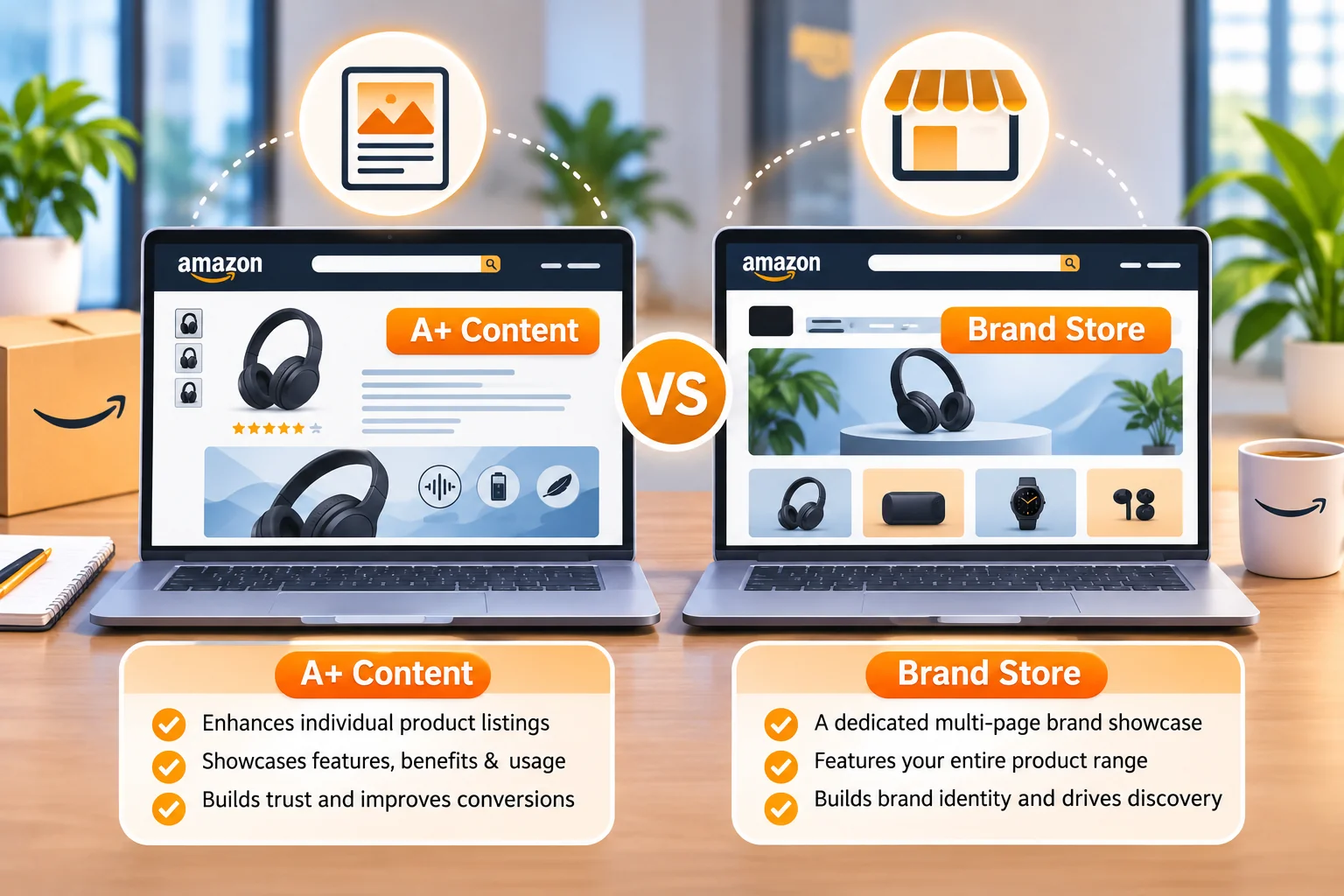
Amazon A+ Content enhances individual product detail pages with rich images, detailed product information, comparison charts, and other eligible modules. An Amazon Brand Store is a customizable, multipage shopping destination where customers can explore a brand’s product catalog, collections, and story.
Both features can be useful for businesses developing private label products, expanding an established product catalog, or building long-term brand recognition.
In 2026, brands must also consider the importance of consistent product information across traditional Amazon search and AI-assisted shopping experiences.
This guide explains Amazon A+ Content vs Brand Store, including their features, eligibility requirements, costs, design options, business benefits, and practical strategies for using them together.
Whether you sell on Amazon USA, UAE, UK, Saudi Arabia, or another supported marketplace, this comparison can help you understand which tool is appropriate for your business.
1. What Are Amazon A+ Content and Amazon Brand Stores?
Amazon provides brand owners with tools for presenting product information beyond the basic title, bullet points, images, and description.
Two of the most recognizable tools are A+ Content and Brand Stores.
Although they are both associated with brand development, their locations and functions are different.
What Is Amazon A+ Content?
Amazon A+ Content is an enhanced product detail page feature that allows eligible sellers to present additional product information through images, formatted text, comparison charts, videos, and other supported modules.
It was previously associated with the term Enhanced Brand Content, or EBC.
A+ Content appears within the product detail page, normally in the product description area.
Its purpose is to help shoppers understand the product they are already considering.
For example, a customer viewing a handheld digital microscope might want to understand its screen size, focus adjustment, lighting system, battery capacity, and included accessories.
A+ Content can explain those details through appropriate illustrations, product photographs, comparison modules, and helpful text.
This may reduce uncertainty and help customers decide whether the product meets their needs.
However, A+ Content does not replace the standard listing fields.
Product titles, bullet points, main images, attributes, and other mandatory information must still be maintained accurately.
The enhanced modules provide an additional opportunity to communicate useful information.
What Is an Amazon Brand Store?
An Amazon Brand Store is a dedicated, customizable storefront hosted within Amazon that allows eligible brands to organize and showcase their product collections, brand information, and promotional content.
Unlike A+ Content, which is attached to individual product detail pages, a Brand Store functions as a separate shopping destination.
It can contain a homepage and additional pages organized by categories, product collections, or customer interests.
For example, a children’s educational toy brand might create separate Store pages for Montessori toys, learning games, educational activity books, and gift ideas.
A customer visiting the Brand Store can explore different products without leaving that brand’s dedicated shopping environment.
Amazon Brand Stores can feature product grids, lifestyle imagery, videos, navigation menus, and other supported content.
Brands may direct shoppers to their Store through eligible Amazon advertising, product detail page links, and external marketing channels.
The experience is designed to help customers discover more of the brand’s catalog.
What Is the Main Difference Between A+ Content and a Brand Store?
The most important difference is where the content appears and what it is intended to achieve.
Amazon A+ Content is primarily product-specific.
It helps a customer understand the details of a particular item while viewing that item’s product page.
An Amazon Brand Store is primarily brand- and catalog-focused.
It helps customers explore the company’s product range, discover related items, and learn about the brand.
Consider a business selling several bathroom accessories.
The A+ Content for a suction cup razor holder might explain installation, surface compatibility, material, dimensions, and usage.
The Brand Store might present the company’s complete bathroom organization collection, including razor holders, adhesive hooks, towel accessories, and other products.
Both serve useful purposes, but they address different customer questions.
Do Amazon A+ Content and Brand Stores Require Brand Registry?
Amazon Brand Registry is important for accessing many enhanced brand-building features.
For Brand Stores, qualifying Brand Registry enrollment and the appropriate authorized role are generally central eligibility requirements for seller-managed brands.
Amazon’s A+ Content eligibility guidance is more nuanced.
Its current US documentation identifies a Professional selling account together with an eligible Brand Representative or Reseller role for a registered brand, or qualifying generic products.
The available features and permissions depend on the account, brand relationship, and marketplace.
Premium A+ Content has additional eligibility requirements.
Therefore, sellers should not assume that every Professional account automatically receives every brand feature.
They should check the actual permissions displayed in Seller Central.
Is Amazon A+ Content the Same as Amazon Brand Story?
No. Brand Story is another content experience connected with Amazon’s enhanced brand tools.
Amazon describes Brand Story as a section that can introduce a brand, communicate its values, and connect customers with additional products or the Brand Store.
It can appear under the “From the brand” area on eligible product detail pages.
Brand Story may contain imagery, text cards, carousel content, and eligible links.
This makes it useful as a connection between an individual product detail page and the wider brand catalog.
However, Brand Story is not a replacement for a complete multipage Store.
A brand can use A+ Content for detailed product education, Brand Story for brand identity, and a Brand Store for broader catalog navigation.
2. Amazon A+ Content vs Brand Store: Features, Benefits, and Key Differences
Both tools can contribute to a professional brand experience, but their practical capabilities differ significantly.
The following comparison highlights important differences.
| Feature | Amazon A+ Content | Amazon Brand Store |
|---|---|---|
| Primary Purpose | Explain individual products | Showcase brand and catalog |
| Location | Product detail pages | Dedicated Amazon storefront |
| Main Focus | Features and purchase questions | Brand discovery and product collections |
| Content | Text, images, charts, eligible video modules | Pages, images, videos, product grids |
| Navigation | Limited product and brand connections | Organized multipage navigation |
| Customer Journey | Product evaluation | Brand exploration and cross-selling |
| Advertising Destination | Part of the product page experience | Eligible Sponsored Brands and other campaigns |
| Creation Fee | No additional Amazon content fee for eligible sellers | Free creation and maintenance for eligible brands |
| Performance Evaluation | Product metrics and eligible content experiments | Store traffic and engagement insights |
Which Tool Is Better for Product Education?
A+ Content is generally better suited to detailed education about an individual product.
It allows sellers to explain how a product works, what it includes, and which features may matter to customers.
For example, a reusable shower accessory may require instructions showing how to clean the installation surface, apply suction, and safely remove the item.
Product-specific enhanced content can communicate this information through images and short explanations.
Likewise, an educational toy may benefit from visuals showing how the different parts fit together.
The content should remain accurate to the actual product and should not introduce unsupported claims.
A+ Content is valuable when purchase decisions depend on detailed product understanding.
Which Tool Is Better for Building Brand Awareness?
Brand Stores are especially useful when businesses want to introduce customers to a broader collection of products.
A customer discovering one item may not know that the same company sells related accessories.
A Brand Store provides a place to explore those products within a consistent branded experience.
Businesses can communicate brand identity through design, imagery, product collections, and relevant storytelling.
This may be particularly useful for private label sellers developing multiple related products.
However, building a Store does not automatically create customer awareness.
Brands still need suitable discovery channels and marketing strategies.
Which Tool Is Better for Cross-Selling?
Both tools can support product discovery across a brand’s catalog, but they do so differently.
A+ Content comparison modules and Brand Story elements can introduce related products from eligible catalogs.
These modules help customers understand differences between alternatives.
A Brand Store can organize the complete product range through categories and dedicated pages.
For example, a home organization brand might display kitchen storage accessories, bathroom hooks, and household organizers in separate Store collections.
This gives customers more opportunities to explore products that meet related needs.
Cross-selling should remain relevant and customer-focused.
Showing unrelated items without a clear connection may weaken the shopping experience.
Which Tool Is Better for Amazon Advertising?
A Brand Store can function as a destination for eligible advertising campaigns, including supported Sponsored Brands campaigns.
Instead of sending shoppers directly to one product, certain campaigns can introduce a collection or specific Store page.
This approach may be helpful when an advertisement promotes multiple related products.
A+ Content works differently.
It enhances the product detail page that a customer visits, whether the customer arrives through organic search, advertising, or another supported route.
Therefore, the tools can complement each other.
An advertisement may introduce a product or collection, while detailed product content helps customers evaluate individual items.
Can A+ Content and Brand Stores Improve Amazon SEO?
Both can contribute to better customer understanding and a more complete brand experience.
However, neither provides a guaranteed shortcut to first-page organic rankings.
Amazon has not published a universal ranking formula stating that creating A+ Content or a Brand Store automatically increases keyword positions.
Traditional product listing elements remain important, including accurate titles, relevant attributes, product images, pricing, and availability.
A+ Content can provide additional product information to customers.
Brand Stores can create structured destinations for product discovery and brand exploration.
Sellers should evaluate these features using customer behavior and measurable business outcomes rather than assuming guaranteed ranking improvements.
3. What Are the Different Types of Amazon A+ Content and Brand Store Features?
Amazon provides multiple options for developing richer product and brand experiences.
Understanding the available features can help sellers choose appropriate formats for their products.
What Is Basic Amazon A+ Content?
Basic A+ Content is designed to improve product detail pages with enhanced images, formatted text, brand information, and comparison modules.
Amazon’s design guidance describes support for up to five Basic A+ modules per ASIN.
Available module types can include combinations of images and text, specification charts, and product comparison tables.
For example, a seller offering an educational matching game may use one module to explain the learning activity, another to show product dimensions, and another to describe package contents.
The layout should prioritize helpful information instead of repeating claims already visible elsewhere.
Basic A+ Content is often a practical starting point for eligible brands creating their first enhanced product pages.
What Is Amazon Premium A+ Content?
Premium A+ Content offers additional design and interaction capabilities for eligible sellers.
Amazon’s published guidance describes larger images, video, interactive hotspots, navigation carousels, Q&A sections, and enhanced comparison charts.
Premium layouts may allow up to seven modules per ASIN, subject to the relevant content rules and marketplace availability.
Eligibility is not automatically granted to every seller with Basic A+ Content.
Amazon applies additional requirements that brands must satisfy.
Sellers should review Premium eligibility within A+ Content Manager.
A brand should also consider whether the product genuinely benefits from more interactive material.
For a technically complex item, an interactive demonstration or detailed Q&A may provide useful clarification.
For a simple accessory, a smaller number of accurate visual explanations may be sufficient.
Does Premium A+ Content Guarantee Higher Conversion Rates?
No. Amazon reports that Basic A+ Content can increase sales by up to 8%, while well-implemented Premium A+ Content can increase sales by up to 20%, based on its internal data.
These figures describe potential outcomes reported by Amazon, not guaranteed increases for every listing.
Actual performance depends on the product category, existing listing quality, customer traffic, pricing, content design, and other factors.
If the current product listing is already informative, adding more modules may produce different results from improving a listing that previously lacked important information.
Sellers should use available performance tools and suitable experiments to understand the impact of content changes.
The objective is useful product education rather than simply filling every available module.
What Is Amazon Brand Story Content?
Brand Story helps eligible sellers introduce the company behind the product.
It can explain the brand’s background, values, mission, and product collection.
Amazon describes Brand Story as a separate experience that can be used alongside Basic or Premium A+ Content.
For example, a children’s educational toy company might explain its focus on hands-on learning.
The content could introduce additional product categories and provide suitable links within Amazon.
Brand Story is especially useful when customers may benefit from learning about the wider business.
However, the claims must remain accurate and compliant with Amazon’s content requirements.
What Features Can an Amazon Brand Store Include?
Brand Stores offer flexible content structures that can be adapted to different product catalogs.
Depending on the available templates and marketplace capabilities, a Store may include:
- A branded homepage introducing the product collection.
- Navigation menus linking to different Store pages.
- Product grids featuring selected ASINs.
- Category pages for related product groups.
- Lifestyle imagery illustrating appropriate uses.
- Product videos and educational content.
- Featured collections or seasonal themes.
- Additional brand storytelling.
- Supported promotional content and shopping features.
The most effective structure depends on the size and diversity of the catalog.
A brand with only a few products may need a relatively simple Store.
A company with dozens of products across multiple categories may benefit from more detailed navigation.
Can a Brand Store Have Multiple Pages?
Yes. Multipage organization is one of the defining features of Brand Stores.
A business can create different pages to group products by category, collection, or customer need.
For example, a brand selling home accessories may organize its Store around bathroom organization, kitchen storage, and household essentials.
Another brand selling educational toys may create pages for preschool learning, creative activities, and family games.
The navigation should be intuitive.
Customers should be able to understand which products belong to each category.
Avoid creating large numbers of nearly empty pages that provide little practical value.
Can Customers Visit Brand Stores Directly?
Eligible Brand Stores have dedicated Amazon URLs.
Brands can use these URLs in supported advertising and external marketing activities.
Customers may also discover Stores through brand links on Amazon product detail pages and other supported placements.
For example, a business promoting a collection through social media may direct visitors to its Brand Store.
However, the exact link format, availability, and advertising options depend on the marketplace and account.
Sellers should use the URL generated for their approved Store rather than inventing a Store address.
What Is the Difference Between a Brand Store and an Influencer Storefront?
An Amazon Brand Store is not the same as an Amazon Influencer storefront.
A Brand Store represents an eligible brand and generally showcases its own product catalog and brand information.
An Influencer storefront is associated with the Amazon Influencer Program and can feature products recommended by an eligible creator.
Although both are sometimes described as Amazon storefronts, their purposes, eligibility requirements, and management tools differ.
Sellers planning a branded shopping destination should review Amazon’s Brand Stores guidance rather than following instructions intended for influencers.
4. How Do You Create Amazon A+ Content and an Amazon Brand Store?
Both features require preparation, accurate product information, and compliance with Amazon’s relevant content policies.
However, their creation workflows are different.
Step 1: Confirm Brand and Seller Eligibility
Before creating enhanced content, verify your account permissions.
For A+ Content, Amazon’s current guidance generally requires a Professional selling plan and appropriate eligibility through Brand Registry roles or qualifying generic product conditions.
Brand Stores are available to eligible enrolled brands and other qualifying authorized users.
Brand Registry benefits can vary by marketplace and account role.
A brand owner may need to complete registration or assign authorized representatives before additional tools become available.
Do not assume that merely selling a branded product provides permission to modify every brand asset.
Step 2: Prepare Your Product Information
Collect the specifications customers need to understand the product.
Important information may include materials, dimensions, capacity, compatibility, package quantity, care instructions, and relevant certifications.
For example, if a digital microscope has a 2.4-inch display, that specification should be verified before being placed into images or descriptions.
If a product is available in several colors, ensure that the correct product variation appears in each visual.
Accurate information is especially important when content is reused across multiple ASINs.
A design mistake repeated across several listings can create widespread customer confusion.
Step 3: Create A+ Content in Seller Central
Amazon directs eligible sellers to A+ Content Manager in Seller Central.
The documented process generally involves opening the A+ Content tool, selecting the content type, creating modules, and adding suitable images and text.
Sellers then associate the content with eligible ASINs and submit it for review.
The interface may change, and available options depend on the account.
Approved content appears on the relevant product detail pages.
Content must follow Amazon’s review requirements.
Avoid unsupported claims, prohibited promotional messages, misleading images, and other restricted content.
Step 4: Design A+ Content Modules
Begin by identifying the most important customer questions.
For example, a seller offering a suction cup shower accessory might structure the content around product features, installation, surface compatibility, product dimensions, and relevant usage scenarios.
Each module should serve a distinct purpose.
Avoid repeating the same marketing statement across multiple banners.
Use consistent photography and visual hierarchy.
If a product has multiple variations, confirm that the displayed color, shape, and package quantity are accurate for each assigned ASIN.
Visual quality is important, but the design should never change the real product.
Step 5: Review A+ Content for Desktop and Mobile
Amazon customers shop on different devices.
Images that look clear on desktop may become difficult to read on mobile screens.
Sellers should preview the available mobile experience before submission.
Keep important product details readable and avoid placing essential information in areas where it may be cropped.
For eligible Premium modules requiring separate asset dimensions, follow the specifications displayed in the relevant Amazon content tool.
Do not assume that all desktop and mobile module types use identical image dimensions.
Testing the content across supported devices helps identify readability and layout issues.
Step 6: Create Your Amazon Brand Store
Eligible sellers can use the Store builder through the appropriate Amazon Ads or Seller Central workflow.
Amazon provides templates and a drag-and-drop editing experience for creating branded pages.
Begin by selecting a structure appropriate for the product catalog.
A simple Store may include a homepage and a few category pages.
A larger brand might organize multiple product groups around customer needs.
Use the brand’s approved logo, accurate product imagery, consistent colors, and relevant marketing content.
Prepare the page structure before adding extensive design elements.
Step 7: Organize Brand Store Navigation
Store navigation should help customers find the products they want.
If a business sells several educational toys, product categories may be organized by activity type rather than arbitrary internal SKU names.
For example, customers may find it easier to explore learning games, activity books, and sensory toys than collections labeled only with product codes.
Each page should contain relevant products and useful supporting content.
Avoid misleading category names.
If products are unavailable, review whether the Store needs updating.
The objective is creating a practical shopping destination rather than a complicated design.
Step 8: Submit the Store for Review
Amazon reviews Brand Store submissions against applicable content policies.
The Store must meet relevant requirements before publication.
Claims, imagery, product information, and page structure should be checked before submission.
If Amazon rejects content, review the stated reason and make the necessary corrections.
Publishing a Brand Store does not automatically guarantee that customers will visit it.
The brand must also consider how shoppers will discover the Store.
Step 9: Connect A+ Content, Brand Story, and Brand Store
Once the relevant features are available, build a consistent customer journey.
A shopper may discover a product through Amazon search and open its detail page.
The A+ Content can explain the item’s features and intended uses.
Brand Story can introduce the company and, where supported, provide a route to its Brand Store.
The Brand Store can then help the shopper explore other products.
This creates a connected brand experience rather than isolated pieces of content.
The information should remain consistent across every stage.
Step 10: Review and Update Published Content
Enhanced content should not be treated as a one-time project.
Products may change packaging, specifications, or available variations.
New products may be added to the catalog.
Customer feedback may reveal questions that are not adequately answered.
Review A+ Content and Store pages periodically to ensure they remain accurate.
For example, if a product’s packaging changes, associated imagery may need revision.
If a Store category becomes outdated, its product collection should be updated.
Regular maintenance supports a more reliable customer experience.
5. Which Is Better for Amazon Sales, Conversion Rates, and Brand Growth?
The better choice depends on the business objective.
Amazon A+ Content and Brand Stores support different customer activities, so their results should be evaluated using appropriate metrics.
Is A+ Content Better for Conversion Rate Optimization?
A+ Content is particularly relevant to shoppers who are already viewing a product detail page.
These customers may be comparing specifications or deciding whether the product meets their needs.
Clear images and informative content can reduce uncertainty.
For example, a customer evaluating a matching memory game may want to know how many cards are included and how the game is played.
A+ Content can answer these questions in a visual format.
However, conversion also depends on price, shipping, stock availability, ratings, and other elements of the offer.
Enhanced content alone cannot resolve every sales problem.
Is a Brand Store Better for Increasing Product Discovery?
A Brand Store provides a destination for exploring multiple products from the same company.
This can be helpful for businesses with related product lines.
For example, someone purchasing a bathroom accessory might discover complementary storage products through the brand’s Store.
A customer shopping for educational toys might explore additional age-appropriate learning activities.
However, a Store needs visitors to produce meaningful results.
Traffic may come from supported Amazon placements, advertising, product detail pages, or external campaigns.
Building a Store without considering how customers will find it may limit its commercial value.
Can A+ Content Increase Sales?
Amazon’s official A+ Content page reports potential sales increases of up to 8% for Basic A+ Content and up to 20% for well-implemented Premium A+ Content, based on Amazon internal data.
These figures should not be presented as guaranteed results.
A seller’s actual performance depends on the product, competitive environment, baseline content quality, traffic, and other variables.
For example, replacing unclear information with accurate visual explanations may address meaningful customer concerns.
Adding decorative modules without useful information may offer less value.
Brands should assess whether customers benefit from the changes.
Can Brand Stores Support Repeat Purchases?
Brand Stores can help shoppers become familiar with a company’s wider product range.
Amazon’s published brand management materials discuss the potential relationship between Store engagement and repeat purchasing.
However, reported performance comparisons should not automatically be interpreted as guaranteed causal results for every brand.
A customer’s decision to return depends on product satisfaction, pricing, demand, and other factors.
Stores are most useful when brands have relevant products that customers may want to explore again.
How Do You Measure A+ Content Performance?
A+ Content performance should be evaluated in the context of the underlying product listing.
Relevant metrics may include ordered units, sessions, unit session percentage, sales revenue, and product returns.
For eligible brands, Amazon Manage Your Experiments can support controlled comparisons of certain listing content.
This can help determine whether an eligible content variation performs better under the available testing conditions.
However, not every change or module can necessarily be tested through the same workflow.
Avoid attributing every increase in product sales to A+ Content when pricing, advertising, inventory, or seasonality also changed.
How Do You Measure Brand Store Performance?
Amazon provides Store performance reporting for eligible advertisers and brand owners.
Depending on the available reporting experience, sellers can examine traffic sources, page views, visits, attributed sales, and engagement-related data.
These metrics can help identify which Store pages attract customers and where shoppers explore the catalog.
For example, a product collection receiving strong traffic but limited purchasing activity may need review.
However, Store-attributed sales should not be compared directly with every A+ Content performance metric without considering measurement differences.
The two features have different customer journeys and reporting environments.
How Much Does Amazon A+ Content Cost?
Amazon states that A+ Content is free for eligible sellers.
This means the platform does not charge an additional A+ publishing fee under the documented eligibility conditions.
However, other costs may apply.
A Professional selling plan has its own subscription fees where applicable.
Businesses may also spend money on photography, copywriting, illustrations, video production, translation, and professional design services.
The overall project cost therefore depends on the scope and complexity of the content.
Premium A+ Content eligibility does not mean that professional production services are included free.
How Much Does an Amazon Brand Store Cost?
Amazon states that creating and maintaining an eligible Brand Store is free.
Brands do not need to purchase advertising simply to create a Store.
However, developing the Store may involve additional business expenses.
These can include professional design, brand photography, video production, catalog organization, and ongoing content updates.
If a brand uses Sponsored Brands or other paid campaigns to drive Store traffic, applicable advertising charges are separate.
Businesses should distinguish Amazon’s Store creation fee from their total marketing investment.
Should New Amazon Sellers Prioritize A+ Content or a Brand Store?
For a business launching one or two products, optimizing the individual product detail pages may be the most immediate priority.
Customers arriving on those pages need accurate descriptions, useful images, and clear explanations before purchasing.
Eligible A+ Content can support that process.
A Brand Store can still be valuable for a small brand, particularly when it has a clear identity or plans to introduce additional products.
However, the initial Store structure may be relatively simple.
For a business with several related products, investing in both features may make more sense.
The correct priority depends on product complexity, catalog size, customer acquisition strategy, and available resources.
6. How Should Amazon Brands Use A+ Content and Brand Stores Together in 2026?
The strongest approach is often to treat A+ Content and the Brand Store as complementary parts of one brand strategy.
One helps customers understand individual products.
The other helps customers explore the wider brand.
However, using both successfully requires clear objectives and consistent information.
Create a Connected Customer Journey
Start by considering how customers first encounter your products.
Some customers may arrive through organic Amazon search.
Others may discover the brand through Sponsored Products, Sponsored Brands, recommendations, social media, or external links.
Once they open a product detail page, accurate product information should help them evaluate the offer.
A+ Content can explain relevant features and answer common questions.
Where supported, Brand Story can introduce additional products or the brand identity.
The Brand Store can then provide a broader catalog experience.
The goal is to make each step useful without forcing customers through unnecessary navigation.
Maintain Consistent Brand Identity
Visual consistency helps customers recognize a brand across different Amazon experiences.
Use approved logos, accurate product photography, consistent brand colors, and a clear design style.
For example, a brand selling educational toys may use a recognizable visual identity across its product listings and Store.
However, maintaining consistency does not mean repeating identical images everywhere.
Each content asset should have a useful purpose.
A+ Content may show product-specific demonstrations, while the Store may highlight multiple categories.
Consistency should support clarity rather than limit useful information.
Improve Product Information for AI-Assisted Shopping
Amazon’s AI shopping capabilities encourage sellers to think carefully about the questions customers ask.
Customers may want to know whether a product is compatible with a particular surface, appropriate for a specific age group, or suitable for an intended activity.
A+ Content can help communicate these details in an engaging format.
The Brand Store can organize related products so shoppers can understand the brand’s broader offerings.
However, sellers should not assume that creating enhanced content guarantees placement in AI-generated recommendations.
Amazon has not published a universal AI recommendation formula for Brand Stores or A+ Content.
Accurate standard listing fields, product attributes, and compliant content remain essential.
Use Brand Stores for Product Collections and Campaigns
A Store can support collections organized around customer needs.
For example, a home organization brand may highlight bathroom accessories, kitchen storage, and household essentials.
An educational toy brand may organize products by learning activity or suitable age range.
Eligible advertising campaigns can direct relevant shoppers to Store destinations.
The landing page should match the promise of the advertisement.
For example, an advertisement promoting educational activity books should not direct shoppers to an unrelated collection.
Relevant navigation can create a more useful shopping experience.
Use A+ Content to Answer Purchase Objections
Product-specific questions can prevent customers from buying.
For example, a customer may be uncertain about product size, package contents, installation, or compatibility.
A+ Content can address these concerns with clear explanations and accurate visuals.
Review customer questions, legitimate reviews, and return reasons to identify where clarification is needed.
A well-designed module should communicate a useful answer rather than simply display decorative marketing.
For technically complex products, additional diagrams or demonstrations may be appropriate.
For simple items, concise visuals may be more effective.
Use Brand Story as a Connection Between Both Tools
Brand Story can help customers learn about the company while viewing an individual product.
Where Amazon supports suitable linking, it can introduce related products and the wider Store.
For example, a customer buying an educational microscope may discover other educational products associated with the same brand.
This creates a natural opportunity for additional brand exploration.
However, the navigation should remain accurate and relevant.
Do not present unrelated products as accessories or make misleading compatibility claims.
Build a Practical Content Development Plan
Businesses can organize their enhanced brand content projects into manageable stages.
Begin by confirming account and brand eligibility.
Next, audit existing product listings to identify incomplete information.
Prioritize the products with the greatest need for clear customer explanations.
Develop A+ Content using accurate specifications and appropriate visuals.
Create a Store structure that reflects the actual catalog.
Review the content for consistency across mobile and desktop experiences.
Submit the content through Amazon’s relevant approval process.
After publication, measure performance and update content based on reliable evidence.
Frequently Asked Questions About Amazon A+ Content vs Brand Stores
1. What is the main difference between Amazon A+ Content and a Brand Store?
A+ Content enhances individual product detail pages with additional product information, while a Brand Store is a separate multipage destination for exploring a brand and its product catalog.
2. Is Amazon A+ Content better than a Brand Store?
Neither tool is universally better. A+ Content is useful for product education, while Brand Stores support catalog discovery and brand exploration. The most appropriate choice depends on business goals.
3. Do I need Amazon Brand Registry for A+ Content?
Brand Registry is central to many A+ Content capabilities. Amazon’s current US guidance also identifies eligibility for certain generic products under appropriate conditions. Check account-specific permissions.
4. Do I need Brand Registry to create a Brand Store?
Seller-managed Brand Stores generally require appropriate Brand Registry enrollment and authorization, although Amazon also documents qualifying vendor and agency arrangements.
5. Is Amazon A+ Content free?
Amazon states that eligible sellers can create A+ Content without an additional platform content fee. Professional selling subscriptions and optional production services are separate.
6. Is creating an Amazon Brand Store free?
Yes. Amazon states that eligible brands can create and maintain a Brand Store for free. Advertising and professional design services may create separate expenses.
7. What is the difference between Basic and Premium A+ Content?
Basic A+ Content provides enhanced images, text, and comparison modules. Premium A+ Content offers additional capabilities such as larger images, videos, interactive hotspots, carousels, and Q&A modules for eligible brands.
8. Does Amazon A+ Content improve organic rankings?
Amazon does not guarantee higher organic search rankings from A+ Content. It can improve product information and customer understanding, but visibility depends on broader marketplace considerations.
9. Can Amazon Brand Stores increase sales?
Brand Stores provide opportunities for product discovery, brand engagement, and shopping across collections. Results depend on traffic quality, product demand, content, pricing, and other factors.
10. Can I use A+ Content and a Brand Store together?
Yes. Eligible brands can use both to create a connected shopping experience, with A+ Content explaining individual products and the Brand Store showcasing the wider catalog.
How Can iNNOVEX Enterprises Help With Amazon A+ Content and Brand Store Design?
Creating effective Amazon brand content requires accurate product information, thoughtful visual design, appropriate content structures, and compliance with marketplace requirements.
At iNNOVEX Enterprises, an Amazon SPN agency, we support businesses with Amazon branding, listing content, storefront development, and marketplace management.
Our relevant services include:
- Amazon A+ Content Creation: Developing enhanced product information and visual modules for eligible listings.
- Amazon Premium A+ Content Support: Helping eligible brands prepare richer product presentations.
- Amazon Brand Store Design: Supporting Store planning, branded layouts, category organization, and product collections.
- Amazon Brand Registry Support: Assisting eligible businesses with relevant registration and brand management workflows.
- Amazon Listing Creation: Preparing product titles, descriptions, images, and accurate attributes.
- Amazon Product Photography and Video: Developing visual content that communicates real product features.
- Amazon SEO and Content Optimization: Improving product information, keyword relevance, and customer-focused descriptions.
- Amazon PPC Management: Supporting relevant advertising strategies and performance monitoring.
- Amazon Account Management: Coordinating catalog, inventory, content, and advertising operations.
We support Amazon sellers targeting the UAE, USA, UK, Saudi Arabia, and other international marketplaces.
Our objective is to help brands create accurate, professional content that supports their marketplace operations and customer experience.
Want to develop professional Amazon A+ Content or a customized Brand Store?
Contact iNNOVEX Enterprises to discuss Amazon branding, enhanced product content, and storefront development.
Conclusion: Should You Choose Amazon A+ Content or a Brand Store?
Amazon A+ Content and Brand Stores are different but complementary tools that help businesses communicate product information and create stronger brand experiences.
A+ Content focuses on individual product detail pages, helping shoppers understand features, specifications, and intended uses.
A Brand Store provides a dedicated destination where customers can explore product collections and learn more about the company.
For new sellers with a small catalog, improving product detail pages may be an important initial priority.
For established brands with multiple related products, combining A+ Content, Brand Story, and a well-organized Brand Store may create a more complete shopping experience.
Neither tool guarantees higher organic rankings, conversion rates, or sales.
Results depend on the quality of the content, customer demand, product competitiveness, advertising, and business operations.
The most effective strategy begins with accurate product information and a clear understanding of customer needs.
By using Amazon’s enhanced brand tools appropriately, sellers can make their listings more informative and their product collections easier to explore.
Ready to strengthen your Amazon brand presence in 2026?
Visit iNNOVEX Enterprises for professional Amazon A+ Content creation, Brand Store development, listing optimization, and account management support.
Official Amazon Sources and References
- Amazon – A+ Content Features and Eligibility
- Amazon – A+ Content Design Guide
- Amazon Ads – Brand Stores
- Amazon Ads – Brand Store Best Practices
- Amazon – How to Create a Brand Store
- Amazon – Brand Registry
Disclaimer: This article provides general information as of November 2026. A+ Content eligibility, Premium access, Brand Store features, module specifications, and account permissions may vary by marketplace and can change. Amazon does not guarantee specific sales or ranking improvements from enhanced content.