Amazon PPC advertising helps sellers attract shoppers, increase product visibility, and generate marketplace sales. However, advertising success is not measured by the number of clicks or orders alone. Sellers must also understand how much they spend to generate advertising-attributed revenue.
One of the most frequently asked questions among Amazon advertisers is: What is a good Amazon ACOS, and when is a high ACOS acceptable?
Some sellers believe that an ACOS below 20% is always profitable, while others assume that any campaign with an ACOS above 40% must be paused immediately. Neither assumption is universally correct.
A profitable Amazon advertising strategy depends on product margins, cost per click, conversion rates, business objectives, and how advertising contributes to overall performance.
Whether you sell on Amazon UAE, USA, UK, Saudi Arabia, or another marketplace, understanding your ideal Amazon ACOS can help you make better decisions about PPC campaign optimization.
This comprehensive guide explains ACOS calculations, break-even ACOS, target ACOS, high advertising costs, and practical methods for improving Amazon PPC profitability in 2026.
What Is a Good Amazon ACOS in 2026?
A good Amazon ACOS is an advertising cost percentage that supports your product’s financial margins and the objectives of your campaign. There is no universal ACOS percentage that is profitable for every Amazon seller.
For example, a product with a 35% contribution margin before advertising may be able to support an ACOS of 20% while retaining some contribution after ad spending.
However, a product with only a 15% contribution margin may lose money on advertising-attributed orders at the same 20% ACOS.
Amazon Ads itself explains that a good ACOS varies according to business conditions, profit margins, and campaign objectives.
For mature products focused on immediate profitability, target ACOS should usually remain below the calculated break-even ACOS.
For new product launches or customer acquisition campaigns, sellers may temporarily accept higher ACOS if the additional spending has a justified objective, a defined financial limit, and measurable results.
The right question is not simply whether your ACOS is low or high. It is whether your advertising expenditure supports your overall business goals at an acceptable cost.
What Does ACOS Mean in Amazon Advertising?
ACOS stands for Advertising Cost of Sales. It measures advertising spending as a percentage of sales attributed to Amazon advertising.
ACOS is commonly used to evaluate Sponsored Products and Sponsored Brands campaigns.
A lower ACOS means the campaign spends less on advertising relative to its attributed revenue, while a higher ACOS means advertising represents a larger share of that revenue.
However, ACOS is not the same as profit margin.
It does not directly include the cost of manufacturing products, Amazon referral fees, FBA fulfillment expenses, returns, or other business operating costs.
Therefore, a campaign may show a low ACOS while still producing limited or negative profit.
Sellers should evaluate ACOS alongside actual product economics instead of using it as an isolated success metric.
How Do You Calculate Amazon ACOS?
Amazon ACOS is calculated by dividing advertising spend by advertising-attributed sales and multiplying the result by 100.
Amazon ACOS Formula = (Advertising Spend ÷ Advertising Sales) × 100
For example, suppose your Amazon Sponsored Products campaign spends AED 300 and generates AED 1,500 in attributed sales.
The calculation is:
ACOS = (300 ÷ 1,500) × 100 = 20%
This means the campaign spent AED 20 on advertising for every AED 100 of attributed revenue.
Consider another campaign that spends AED 500 and generates AED 1,000 in sales.
Its ACOS would be 50%.
The second campaign spends a larger percentage of revenue on advertising, but whether that spending is acceptable depends on the product’s margins and advertising objectives.
If advertising-attributed sales are zero, ACOS is mathematically undefined because the calculation would involve dividing by zero.
In this situation, sellers should investigate clicks, spending, targeting relevance, and product conversion performance rather than treating ACOS as an ordinary percentage.
What Is the Difference Between Low, Moderate, and High Amazon ACOS?
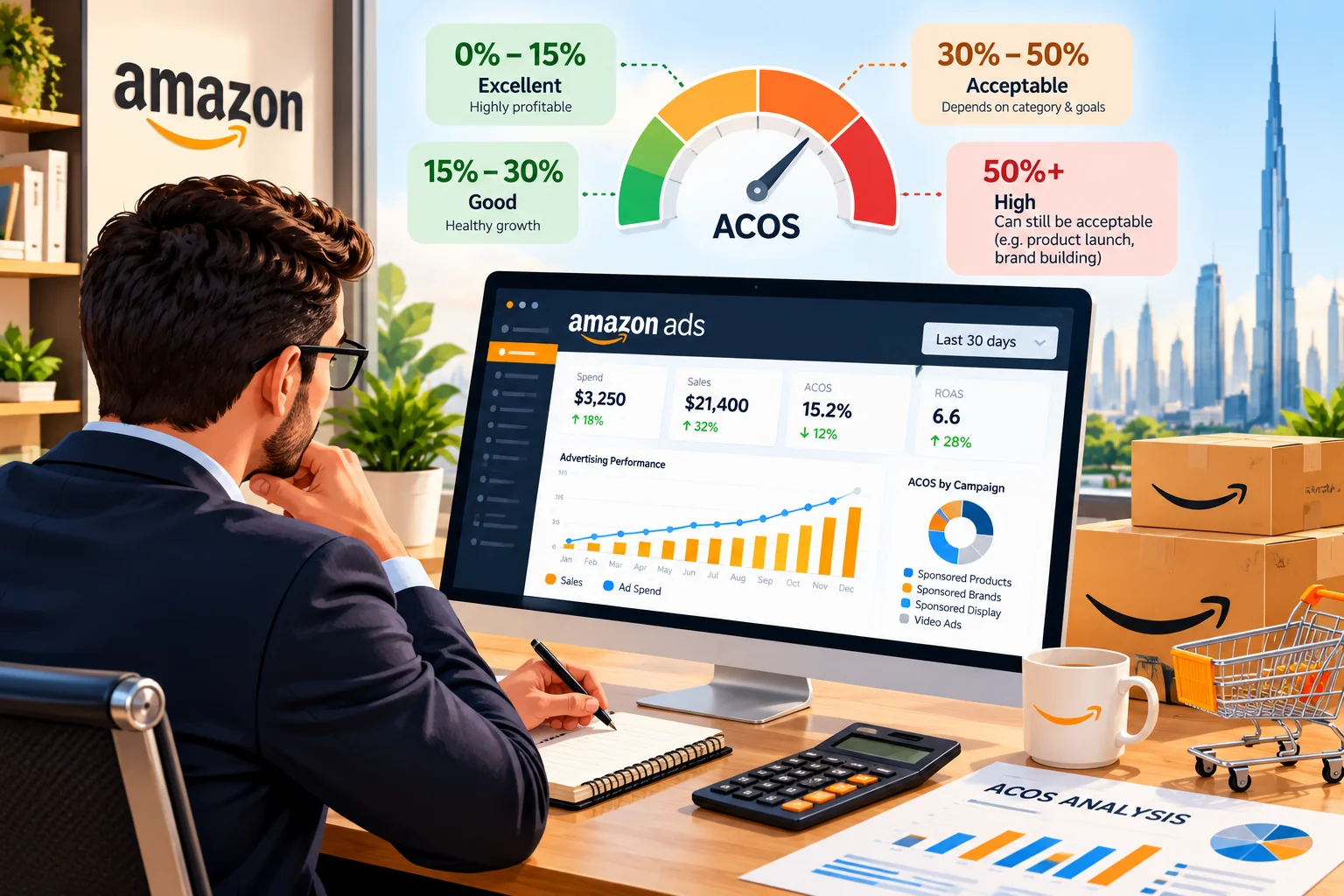
ACOS ranges can help organize a discussion about advertising efficiency, but they should never replace product-specific profitability calculations.
The following table uses illustrative classifications rather than official Amazon benchmarks.
| ACOS Range | Illustrative Classification | What to Evaluate |
|---|---|---|
| Below 15% | Relatively low advertising cost | Conversion, traffic volume and profitability |
| 15%–25% | Moderate advertising cost | Break-even margin and growth opportunities |
| 25%–40% | Higher advertising cost | Available margins and campaign objectives |
| Above 40% | High advertising cost | Financial limits and incremental value |
These percentages are examples for interpretation, not universal targets or verified industry averages.
A seller with substantial margins may profit at an ACOS that another seller cannot afford.
The appropriate benchmark is your own break-even ACOS and the outcome you intend to achieve.
What Is Break-Even ACOS on Amazon?
Break-even ACOS is the advertising cost percentage at which the contribution available from advertising-attributed sales is fully consumed by advertising spending.
It helps sellers estimate the maximum advertising cost they can absorb before the advertised sales stop contributing positive profit under their cost assumptions.
To calculate it, first identify the amount remaining after deducting relevant product and transaction expenses before advertising.
These may include product sourcing, freight, referral fees, fulfillment expenses, returns allowances, and other variable costs.
The resulting contribution margin can be used to estimate break-even ACOS.
How Do You Calculate Break-Even ACOS?
Use the following formula:
Break-Even ACOS = (Contribution Before Advertising ÷ Selling Price) × 100
Consider an illustrative Amazon UAE product selling for AED 100.
| Product Financial Details | AED |
|---|---|
| Selling Price | 100 |
| Product Landed Cost | 35 |
| Amazon Referral Fee | 15 |
| FBA Fulfillment | 10 |
| Other Variable Costs | 5 |
| Contribution Before Advertising | 35 |
The product has AED 35 available before advertising.
Break-Even ACOS = (35 ÷ 100) × 100 = 35%
Under these assumptions, an ACOS of 35% would consume the full contribution available before advertising.
An ACOS of 20% would leave approximately AED 15 contribution per AED 100 of advertising-attributed sales.
An ACOS of 45% would result in an estimated AED 10 negative contribution per AED 100 of attributed sales.
These calculations exclude any costs not included in the table, such as certain fixed overheads or tax effects.
The true break-even point should use your actual financial information.
What Is Target ACOS and How Should You Set It?
Target ACOS is the advertising cost percentage a seller aims to achieve while pursuing a specific profitability or growth objective.
It should be calculated using the product’s break-even ACOS and desired contribution after advertising.
Target ACOS = Break-Even ACOS − Desired Contribution Margin After Advertising
Suppose a product has a break-even ACOS of 35% and the seller wants to retain at least a 10% contribution margin after advertising.
The target ACOS would be 25%.
This target may be appropriate for a mature product focused on sustainable contribution.
For a new product, the seller might temporarily select a higher target to gather data or acquire customers.
However, such a decision should include a defined testing budget, review period, and acceptable financial loss limit.
Target ACOS should also be revised when product prices, Amazon fees, fulfillment charges, or sourcing costs change.
When Is a High Amazon ACOS Acceptable?
A high ACOS is not automatically an indication that an Amazon advertising campaign has failed.
Amazon Ads recognizes that newly launched campaigns and different marketing objectives may justify evaluating more than ACOS alone.
However, higher advertising spending should always support a deliberate business strategy.
The following situations may justify temporarily accepting an ACOS above the usual target.
1. During a New Product Launch
New listings may have limited customer reviews, little advertising history, and uncertain conversion rates.
Sellers sometimes invest more aggressively during launch to test relevant search terms and understand customer response.
A high ACOS may be acceptable during a controlled research phase if the seller can afford the cost and is collecting useful information.
However, sellers should not assume that expensive PPC traffic will automatically improve organic rankings.
Review advertising results alongside listing conversion, product quality, and customer demand.
2. During Keyword and Product Targeting Research
Discovery campaigns can generate valuable search term and product targeting data.
Automatic targeting, broad match keywords, and selected product targets may initially have higher advertising costs while the seller identifies better-performing opportunities.
The value of research depends on whether the findings lead to measurable campaign improvements.
Set a defined discovery budget and review search term performance.
Do not allow inefficient discovery campaigns to continue indefinitely without a clear objective.
3. When Acquiring Valuable New Customers
Some brands focus on attracting first-time buyers who may purchase again in the future.
In this situation, customer acquisition cost and potential repeat-purchase value may be relevant.
However, future customer lifetime value should not be assumed without supporting sales data.
Brands should distinguish repeat-purchase products from products with limited repeat demand.
A higher acquisition cost can sometimes be justified when credible evidence shows that future customer contribution is likely to exceed the initial acquisition loss.
4. During Strategic Marketplace Expansion
A brand entering Amazon UAE, Saudi Arabia, the UK, or another marketplace may initially face unfamiliar competition and conversion patterns.
Controlled advertising tests can help identify local search behavior, price expectations, and product demand.
Higher ACOS may occur during this learning period.
However, marketplace expansion should involve a defined testing plan rather than unrestricted advertising spending.
The seller must also account for marketplace-specific logistics, taxation, fees, and inventory requirements.
5. When High-ACOS Campaigns Support Measurable Overall Growth
Some campaigns may generate direct sales inefficiently while also supporting broader brand discovery.
A seller might evaluate total sales growth, new-to-brand customers where supported, and subsequent purchasing behavior.
However, these effects should be assessed using credible evidence rather than assuming that advertising automatically creates additional organic sales.
The campaign should be reviewed against total business contribution and a defined growth objective.
When Is a High Amazon ACOS a Warning Sign?
High ACOS becomes a concern when advertising consistently exceeds the product’s available contribution without a justified strategic benefit.
Warning signs include:
- Repeated losses: Campaigns consistently spend more than the contribution generated by attributed sales.
- Irrelevant search terms: Ads attract shoppers searching for unrelated or unsuitable products.
- Weak conversion rates: Paid traffic visits the listing but rarely purchases.
- Expensive keywords: CPC increases without corresponding improvement in sales value.
- Uncompetitive offers: Pricing, reviews, or delivery terms are weaker than relevant competitors.
- No testing limits: High spending continues without clear objectives or review dates.
- Poor inventory planning: Advertising investment does not align with product availability.
If these problems continue, sellers should review campaign targeting, listing performance, and product economics before increasing advertising budgets.
What Is the Difference Between Amazon ACOS, ROAS, and TACOS?
ACOS, ROAS, and TACOS measure different aspects of advertising performance.
Understanding how they relate can help sellers avoid misleading conclusions.
| Metric | Formula | Purpose |
|---|---|---|
| ACOS | Ad Spend ÷ Attributed Ad Sales × 100 | Advertising cost efficiency |
| ROAS | Attributed Ad Sales ÷ Ad Spend | Advertising revenue per currency unit spent |
| TACOS | Ad Spend ÷ Total Sales × 100 | Advertising cost relative to overall sales |
For example, suppose advertising spend is AED 500, advertising-attributed sales are AED 2,000, and total sales are AED 4,000.
ACOS would be 25%, ROAS would be 4, and TACOS would be 12.5%.
These measurements provide different perspectives.
A seller should also review actual operating profit or contribution because neither ACOS nor TACOS directly accounts for all product and operating expenses.
ROAS should ordinarily be expressed as a ratio such as 4x, not confused with ACOS percentages.
Can a High ACOS Still Be Profitable?
Yes, depending on the product’s contribution margin before advertising.
A high ACOS is a relative measure rather than an absolute financial result.
Consider two hypothetical products:
- Product A: Break-even ACOS of 55% and actual ACOS of 40%. Under the stated cost assumptions, advertising-attributed sales retain positive contribution.
- Product B: Break-even ACOS of 18% and actual ACOS of 25%. Under the stated cost assumptions, advertising-attributed sales produce negative contribution.
Product A has a higher advertising cost percentage but may still be economically sustainable.
Product B has a lower ACOS but exceeds its available margin.
This demonstrates why comparing ACOS across unrelated products without examining costs can lead to incorrect decisions.
High-margin products may have more flexibility, while low-margin products often require tighter advertising efficiency.
How Can Amazon Sellers Reduce a High ACOS?
Reducing ACOS requires improving the relationship between advertising spending and attributed sales.
Sellers should focus on the underlying factors influencing CPC and conversion rather than lowering bids indiscriminately.
Improve Keyword and Search Term Relevance
Review Sponsored Products search term reports to understand which customer searches generate sales and which consume budget inefficiently.
Identify irrelevant searches and consider appropriate negative targeting.
Promising relevant search terms can be tested through more controlled manual campaigns.
Avoid making negative targeting decisions solely on a few clicks without considering relevance and available data.
Optimize Product Listings and Offers
Review the product’s title, images, bullet points, specifications, pricing, reviews, and delivery experience.
Relevant traffic will not reliably convert if shoppers cannot understand the product or see sufficient value in the offer.
Accurate product information and competitive offers may improve the shopping experience, although results must be tested.
Review Bids, Placements, and Campaign Structure
Compare keyword targets, product targets, automatic targeting groups, and placement performance.
Reduce bids or pause repeatedly inefficient targeting where the data supports action.
Consider separating exact, phrase, and broad campaigns to improve budget control and reporting.
Avoid duplicating campaigns without a clear reason.
Improve Conversion Rate Before Scaling
Higher conversion rates can reduce the expected advertising cost per order when CPC remains unchanged.
If a product receives many clicks but few purchases, investigate product-market fit and listing quality.
Spending more to attract the same poorly converting traffic may increase losses instead of improving performance.
How Does Conversion Rate Affect Amazon ACOS?
Conversion rate and cost per click strongly influence the expected cost of acquiring an advertising-attributed order.
Consider a product selling for AED 100 with an average CPC of AED 2.
If 5% of ad clicks generate an order, approximately 20 clicks are required per expected order.
The expected advertising cost is AED 40 per order, equivalent to approximately 40% ACOS under this simplified one-unit purchase example.
If conversion improves to 10%, the expected number of clicks per order falls to 10.
The expected advertising cost becomes AED 20 per order, equivalent to approximately 20% ACOS.
The example assumes stable CPC, selling price, and attribution.
It illustrates why improving listing conversion can be as important as optimizing bids.
Should Sellers Pause Campaigns With High ACOS?
Not necessarily.
Before pausing a high-ACOS campaign, sellers should consider the amount of data available, product margins, target relevance, and campaign objectives.
A newly launched campaign with limited sales data may have unstable performance.
A mature campaign with substantial spend and persistent losses may require stronger intervention.
Review search terms, individual targets, product availability, and contribution margin.
If some targets perform well while others lose money, targeted adjustments may be more effective than pausing the entire campaign.
A campaign should be paused when the evidence indicates that continuing spending is unlikely to justify its cost under the seller’s objectives and risk limits.
How Often Should You Review Amazon ACOS?
The appropriate review frequency depends on advertising spend, campaign maturity, and data volume.
Daily monitoring can identify unexpected spending, product availability issues, or operational problems.
Weekly reviews can focus on search terms, bids, targeting performance, and conversion trends.
Monthly reviews can evaluate broader changes in ACOS, TACOS, product profitability, and account performance.
Sellers should account for Amazon’s applicable advertising attribution windows and reporting delays.
Avoid making major changes based on incomplete attribution or insignificant sample sizes.
A disciplined review process helps distinguish short-term fluctuations from sustained performance problems.
What Amazon PPC Mistakes Can Increase ACOS?
Several common advertising mistakes can increase costs without improving results.
- Targeting high-volume but poorly relevant keywords.
- Using excessive bids without considering conversion performance.
- Failing to review search term reports and inefficient product targets.
- Advertising products with weak or incomplete listings.
- Ignoring pricing, customer reviews, and delivery competitiveness.
- Using overlapping campaigns without clear allocation objectives.
- Increasing daily budgets to compensate for weak conversion.
- Ignoring changes to product costs and break-even margins.
- Making major decisions before sufficient data is available.
- Evaluating every campaign using the same ACOS target.
Avoiding these mistakes requires connecting advertising performance with product economics and customer purchasing behavior.
How Can iNNOVEX Enterprises Help Improve Amazon ACOS?
Managing Amazon advertising requires ongoing analysis of profitability, campaign structure, keyword relevance, bids, and product conversion.
At iNNOVEX Enterprises, we provide Amazon PPC management and optimization services for businesses seeking more structured advertising performance.
Our services include:
- Amazon PPC Audit: Reviewing advertising costs, high-ACOS campaigns, search terms, and potential inefficiencies.
- Amazon PPC Management: Campaign monitoring, budget allocation, bid adjustments, and ongoing optimization.
- Sponsored Products Management: Automatic and manual targeting, negative keywords, and campaign performance analysis.
- Amazon PPC Keyword Research: Identifying relevant search terms for product advertising.
- Amazon PPC Campaign Optimization: Evaluating conversion, CPC, ACOS, ROAS, and advertising efficiency.
- Amazon Listing Optimization: Improving product information and visual content to support purchasing decisions.
- Amazon Account Management: Coordinating advertising, catalog, and inventory-related activities.
Our approach is to evaluate advertising in the context of real business objectives rather than simply chasing the lowest possible ACOS.
We support sellers operating across Amazon UAE, USA, UK, Saudi Arabia, and other marketplaces.
Is your Amazon ACOS too high, or are you unsure whether your advertising is profitable? Visit iNNOVEX Enterprises to discuss an Amazon PPC audit and campaign optimization plan.
Frequently Asked Questions About Amazon ACOS
1. Is 20% a good Amazon ACOS?
A 20% ACOS may be profitable if the product has sufficient contribution margin before advertising. However, it can be unprofitable when the break-even ACOS is below 20%.
2. Is 30% ACOS too high on Amazon?
Not necessarily. A 30% ACOS may be acceptable for products with higher available margins or during a controlled launch. Compare it with the calculated break-even ACOS.
3. Is 50% Amazon ACOS bad?
A 50% ACOS represents substantial advertising spending relative to attributed revenue. It may be financially sustainable for some high-margin products, but many products cannot absorb that level of advertising cost.
4. What is a good Amazon ACOS for beginners?
Beginners should calculate their product’s break-even ACOS and determine a sustainable target. There is no universal beginner ACOS benchmark.
5. What is break-even ACOS?
Break-even ACOS is the estimated advertising spend percentage that consumes the contribution available before advertising. Above that level, attributed sales may produce negative contribution under the stated cost assumptions.
6. Why is my Amazon ACOS suddenly increasing?
Possible causes include higher CPC, lower conversion rates, price changes, increased competition, irrelevant search traffic, or changes in attributed sales reporting.
7. Can a high ACOS help launch a new product?
Higher ACOS may be accepted temporarily during controlled product launch testing, but it does not guarantee organic ranking improvements or future profitability.
8. What is the difference between ACOS and TACOS?
ACOS compares advertising spending with advertising-attributed sales. TACOS compares advertising spending with total sales over the same reporting period.
9. Should I reduce bids to lower Amazon ACOS?
Reducing inefficient bids can help control spending, but bid changes should reflect target relevance, conversion performance, and available data.
10. Can an Amazon PPC agency guarantee lower ACOS?
No. An agency can evaluate campaigns and recommend optimization strategies, but actual results depend on product economics, competition, conversion rates, and marketplace conditions.
Conclusion: What Is a Good Amazon ACOS for Your Business?
A good Amazon ACOS is one that aligns with your contribution margins, campaign objectives, and acceptable advertising risk.
The most effective approach is to calculate break-even ACOS first, then establish a realistic target based on desired profitability and business growth.
A low ACOS is not automatically profitable, and a high ACOS is not always unacceptable.
New product launches, keyword research, and customer acquisition strategies may sometimes justify temporarily higher advertising costs.
However, sustained spending above break-even requires a clear business justification supported by reliable financial evidence.
Amazon sellers should review ACOS alongside ROAS, TACOS, conversion rates, CPC, total sales, and product-level contribution.
By connecting advertising decisions to actual product economics, sellers can develop more sustainable PPC strategies.
Need help reviewing high Amazon ACOS or optimizing advertising campaigns? Contact iNNOVEX Enterprises for professional Amazon PPC audit and management support.
Official Sources and References
- Amazon Ads – What Is Advertising Cost of Sales?
- Amazon Ads – Advertising Metrics and FAQs
- Amazon Ads – Digital Advertising Fundamentals
- Amazon Ads – Advertising Budget and Performance Measurement
Disclaimer: This article is provided for general educational purposes as of October 2026. Advertising metrics, campaign features, and attribution rules can differ by marketplace or change over time. The financial examples are illustrative and do not guarantee sales or advertising profitability.