Starting an Amazon private label business is an attractive option for entrepreneurs who want to develop their own product brand rather than resell products manufactured under another company’s name.
However, many new sellers believe they must register a trademark and enroll in Amazon Brand Registry before they can create their first private label listing.
This assumption can delay product launches, increase initial expenses, and create confusion about Amazon’s actual selling requirements.
So, can you sell private label products on Amazon without Brand Registry in 2026?
Yes. Amazon allows eligible sellers to list and sell their own branded products without enrolling in Amazon Brand Registry, provided they meet the applicable listing requirements and obtain brand name approval when required.
Amazon’s official guidance explains that sellers without a registered trademark can request permission to list products using an unregistered brand name.
However, the brand must be accurately represented on the product or packaging, and the seller must follow Amazon’s product identification, category, safety, and catalog policies.
Selling without Brand Registry is therefore possible, but it differs from having a fully registered and protected Amazon brand.
Without enrollment, sellers may lack access to certain brand-exclusive tools, intellectual property protection resources, and advanced promotional features.
These differences can influence how businesses manage their listings, protect their brand identity, and develop long-term marketplace strategies.
For sellers operating in Amazon UAE, USA, UK, Saudi Arabia, and other supported marketplaces, understanding the correct process is essential.
This guide explains how to start an Amazon private label business without Brand Registry, when Amazon brand name approval is needed, how trademarks and GTIN exemptions work, and when enrolling in Brand Registry becomes a worthwhile investment.
1. Can You Sell Private Label Products on Amazon Without Brand Registry?
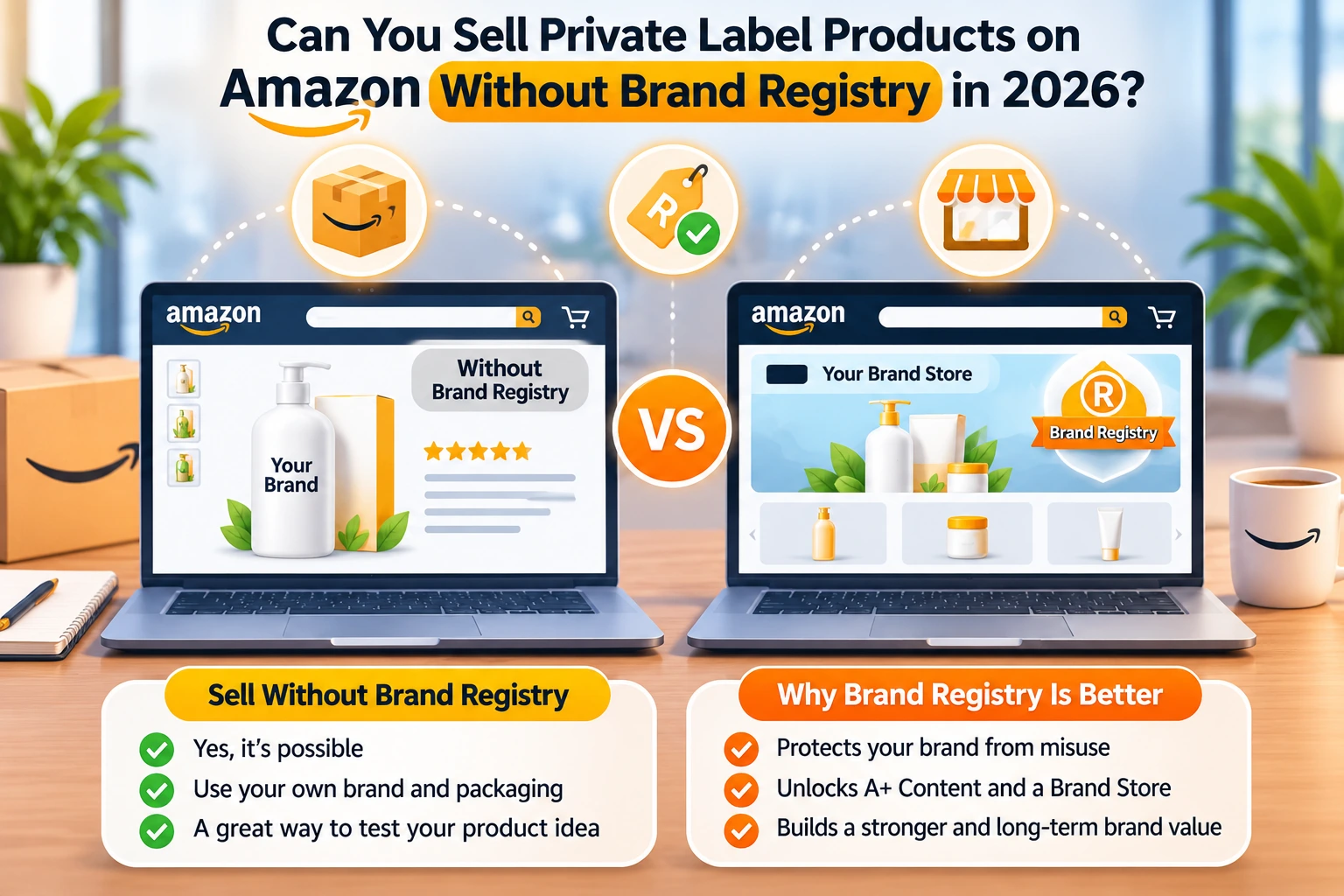
Amazon Brand Registry is not a universal requirement for selling private label products. Eligible businesses can sell products under their own unregistered brand names after completing Amazon’s applicable brand name approval and product listing procedures.
Amazon’s official guide to selling branded products describes a specific process for sellers who have created their own brands but have not enrolled them in Brand Registry.
This process allows eligible businesses to request permission to use an unregistered brand name in the Amazon catalog.
The seller does not necessarily need a registered trademark to submit this particular application.
However, Amazon may require evidence that the product genuinely carries the proposed brand.
This is different from Brand Registry enrollment, which requires an eligible pending or registered trademark and other supporting information.
What Is Amazon Private Label Selling?
Amazon private label selling is a business model in which a seller develops and markets products under its own brand name.
The products may be manufactured by an independent supplier or produced through the seller’s own manufacturing arrangements.
For example, a business might source household storage accessories from a factory, develop its own packaging, choose a brand name, and sell the finished products under that brand on Amazon.
The seller is responsible for the commercial decisions surrounding the product.
These can include product selection, supplier negotiation, packaging design, listing creation, pricing, shipping, marketing, customer experience, and applicable compliance requirements.
Unlike ordinary resale, the seller is developing an identifiable brand associated with its product offering.
However, merely purchasing an unbranded product from a supplier does not automatically establish a legally protected brand.
The seller should verify trademark availability, appropriate branding, and relevant intellectual property rights before investing in production.
What Is Amazon Brand Registry?
Amazon Brand Registry is a free program that provides eligible brand owners with access to additional brand-building and intellectual property protection resources.
Amazon describes the program as a way to help businesses develop and protect their brands within Amazon stores.
Enrollment can unlock eligibility for tools such as Brand Stores, brand-related analytics, enhanced content capabilities, and protection programs, depending on the account and marketplace.
Brand Registry is not the same thing as a seller account.
A seller account enables eligible businesses to list and sell products.
Brand Registry provides additional tools for qualifying brands.
A business may therefore have an active Amazon seller account and sell products without being enrolled in Brand Registry.
Is Brand Registry Mandatory for Every Amazon Seller?
No. Amazon explicitly states that sellers can operate without Brand Registry.
This applies to a variety of selling arrangements, including eligible unregistered branded products and genuinely unbranded items.
However, the permission to sell products should not be confused with unrestricted permission to use any brand name.
Amazon may require approval for an unregistered brand.
Certain product categories may also require separate selling authorization.
The right to sell a particular product depends on the product, the marketplace, its compliance requirements, and the seller’s eligibility.
Brand Registry is optional for some selling situations, but specific brand benefits require appropriate enrollment and authorization.
Can You Sell Under Your Own Brand Name Without a Trademark?
Yes, Amazon provides a process for requesting approval to use an unregistered brand name.
This process can be used by eligible sellers who have developed a brand but do not yet have a registered or pending trademark.
The seller must demonstrate that the proposed name represents a genuine brand.
Amazon’s official guidance requires the brand name and logo to be permanently affixed to the products or packaging.
Examples of acceptable manufacturing methods can include suitable printed or embossed branding.
Removable stickers are not sufficient under Amazon’s published unregistered-brand guidance.
The branding shown in the submitted product images should match the brand name entered during listing creation.
Approval is not automatic.
Amazon may request additional information or reject an application that does not satisfy its requirements.
What Is the Difference Between Brand Name Approval and Brand Registry?
Brand name approval allows a seller to use an approved unregistered brand name when creating eligible product listings.
Brand Registry enrollment establishes access to a wider set of brand-related tools after the relevant eligibility requirements have been satisfied.
Brand name approval does not grant the same protections or permissions as Brand Registry.
For example, a seller whose unregistered brand has been approved may be able to create product listings but may not receive the complete set of brand-exclusive analytics, advertising, Store, or intellectual property protection benefits.
Amazon specifically advises sellers to consider the trademark process and Brand Registry enrollment when planning long-term brand development.
The correct approach depends on the seller’s business objectives and product launch timetable.
2. What Are the Requirements for Selling Amazon Private Label Products Without Brand Registry?
Although sellers can launch eligible private label products without Brand Registry, they must still comply with Amazon’s seller registration, catalog, product identification, and regulatory requirements.
Skipping Brand Registry does not mean skipping product verification or applicable legal responsibilities.
Requirement 1: An Eligible Amazon Seller Account
The first requirement is an active seller account in the intended Amazon marketplace.
Sellers must provide the business and identity information requested during registration.
Depending on the legal entity and marketplace, Amazon may request business registration documents, identification, contact information, billing details, and eligible banking information.
The information should accurately describe the business that owns or operates the seller account.
A seller should not enter false company information or create duplicate accounts to bypass restrictions.
Amazon’s verification requirements may vary by region and seller circumstances.
Requirement 2: A Genuine Brand Name
A private label brand should have a recognizable name associated with the actual products.
Before selecting a name, research whether other businesses already use similar names for related goods.
A brand name that conflicts with another party’s intellectual property can create legal and marketplace risks.
A seller should not assume that approval to use a brand name within Amazon provides ownership of that name under trademark law.
Consider trademark clearance before investing in packaging, inventory, or advertising.
A qualified trademark professional can assess relevant trademark classes and jurisdictions.
Requirement 3: Permanent Branding on Products or Packaging
Amazon’s unregistered-brand listing process requires evidence that the brand is permanently associated with the product or its packaging.
The company logo should include the relevant brand name.
Amazon explains that removable stickers are not sufficient for this particular process.
For example, a seller might arrange for the supplier to print the brand on retail packaging during production.
Another product may have the brand embossed or printed directly onto the item.
The appropriate method depends on the materials, design, and Amazon’s current requirements.
The product images submitted for approval should show the real branding clearly.
Avoid presenting digitally added branding as if it were permanently manufactured onto the physical product.
Requirement 4: Accurate Brand Information
The name entered in the Amazon listing should match the actual brand displayed on the product or packaging.
Spelling, spacing, punctuation, and capitalization should be checked carefully.
Amazon’s brand approval guidance indicates that brand names are sensitive to certain formatting differences.
For example, a company should not enter one spelling in its application and a different spelling when creating the listing.
Brand mismatches can trigger listing errors or additional review.
Confirm the final brand name with your supplier before manufacturing packaging in bulk.
Requirement 5: Product Identification and GTIN Compliance
Many Amazon products require a Global Trade Item Number, commonly called a GTIN.
Depending on the product category and market, this identifier may be a UPC, EAN, ISBN, or another accepted format.
Amazon’s registration guidance identifies GS1 as a source for obtaining legitimate product identifiers.
Some products may qualify for a GTIN exemption if they do not have an applicable product identifier.
However, exemptions are not automatic.
Brand name approval, Brand Registry enrollment, and GTIN exemption are separate processes.
A seller should not assume that receiving one approval automatically satisfies the other requirements.
Requirement 6: Accurate Product Listings
A private label listing should accurately identify the product and its relevant specifications.
Important information can include title, images, material, dimensions, quantity, intended uses, compatible accessories, and category-specific attributes.
For example, a seller offering a rechargeable LED writing board should provide the actual screen size, charging method, battery specifications, and package contents.
The seller should not copy unsupported specifications from a competitor.
Amazon listing policies also prohibit misleading representations and other unacceptable content.
Product descriptions should reflect the actual item customers receive.
Requirement 7: Product Safety and Regulatory Compliance
Private label sellers remain responsible for applicable product safety and regulatory requirements.
These requirements depend on the product category and country.
For example, children’s toys, electronics, cosmetics, food products, and certain battery-powered items may be subject to different rules.
Compliance can involve testing, labeling, certificates, warnings, or product registrations.
A product allowed for sale in the UAE may face additional or different requirements in the United States or Saudi Arabia.
Sellers should check relevant regulations before importing goods.
Amazon may also request product safety documentation independently of government authorities.
Requirement 8: A Suitable Fulfillment Arrangement
A private label business may choose an eligible Amazon fulfillment method according to its operations.
Fulfillment by Amazon, or FBA, allows Amazon to store and fulfill eligible customer orders.
Merchant fulfillment may be available when the seller manages shipping and customer delivery requirements.
Brand Registry is not a universal prerequisite for using Amazon FBA.
However, the seller must follow the applicable inbound shipment, packaging, barcode, customs, and inventory requirements.
If products are manufactured internationally, identify the correct importer and account for shipping expenses before dispatching inventory.
Requirement 9: Proper Supplier and Business Documentation
A seller should maintain appropriate records relating to product production, sourcing, payments, and brand ownership.
Useful documentation can include commercial invoices, purchase orders, supplier agreements, packaging specifications, product photographs, and applicable testing records.
These records may help the business respond to Amazon verification requests and resolve operational disputes.
However, possessing an invoice does not automatically establish ownership of a trademark.
Trademark rights and seller authorization should be evaluated separately.
3. How Can You Create a Private Label Listing Without Amazon Brand Registry?
Amazon has documented a process for sellers who want to create listings under their own unregistered brand names.
The process starts in Seller Central and may involve additional catalog authorization.
The following steps provide a practical framework.
Step 1: Research Your Private Label Product
Begin by identifying a product with suitable customer demand and realistic commercial potential.
Consider customer needs, competition, selling prices, product specifications, and fulfillment expenses.
For example, a seller interested in household accessories might research bathroom organizers, adhesive hooks, or storage products.
Review genuine customer feedback to understand what buyers value and which product problems they frequently encounter.
Do not select a product solely because a competitor appears to generate high sales.
Evaluate the expected profitability after product sourcing, Amazon fees, shipping, advertising, returns, and other expenses.
Step 2: Select Your Brand Name
Choose a name suitable for the product category and long-term business plans.
A good brand name should be distinctive and appropriate for the intended customers.
Check whether the name is already used by another business.
Trademark clearance is particularly important if the business plans to sell in several countries.
A name available on a website or social media platform is not automatically available for trademark registration.
Consider future product categories before finalizing the name.
A brand focused on multiple household products may benefit from a name that is not unnecessarily restricted to one item.
Step 3: Arrange Permanent Product or Packaging Branding
Work with the supplier to incorporate the chosen brand name into the final product or retail packaging.
Confirm that the visible branding will match the intended Amazon catalog information.
Amazon’s official guidance says the logo must include the brand name and be permanently affixed.
Removable stickers do not satisfy the published requirements for the unregistered-brand route.
Ask the supplier to provide actual production samples before approving the full order.
Inspect spelling, printing quality, placement, colors, and packaging materials.
Do not assume that a digital packaging mockup is sufficient evidence of a finished branded item.
Step 4: Prepare Real Product Photographs
Photographs used for brand approval should show the real item or packaging and its actual branding.
Make sure the brand name is clearly visible and corresponds to the application.
Amazon may provide detailed image requirements during the approval process.
For normal product listing images, follow the separate category and marketplace image requirements.
Avoid adding logos digitally to approval photographs when those logos are not physically present.
Keep original supplier or production photographs available if additional documentation is requested.
Step 5: Open Add Products in Seller Central
Sign in to the correct Amazon Seller Central marketplace.
Navigate to the product creation workflow through Catalog and Add Products or the currently available equivalent interface.
Search for the product to determine whether a relevant listing already exists.
If the item is genuinely a new private label product, proceed through the appropriate new listing creation process.
Do not create unnecessary duplicate listings for identical existing branded items.
Confirm the correct product category and item type.
Step 6: Enter Your Unregistered Brand Name
During listing creation, enter the brand name that appears on the product or packaging.
If Amazon does not recognize or approve the name, the system may display error code 5665.
This error generally indicates that the entered brand name requires approval.
Amazon’s official seller guidance directs applicants to submit a Selling application for Catalog Authorization.
The application may request supporting product information and photographs.
Read the actual instructions displayed in your account because requirements can vary.
Step 7: Complete the Catalog Authorization Application
Follow the application link provided by Amazon.
Submit the requested evidence showing the relationship between the proposed brand name and the product.
Ensure the physical branding is legible and consistent.
Amazon’s brand approval guidance emphasizes matching names and genuine product or packaging images.
Do not assume approval is guaranteed simply because the company created its own packaging design.
If Amazon requests clarification, provide accurate documentation.
Once authorization is granted, the seller can proceed with eligible listings under the approved brand name.
Step 8: Understand Amazon Error Codes
Several listing errors may relate to brand names and catalog permissions.
| Error | Possible Meaning | Recommended Action |
|---|---|---|
| 5665 | Brand name has not been approved | Follow the brand authorization application |
| 5664 | Possible generic or brand-name policy issue | Review brand-name evidence and application instructions |
| 5668 | Required brand name may be missing | Confirm the correct brand attribute and supporting evidence |
| 5461 | Insufficient permission to create a product page for a brand | Review selling roles or the applicable authorization process |
The exact remedy depends on the actual error and account circumstances.
Use Amazon’s instructions rather than attempting to bypass catalog restrictions.
Step 9: Obtain a Valid GTIN or Check Exemption Eligibility
After resolving brand authorization, confirm the product identification requirements.
A private label product may need a valid GTIN assigned through an appropriate GS1 arrangement.
For products without a GTIN, Amazon may offer an exemption process where eligible.
Open the relevant product creation workflow and follow the instructions associated with the product ID field.
If an exemption application is required, submit the requested information.
Approval depends on the product, brand, category, and marketplace.
Do not use another company’s barcode or assume that a barcode already assigned to a different product is appropriate.
Step 10: Create the Complete Product Listing
Prepare a clear title that identifies the product and its main characteristics.
Add accurate bullet points explaining important features and relevant uses.
Include product specifications such as dimensions, material, color, capacity, and package quantity.
Use high-quality photographs of the actual item.
For example, if a product contains a two-pack of hooks, the listing should clearly reflect the quantity.
Do not show a four-pack when customers will receive only two pieces.
Ensure variations accurately correspond to the products being sold.
Avoid unsupported performance or safety claims.
Step 11: Configure Amazon FBA or Merchant Fulfillment
Choose a fulfillment method suitable for the item and business.
If using FBA, prepare inventory according to the relevant Amazon shipment requirements.
Confirm product labeling, carton details, inbound shipment information, and any necessary preparation.
If shipping internationally, arrange the appropriate importer and customs procedures.
Calculate freight, storage, referral fees, fulfillment charges, and estimated advertising costs.
Avoid sending excessive inventory before validating customer demand.
Step 12: Launch and Monitor Performance
After the listing is approved and the product is available, monitor relevant performance metrics.
Review sessions, ordered units, conversion, inventory, customer feedback, and advertising reports.
If eligible, Sponsored Products advertising may help introduce the listing to relevant customers.
Research keywords that accurately describe the product.
Adjust the campaign according to actual performance rather than assuming that every popular keyword will generate profitable sales.
A successful private label launch depends on ongoing operations, not simply receiving catalog approval.
4. What Is the Difference Between Selling With and Without Brand Registry?
Amazon Brand Registry provides additional capabilities for eligible brands, but sellers can begin certain private label operations without it.
Understanding the practical differences helps businesses decide whether to apply immediately or launch through the unregistered-brand process.
| Feature | Without Brand Registry | With Brand Registry |
|---|---|---|
| Sell Own Branded Products | Possible with required approval | Available subject to permissions |
| Trademark for Enrollment | Not required for unregistered-brand approval | Eligible pending or registered mark required |
| Amazon FBA | Available to eligible sellers | Available to eligible sellers |
| Sponsored Products | Generally possible if eligible | Generally possible if eligible |
| Brand Store | Generally unavailable to unregistered seller brands | Available to eligible authorized brands |
| Sponsored Brands | Generally unavailable to unregistered seller brands | Available subject to advertising eligibility |
| A+ Content | Brand-exclusive access limited; qualifying generic products may have access | Eligible brand roles can access supported tools |
| Brand Analytics | Generally no brand-exclusive access | Available to eligible roles |
| Brand Protection Tools | Limited compared with enrolled brands | Additional eligible protection resources |
Can You Use Amazon FBA Without Brand Registry?
Yes. FBA is not restricted exclusively to Brand Registry participants.
An eligible seller can use the fulfillment program for products that meet Amazon’s requirements.
FBA provides storage, order handling, and fulfillment for eligible inventory.
However, FBA enrollment does not establish brand ownership or trademark rights.
Sellers remain responsible for product sourcing, catalog accuracy, importation, and compliance.
Can You Run Amazon PPC Without Brand Registry?
Eligible sellers can generally use Sponsored Products without Brand Registry.
This advertising format helps promote eligible product listings through paid placements.
However, other Amazon advertising products have additional eligibility conditions.
For example, Amazon Ads’ August 2026 Sponsored Brands eligibility guidance requires sellers to be registered brand owners through Brand Registry, alongside other account requirements.
Therefore, sellers should not assume that access to Sponsored Products automatically grants access to Sponsored Brands.
Advertising eligibility also varies by marketplace and product category.
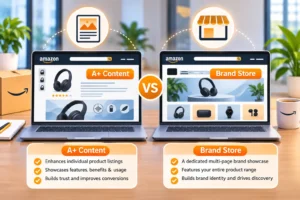
Can You Create Amazon A+ Content Without Brand Registry?
This requires careful distinction.
Amazon’s current US A+ Content documentation identifies Professional sellers with eligible Brand Representative or Reseller roles for registered brands, as well as certain sellers with generic products, as potentially eligible.
Therefore, it would be inaccurate to say that every seller without Brand Registry is categorically prohibited from using any form of A+ Content.
However, approval to use an unregistered private label brand name does not automatically provide the brand-exclusive permissions associated with Brand Registry.
A seller should verify the tools available in its actual account.
Do not treat qualifying Generic product access as permission to mislabel a genuinely branded item.
Can You Create an Amazon Brand Store Without Brand Registry?
For ordinary seller-managed brands, Amazon Brand Registry is generally required to create a Brand Store.
Amazon also documents access for eligible vendors and agencies representing vendors.
A seller who has only received approval to use an unregistered brand name should not expect automatic Store access.
A Brand Store provides a dedicated multipage destination where customers can explore a brand’s products and collections.
It can support relevant brand advertising and cross-selling activities.
Brand Store creation is free for eligible brands, although professional design and advertising may involve separate expenses.
Can You Protect Your Brand Without Brand Registry?
Brand Registry provides access to additional intellectual property protection tools, but trademark rights arise from applicable law rather than the Amazon program itself.
A company may have certain legal rights outside Brand Registry.
However, access to Amazon’s enhanced brand protection processes may be limited until enrollment.
For long-term private label businesses, this can become an important consideration.
If a seller plans to invest substantially in packaging, product development, and advertising, establishing a suitable intellectual property strategy may help reduce business risks.
Brand Registry does not guarantee that every infringement or counterfeit problem will be prevented.
Does Brand Registry Automatically Improve Search Rankings?
Amazon does not promise that enrollment automatically places products higher in organic search results.
Brand Registry can provide tools that help eligible brands improve product content, analyze performance, and build a more complete customer experience.
However, search visibility depends on broader marketplace conditions.
Product relevance, customer demand, competitive offers, accurate listings, and availability remain important.
A seller should not enroll solely because of a claim that Brand Registry guarantees first-page rankings.
The program’s benefits should be evaluated on their actual features.
5. Should You List Products as Generic or Start With Your Own Brand?
One of the most consequential decisions for new private label sellers is whether to list an item as Generic or under a developing brand name.
The two choices are not interchangeable.
Amazon has explicit policies governing the use of Generic in product listings.
What Is an Amazon Generic Product?
A Generic product is an item that does not belong to an identifiable consumer brand.
It has no distinctive brand name or logo attached to the product.
For example, a genuinely unbranded household item may qualify for a Generic listing when it meets the applicable catalog rules.
However, a product with a visible brand name on its packaging should not be misrepresented as Generic.
Amazon’s official Generic Product policy requires sellers to accurately classify their items.
Generic should be used only when the product is genuinely unbranded.
Can You Launch a Private Label Product as Generic?
A seller may launch a genuinely unbranded product as Generic if it meets Amazon’s policy.
However, this is not the same as establishing an identifiable private label brand.
If the business intends to develop a long-term brand, labeling the product Generic simply to avoid the unregistered-brand approval process can cause substantial complications.
Amazon states that existing Generic listings cannot be converted directly into branded listings.
The seller must create a new listing when the product becomes branded.
Therefore, the initial catalog decision should reflect the actual product and long-term business plan.
Can You Change Generic to Your Brand Name Later?
No. Amazon’s published Generic Product policy states that sellers cannot change an existing product listing from Generic to a specific brand name.
If a seller later develops a branded version, Amazon requires a new product listing.
This is an important risk for entrepreneurs who initially choose Generic with the intention of changing the name once their trademark is ready.
A new listing may require new catalog work, product identification arrangements, and launch planning.
The seller should not assume that the original listing’s reviews, ASIN history, or performance can simply be transferred.
Plan the brand strategy before creating the original listing.
What Happens if You Register Your Brand After Creating Unregistered-Branded Listings?
A seller who originally obtained Amazon approval for an unregistered brand may later obtain trademark rights and enroll in Brand Registry.
However, Amazon warns that existing listings created through the unregistered-brand approach may require assistance from Seller Support to become associated with the newly enrolled brand.
That process should not be assumed to occur automatically.
Preserve documentation of original brand approval, product branding, trademarks, and listing identifiers.
When preparing Brand Registry enrollment, verify consistency between the existing catalog brand name and trademark.
This can reduce avoidable discrepancies.
What Are the Risks of Launching Without Brand Registry?
Selling without Brand Registry can be commercially reasonable, but it involves limitations.
The business may not have access to certain brand-exclusive tools.
It may face additional administrative steps when transitioning to a registered brand.
The absence of registered trademark rights can complicate protection and expansion.
A seller may also need to invest in professional brand development later.
However, these risks do not mean that all unregistered-brand launches are unsuitable.
A small business testing a limited product range may have different priorities from an established company investing in a large private label catalog.
When Should You Apply for a Trademark?
For businesses planning a long-term private label brand, early trademark planning is often prudent.
A trademark application can require time for examination and may face objections or conflicts.
Brand Registry currently accepts eligible pending or registered trademarks from approved intellectual property offices, subject to its requirements.
A seller therefore may not need to wait for every aspect of trademark registration to conclude before applying for Brand Registry.
However, the exact eligibility depends on the issuing office, application status, and Amazon’s rules.
Do not assume that filing any trademark application automatically guarantees Brand Registry enrollment.
How Much Does Brand Registry Cost?
Amazon Brand Registry itself is free.
However, trademark application fees and legal assistance may involve separate costs.
A company may also pay for packaging design, product photography, brand development, and other business services.
The price of obtaining trademark rights varies by jurisdiction and application circumstances.
Sellers should distinguish the cost of Amazon enrollment from the legal and commercial cost of building a brand.
For businesses operating in multiple countries, trademark protection should be evaluated according to the intended markets.
When Is Brand Registry Worth It for Private Label Sellers?
Brand Registry becomes particularly relevant when a seller intends to develop a recognizable brand and invest in long-term growth.
For example, a company launching a collection of educational toys may want enhanced product content, a dedicated Brand Store, relevant analytics, and brand protection resources.
A home accessories brand with multiple products may also benefit from presenting its catalog consistently.
However, the value of the program depends on actual eligibility and how effectively the business uses the available tools.
Enrolling in Brand Registry should be part of a wider product, intellectual property, and marketing strategy.
6. How Can You Build a Successful Amazon Private Label Business Without Brand Registry?
Launching a private label brand involves more than obtaining approval for a product listing.
A seller must research demand, source suitable products, calculate expenses, prepare accurate content, and manage the marketplace after launch.
The following considerations can help businesses develop a more structured strategy.
Start With Product Research and Profitability
Choose products based on actual customer needs rather than assumptions about what will sell.
Investigate category demand, competitive products, pricing, and common customer complaints.
Review manufacturing and packaging costs.
Calculate shipping, customs, referral fees, fulfillment expenses, advertising, and expected returns.
For example, if a product generates $30 in net sales revenue and incurs $24 in relevant expenses, it retains $6 before excluded costs.
That represents a 20% contribution margin on the stated revenue basis.
However, final net profit may be lower when other business expenses and applicable taxes are included.
A private label product should have a sustainable financial model before large inventory commitments.
Choose Reliable Manufacturers and Suppliers
Product quality strongly influences customer satisfaction and return rates.
Evaluate suppliers based on their capabilities, communication, production standards, and ability to meet specifications.
Request appropriate samples before approving bulk production.
If the product includes electronics, batteries, children’s components, or regulated materials, check the required documentation carefully.
Confirm the final brand printing method and packaging details.
Maintain written specifications to reduce misunderstandings between the business and the supplier.
Build Accurate and Compliant Product Listings
Create titles that clearly identify the product and its important characteristics.
Use bullet points to answer customer questions and explain real product features.
Provide accurate dimensions, materials, package contents, and compatibility information.
Images should represent the actual item.
Do not claim certifications, safety characteristics, or technical specifications that have not been verified.
A compliant listing supports customer understanding and reduces avoidable confusion.
Use Amazon SEO to Improve Product Discoverability
Relevant keyword research remains useful even without Brand Registry.
Identify search terms that accurately describe the product.
Research different ways customers express product needs.
Use important keywords naturally in appropriate listing fields.
Avoid keyword stuffing, competitor trademark misuse, and irrelevant search terms.
Complete available product attributes accurately.
Search optimization should serve the customer rather than attempt to exploit an undisclosed ranking formula.
Develop a Realistic Advertising Strategy
Eligible sellers may use Sponsored Products to introduce listings to relevant customers.
Before launching, calculate an advertising budget based on contribution margins and cash flow.
Monitor clicks, attributed sales, ACOS, and total product profitability.
For example, a campaign with $100 in advertising spending and $500 in attributed revenue has a 20% ACOS.
However, this alone does not establish whether the campaign is profitable.
The seller must also consider product and fulfillment expenses.
Review performance regularly and refine targeting based on available evidence.
Maintain Healthy Inventory Levels
Inventory planning is important for both FBA and merchant fulfillment.
Insufficient stock can interrupt sales, while excess inventory can increase storage expenses.
Estimate replenishment needs based on actual demand and supplier lead time.
For example, a product selling five units daily with a 30-day lead time may require planning for approximately 150 units of expected lead-time demand before adding a suitable safety allowance.
The correct quantity depends on demand variability, shipping arrangements, and available cash.
Avoid treating a fixed inventory quantity as appropriate for every product.
Prepare for Trademark and Brand Registry Enrollment
Even if the business launches through unregistered-brand approval, it can plan for later trademark registration.
Maintain consistency between the brand name on the product, packaging, listings, and trademark application.
Preserve supporting documents.
Consider the markets where the brand will operate and obtain professional advice about suitable trademark protection.
When eligible, review Amazon Brand Registry requirements and the additional tools available to the brand.
Plan the transition carefully rather than assuming that enrollment automatically changes every existing listing permission.
How Can iNNOVEX Enterprises Help You Launch a Private Label Brand?
Starting a private label business involves product research, supplier coordination, branding, catalog approval, logistics, and advertising.
At iNNOVEX Enterprises, an Amazon SPN agency and business setup service provider, we support sellers with relevant Amazon marketplace and brand development services.
Our services include:
- Amazon Seller Account Setup: Supporting eligible registration and verification workflows.
- Private Label Product Research: Evaluating customer demand and product opportunities.
- Product Sourcing: Supporting supplier research and sourcing coordination.
- Amazon Brand Name Approval: Assisting with applicable catalog authorization workflows.
- Trademark and Brand Registry Support: Helping eligible businesses organize trademark-related and Amazon enrollment requirements.
- Product Branding and Packaging: Supporting relevant branding and packaging preparation.
- Amazon Listing Creation: Preparing accurate titles, descriptions, attributes, and imagery.
- Amazon FBA Setup and Management: Assisting with fulfillment and inventory planning.
- Amazon PPC Management: Supporting relevant advertising campaign research and optimization.
- Amazon Account Management: Coordinating catalog, inventory, and marketplace operations.
We support businesses entering or expanding across Amazon UAE, USA, UK, Saudi Arabia, and other marketplaces.
Trademark rights, product compliance, and applicable legal obligations should be confirmed with qualified professionals and relevant authorities.
Want to launch your own Amazon private label products without delaying your business unnecessarily?
Visit iNNOVEX Enterprises to discuss Amazon seller account setup, private label sourcing, brand registration support, and marketplace management.
Frequently Asked Questions About Private Label Selling Without Brand Registry
1. Can I sell private label products on Amazon without Brand Registry?
Yes. Amazon allows eligible sellers to sell their own branded products without Brand Registry when they satisfy the applicable requirements and obtain unregistered-brand approval where needed.
2. Do I need a trademark before selling private label products?
A registered trademark is not universally required to begin selling an eligible unregistered private label brand. However, appropriate trademark clearance and legal protection should be considered.
3. What is Amazon error 5665?
Error 5665 generally indicates that the brand name entered during listing creation has not been approved. Sellers can follow Amazon’s catalog authorization application process.
4. Can I use stickers to prove my brand name?
Amazon’s published unregistered-brand guidance states that removable stickers do not satisfy its permanent branding requirement. The brand should be permanently affixed to the product or packaging.
5. Can I use Amazon FBA without Brand Registry?
Yes. Brand Registry is not a universal requirement for using FBA. Eligible sellers must still satisfy fulfillment and product compliance requirements.
6. Can I run Amazon PPC without Brand Registry?
Eligible sellers can generally use Sponsored Products. Sponsored Brands has additional eligibility requirements, including Brand Registry for qualifying seller advertisers.
7. Can I create A+ Content without Brand Registry?
Amazon’s current US guidance allows certain qualifying generic-product sellers to access A+ Content, but unregistered branded listing approval does not automatically unlock brand-exclusive features.
8. Can I change a Generic listing to my private label brand later?
No. Amazon states that Generic listings cannot be directly converted to branded listings. A new listing is required when the product becomes branded.
9. Is Amazon Brand Registry free?
Yes. Amazon Brand Registry enrollment is free, but trademark registration and optional professional services may involve separate expenses.
10. Can I enroll in Brand Registry with a pending trademark?
Amazon accepts eligible pending or registered trademarks under its enrollment requirements. The relevant intellectual property office and other conditions must satisfy Amazon’s rules.
Conclusion: Should You Start Private Label Selling Without Brand Registry?
Yes, eligible sellers can begin selling private label products on Amazon without first enrolling in Brand Registry, but they must follow Amazon’s requirements for unregistered brand names, product identification, catalog authorization, and regulatory compliance.
For entrepreneurs testing their first branded product, the unregistered-brand approval process may provide a practical route to launching.
However, sellers should not confuse brand name approval with trademark ownership or access to the full range of Brand Registry benefits.
A genuine private label product should carry its correct brand name.
It should not be represented as Generic simply to bypass catalog approval.
Amazon’s policies also make early catalog decisions important because Generic listings cannot later be converted directly into branded listings.
Businesses planning long-term growth should evaluate trademark protection and Brand Registry enrollment as part of their wider strategy.
The strongest private label approach combines product research, reliable sourcing, accurate packaging, compliant product listings, appropriate advertising, inventory planning, and financial discipline.
Brand Registry can provide additional tools, but it does not replace the operational work required to build a sustainable business.
At iNNOVEX Enterprises, we support Amazon sellers with private label development, product sourcing, seller account setup, trademark and brand registration support, listing creation, FBA management, and Amazon PPC.
Planning to launch your own Amazon private label brand in 2026?
Contact iNNOVEX Enterprises for assistance with private label product launches and Amazon marketplace operations.
Official Amazon Sources and References
- Amazon – How to Sell Branded Products With or Without a Trademark
- Amazon – Generic Product Policy and Listing Requirements
- Amazon – How to Resolve Listing Errors
- Amazon – Brand Registry Requirements and Benefits
- Amazon – Brand Registry Enrollment Requirements
- Amazon – GTIN and Product Identification Guide
- Amazon – A+ Content Eligibility
- Amazon Ads – Sponsored Brands Eligibility Requirements
Disclaimer: This article provides general information as of November 2026. Amazon brand approval, catalog authorization, trademark requirements, advertising eligibility, GTIN exemptions, and product compliance requirements may vary by marketplace and seller circumstances. Amazon approval is not guaranteed. Obtain qualified legal advice regarding trademark rights and regulated products.