
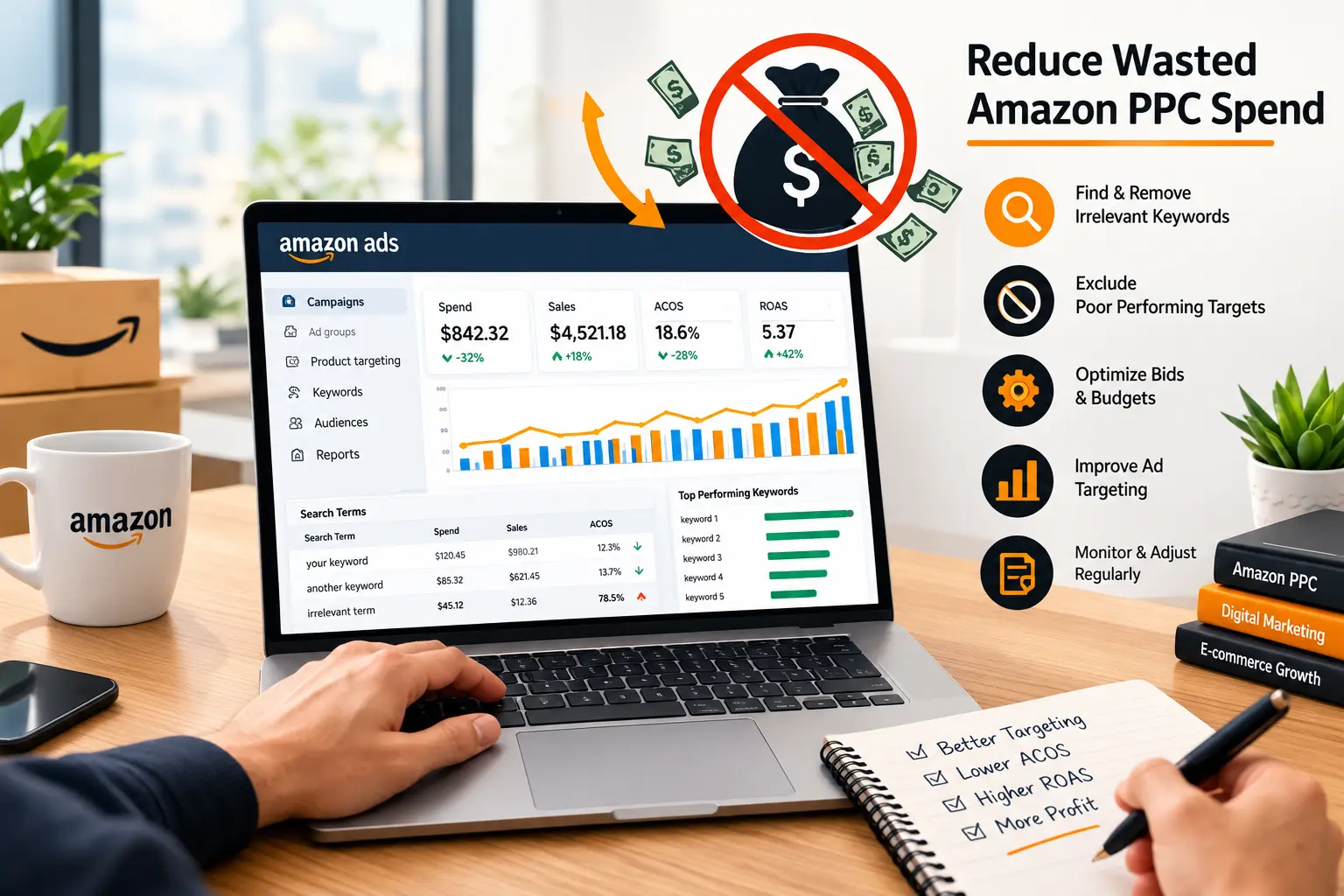
Amazon PPC can be one of the most effective ways to generate visibility, traffic, and sales, but poorly managed campaigns can quickly consume advertising budgets without producing enough return. Amazon PPC wasted spend commonly occurs when ads receive clicks from irrelevant search terms, bids are too aggressive, budgets are poorly allocated, or product listings fail to convert the traffic generated by advertising.
Reducing wasted PPC spend does not necessarily mean spending less. The objective is to make your advertising budget more intentional by directing more of it toward relevant searches, products, and placements that support your campaign goals.
This guide explains how to reduce Amazon PPC wasted spend, identify inefficient campaigns, improve keyword targeting, manage bids and budgets, and build a more structured PPC optimization process.
What Is Amazon PPC Wasted Spend?
Amazon PPC wasted spend refers to advertising expenditure that does not contribute sufficiently toward your defined advertising objective. This can happen when you pay for clicks that are irrelevant, poorly qualified, excessively expensive, or unlikely to convert.
Sponsored Products operate on a cost-per-click model, meaning advertisers pay when shoppers click their ads. Because every click can consume part of your advertising budget, targeting and bid management are important components of PPC efficiency.
Common examples of wasted spend include:
- Irrelevant search terms generating clicks
- Keywords receiving significant spend without producing sales
- Product targets that attract poor-quality traffic
- Bids that are too high for the campaign’s performance
- Poorly structured campaigns
- Duplicate or overlapping targeting
- Advertising products with weak conversion performance
- Campaigns spending their budgets without sufficient return
- Broad targeting that attracts shoppers outside the intended audience
- Sending paid traffic to an under-optimized product listing
However, a keyword that does not immediately produce a sale is not automatically wasted spend. Some campaigns are designed for discovery, launch visibility, brand awareness, or keyword research. Therefore, optimization should consider the purpose of the campaign rather than applying one universal rule to every target.
How to Identify Where Your Amazon PPC Budget Is Being Wasted
Before changing bids or pausing keywords, you need to determine where the inefficient spend is coming from.
The Search Term Report is one of the most useful resources for this process. It can help you understand which customer search terms generated clicks and identify search terms that may require further targeting or negative targeting.
Start by reviewing your search terms and grouping them into three broad categories:
High-performing searches: These are relevant searches that contribute to your campaign objectives and may deserve additional attention or more controlled targeting.
Potential opportunities: These are relevant searches generating useful engagement but requiring additional data before making a major decision.
Inefficient or irrelevant searches: These may consume budget without producing the desired result or may not be sufficiently relevant to the advertised product.
This classification gives you a more useful starting point than simply sorting campaigns by total spend.
Search-term insights can also help identify strong performers and potentially add them as targeting expressions, while low-performing or irrelevant terms can be evaluated for negative targeting.
Use Negative Keywords to Control Irrelevant Traffic
One of the most direct ways to reduce unnecessary Amazon PPC spend is to use negative keywords and negative product targeting appropriately.
Negative targeting can prevent ads from being triggered by shopping queries or product targets that do not meet your campaign goals.
For example, imagine you sell a premium stainless steel water bottle designed for adults. Your campaign could potentially receive traffic from searches related to:
- Kids water bottles
- Plastic bottles
- Bottle replacement parts
- Bottle cleaning accessories
- Free water bottles
- Unrelated drinkware
If those searches are not relevant to your product or campaign objective, continuing to pay for clicks from them can consume budget without supporting the intended audience.
A regular search-term review can help identify these patterns.
However, negative keywords should not be added simply because a search term has not generated a sale after a small number of clicks. Consider relevance, spend, conversion data, campaign objective, and available data before making the decision.
Optimize Amazon PPC Bids Instead of Increasing Them Automatically
Bid management is another major area where Amazon sellers can control advertising efficiency.
A high bid can increase the likelihood of competing for valuable placements, but paying more for a click does not automatically mean that the resulting traffic will convert better.
Your bid strategy should therefore be connected to the performance of the keyword, product target, placement, and campaign objective.
Amazon provides several Sponsored Products bidding options, including dynamic bids, fixed bids, and other bidding controls. For sellers concerned about controlling spend, reviewing bidding strategy can be an important part of PPC management.
A practical approach is to categorize targets based on performance:
Strong performers: Review whether they have room for additional budget or controlled bid increases.
Average performers: Continue collecting data while monitoring their efficiency.
Weak performers: Consider bid reductions, restructuring, or negative targeting depending on the available data.
Do not make aggressive bid changes across an entire account at once. Gradual optimization makes it easier to understand how changes affect performance.
Improve Campaign Structure to Prevent Budget Leakage
Campaign structure can have a significant impact on how easily you control advertising spend.
A disorganized campaign may contain unrelated keywords, products, match types, and targeting strategies under the same budget. When this happens, a high-spending target can consume resources that could otherwise be allocated to more strategically important targets.
A structured Amazon PPC account may separate campaigns according to factors such as:
- Product or ASIN
- Match type
- Keyword theme
- Discovery versus performance targeting
- Branded versus non-branded intent
- Product targeting
- Campaign objective
- Budget requirements
A well-organized account can combine automated campaigns with manual campaigns and refine keywords and match types based on performance.
For example, an automatic campaign can help discover search behavior, while manually targeted campaigns can provide more control over valuable keywords identified from campaign data.
This creates a feedback loop:
Discovery → Search-Term Analysis → Keyword Selection → Manual Targeting → Performance Monitoring → Optimization
That process can help transform advertising data into a more controlled PPC structure.
Don’t Ignore Your Amazon Product Listing
Sometimes PPC appears inefficient because the advertising campaign is not the only problem.
Imagine that a campaign receives strong impressions, relevant clicks, and competitive CPC, but very few orders. The immediate reaction might be to reduce the bids. However, the problem may be occurring after the click.
Your product listing can influence whether paid traffic converts. Listing quality should therefore be considered as part of the broader PPC optimization process.
Review factors such as:
- Product title
- Main image
- Secondary images
- Bullet points
- Product description
- A+ Content
- Price
- Reviews and ratings
- Product availability
- Product differentiation
- Keyword relevance
- Customer expectations
If shoppers are clicking your advertisement but consistently leaving without purchasing, reducing PPC bids may lower spend but does not necessarily solve the underlying conversion problem.
In this situation, listing optimization and PPC optimization should work together.
A strong PPC strategy brings relevant shoppers to the product page. A strong product listing gives those shoppers the information they need to evaluate the offer.
Monitor ACOS and ROAS in the Right Context
Two commonly used Amazon advertising metrics are ACOS and ROAS.
ACOS measures advertising spend as a percentage of advertising-attributed revenue, while ROAS measures advertising-attributed revenue relative to advertising spend.
For example, if you spend $100 on advertising and generate $400 in attributed sales:
ACOS = 25%
ROAS = 4
But a lower ACOS is not automatically the goal for every campaign.
A new product may have different advertising objectives from an established product. A seller may intentionally accept higher advertising costs during a launch while collecting keyword and conversion data.
There is no universal ACOS target that applies to every Amazon seller or campaign. The appropriate level depends on factors such as business objectives, product margins, advertising strategy, and product lifecycle.
Therefore, don’t optimize your entire account around one metric.
Consider:
- Product margin
- Advertising objective
- Selling price
- Organic sales
- Product lifecycle
- Conversion rate
- Keyword relevance
- Customer acquisition goals
- Overall business profitability
The objective is to understand why a campaign has a particular ACOS or ROAS rather than simply trying to achieve an arbitrary number.
Create a Regular Amazon PPC Optimization Routine
Reducing wasted spend requires ongoing monitoring rather than a one-time campaign cleanup.
A useful PPC management workflow can include daily, weekly, and monthly checks.
Daily monitoring
Check for major issues such as:
- Campaigns running out of budget
- Unexpected spending increases
- Major performance changes
- Products becoming unavailable
- Significant campaign delivery changes
Weekly optimization
Review:
- Search terms
- Keyword performance
- Negative keywords
- Product targets
- Bids
- Campaign budgets
- ACOS
- ROAS
- Conversion performance
- Placement performance
Monthly analysis
Look at the larger picture:
- Which products are receiving the most advertising investment?
- Which campaigns are generating meaningful sales?
- Which keywords have become more important?
- Which targets repeatedly consume budget without meeting goals?
- Are campaigns properly separated?
- Are budgets aligned with product priorities?
- Is the product listing converting paid traffic effectively?
This recurring process makes PPC management more systematic.
For multiple products, the workflow can also include SKU-level reporting. This allows sellers to understand how individual products are performing rather than relying only on account-level advertising numbers.
It is also important to recognize that PPC performance can vary by product and marketplace. A strategy that works for one product should not automatically be copied across every SKU.
How an Amazon PPC Virtual Assistant Can Reduce Wasted Spend
Managing PPC manually can become difficult when a seller has multiple products, marketplaces, and campaigns.
An Amazon PPC Virtual Assistant can support the repetitive operational work involved in campaign monitoring and optimization.
Depending on the agreed responsibilities, a PPC VA can help with:
- Search-term analysis
- Keyword research
- Negative keyword identification
- Campaign organization
- Bid monitoring
- Budget monitoring
- PPC reporting
- Keyword performance tracking
- Campaign optimization
- Competitor advertising research
- Performance documentation
The important point is that the VA should work according to defined performance criteria rather than making random changes.
For example, a seller can establish a workflow where the VA reviews search-term data, identifies potential wasted spend, documents the findings, recommends changes, and implements approved optimizations.
This creates greater visibility into where advertising money is going.
For sellers managing multiple private label products, this type of workflow can be especially useful because PPC management becomes increasingly complex as the product catalog grows.
Amazon PPC Wasted Spend Checklist
Before increasing your advertising budget, review the following checklist:
- Are your campaigns targeting relevant searches?
- Have you reviewed the Search Term Report?
- Are irrelevant search terms being negatively targeted?
- Are high-performing search terms being identified?
- Are bids aligned with campaign performance?
- Are high-spending targets receiving enough attention?
- Are campaign budgets allocated according to priorities?
- Are automatic and manual campaigns serving clear purposes?
- Are keywords separated logically?
- Are product targets being reviewed?
- Are you monitoring placement performance?
- Is your product listing optimized for conversion?
- Are your ACOS and ROAS being evaluated against business economics?
- Are you documenting PPC changes?
- Are campaigns being reviewed regularly?
A structured checklist can help prevent PPC management from becoming reactive.
Frequently Asked Questions
What is Amazon PPC wasted spend?
Amazon PPC wasted spend is advertising expenditure that does not contribute sufficiently toward the campaign’s intended objective. It can result from irrelevant search terms, inefficient targets, excessive bids, poor campaign structure, weak conversion, or inappropriate budget allocation.
How can I reduce Amazon PPC wasted spend?
Start by analyzing search-term and campaign performance. Identify irrelevant or inefficient traffic, use negative targeting where appropriate, review bids and budgets, improve campaign structure, and ensure your product listing is capable of converting relevant paid traffic.
Should I pause every Amazon keyword that does not generate sales?
No. A keyword should not automatically be paused simply because it has not generated an order. Consider its relevance, spend, clicks, campaign objective, conversion data, and available sample size before deciding whether to reduce the bid, pause it, restructure the targeting, or continue collecting data.
What are negative keywords in Amazon PPC?
Negative keywords are targeting controls that help prevent ads from appearing for specified shopping queries. They can be used to exclude searches that are irrelevant or do not meet the campaign’s performance goals.
Does lowering Amazon PPC bids reduce wasted spend?
Lowering bids can reduce the amount you are willing to pay for clicks, but it does not automatically solve targeting or conversion problems. Bid adjustments should be considered alongside search-term relevance, conversion performance, campaign objectives, and overall advertising strategy.
What is a good ACOS for Amazon PPC?
There is no universal ACOS target that applies to every Amazon seller or campaign. The appropriate level depends on factors such as product margins, advertising objectives, marketplace conditions, product lifecycle, and business goals.
How often should I optimize Amazon PPC campaigns?
PPC campaigns should be monitored regularly, but optimization frequency should depend on campaign activity and the amount of meaningful data available. Major changes should be based on performance evidence rather than making constant adjustments without enough data.
Can an Amazon PPC Virtual Assistant help reduce wasted ad spend?
Yes. An Amazon PPC Virtual Assistant can assist with search-term analysis, keyword research, negative targeting, bid monitoring, budget tracking, campaign organization, reporting, and ongoing optimization. The exact responsibilities should be defined according to the seller’s PPC strategy and account requirements.
Final Thoughts
Learning how to reduce Amazon PPC wasted spend is not simply about lowering bids or reducing advertising budgets. Effective PPC optimization requires a structured approach to search-term analysis, keyword targeting, negative keywords, campaign organization, bidding, budget allocation, listing optimization, and performance monitoring.
For Amazon sellers, the goal should be to make advertising decisions based on meaningful data and clearly defined business objectives. Regular analysis can help identify where advertising spend is being used efficiently and where campaigns may require further optimization.
Whether you manage PPC campaigns yourself or work with an Amazon PPC Virtual Assistant, a consistent optimization workflow can make your advertising account easier to manage and scale.